
Former Nvidia VC Amulya Vishwanath Says Physical AI Is Entering Its LEGO Era
TL;DR
- Former Nvidia engineer turned VC Amulya Vishwanath says robotics is nearing its ChatGPT moment as Physical AI shifts from bespoke hardware to modular, interoperable building blocks.
- She argues the convergence of foundation models, cheap sensors, simulation, and open-source actuators has created a LEGO era where startups can prototype capable robots in weeks, not years.
- For investors, the breakout opportunity is no longer just humanoids, but the picks-and-shovels layer: data engines, evaluation, dexterity stacks, and vertical-specific foundation models for the physical world.
Why Now Is The Breakout Moment For Physical AI
After a decade of false starts, robotics is finally having its infrastructure moment. That is the core argument from Amulya Vishwanath, a former Nvidia engineer turned venture capitalist who now invests at the intersection of AI and robotics.
Speaking on the current wave of Physical AI startups, Vishwanath said the field is approaching its ChatGPT moment — not because a single humanoid demo went viral, but because the cost and complexity of building intelligent machines has collapsed.
Just as the transformer and large-scale pretraining unlocked an explosion of chatbots, copilots and agents, she sees world models, vision-language-action models and high-fidelity simulation unlocking an explosion of capable robots.
From Bespoke Robots To LEGO Blocks
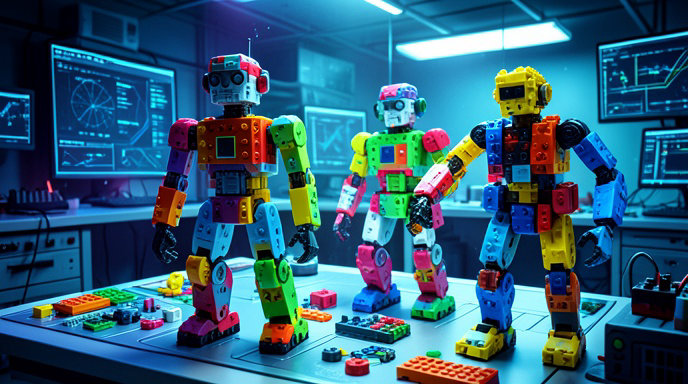
Vishwanath’s central metaphor is LEGO. For 60 years, building a robot meant building everything from scratch: custom motors, custom drivers, custom perception stacks, custom control loops.
That era is over, she argues. Today a founder can snap together off-the-shelf components: commodity depth cameras and lidar, open-source humanoid and arm platforms, cloud-based simulation from Nvidia Isaac and Genesis, and open foundation models for vision, navigation and manipulation.
The result is rapid building and experimentation. Two engineers in a garage can now test thousands of grasping policies in simulation overnight, deploy to a $5,000 arm the next morning, and iterate — a loop that used to require a full lab and millions in funding.
The Three Forces Colliding At Once
Vishwanath points to three simultaneous breakthroughs behind the timing.
First, foundation models for the physical world. Vision-language models gave robots common sense about objects and scenes, while newer vision-language-action models like RT-X, Octo and Project GR00T are giving them generalizable policies instead of hard-coded motions.
Second, simulation as data. Real-world robot data has always been scarce and expensive. Photorealistic simulators and digital twins now let teams generate millions of hours of synthetic demonstrations for edge cases — dropped tools, cluttered kitchens, slippery warehouse floors — that would take years to collect in person.
Third, hardware commoditization. Actuator prices are falling, battery density is improving, and Chinese and American suppliers are shipping capable quadrupeds, arms and wheeled humanoids as developer kits. Hardware is no longer the moat.
What VCs Actually Want To Fund Now
If hardware is LEGO, venture returns will not come from the bricks themselves. Vishwanath says the smartest Physical AI investors are moving up the stack.
The hottest categories she highlights are data engines that collect, label and curate real-to-sim demonstrations at scale, evaluation and safety layers that let enterprises certify robots like they certify drivers, and dexterous manipulation stacks for tasks wheels and chatbots cannot do — folding laundry, handling wires, picking mixed SKUs.
She is notably cautious on general-purpose humanoids as a near-term venture bet, calling them inspiring but brutally capital intensive. The faster path to revenue, she argues, is vertical robots: one foundation model fine-tuned obsessively for warehouses, hospitals, farms or kitchens.
The ChatGPT Moment Hasn’t Happened Yet — But It’s Close
Crucially, Vishwanath does not claim robotics has already had its ChatGPT moment. It is approaching it.
The missing piece, in her view, is autonomous reliability at scale: a robot that can work an entire shift without human intervention, learn from its mistakes, and transfer that learning fleet-wide overnight.
Once a startup demonstrates that for a single high-value job — she points to tote handling, hospital logistics, and food prep as leading candidates — customer pull will be violent, just as it was for code generation and customer support after ChatGPT launched in late 2022.
Advice For Founders In The LEGO Era
For robotics startups, Vishwanath’s playbook is simple: don’t build what you can buy, don’t demo what you can’t deploy, and obsess over data flywheels from day one.
Winners in the LEGO era, she says, will not be the teams with the sleekest hardware video. They will be the teams who ship imperfect robots early, collect proprietary failure data, and compound that data into smarter foundation models competitors cannot copy.
Physical AI, in other words, is no longer a science project. It is a software race built on modular parts — and the building has just begun.

Get All The Latest Updates Delivered Straight To Your Inbox For Free!