
GM's 2028 Escalade IQ and AI Supercomputer Plan to Beat Tesla and China
TL;DR
- GM will debut its fourth-generation EV platform and centralized “AI supercomputer” on the 2028 Cadillac Escalade IQ, replacing dozens of ECUs with a zonal architecture.
- The new electrical brain enables AI-driven driving assistance, faster over-the-air updates, and advanced in-cabin experiences to close the software gap with Tesla, Rivian, and Chinese rivals.
- GM says the simplified wiring and shared computing stack will cut costs, improve manufacturing efficiency, and scale across all future EVs globally.
A New Brain for GM’s Electric Future
General Motors is preparing its biggest electrical overhaul in a century. At the center of its plan to take on Tesla, Rivian, and fast-moving Chinese automakers like BYD, NIO, and XPeng is a shift away from the tangle of 100-plus individual control modules that have defined cars for decades.
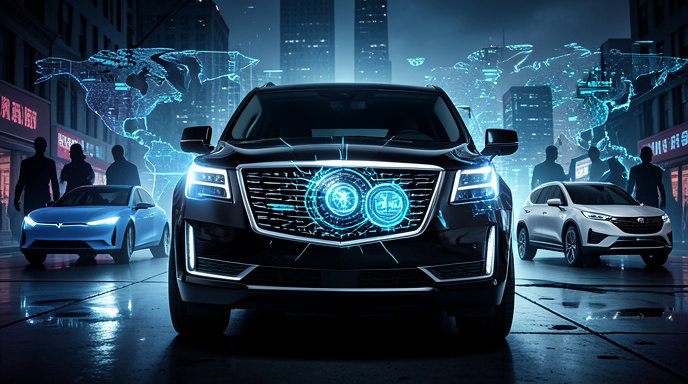
In their place will come a powerful new central computer — what GM executives describe as an AI supercomputer on wheels — paired with a zonal electrical architecture. The tech is set to debut in the 2028 Cadillac Escalade IQ, the flagship electric full-size SUV, before rolling out across GM’s global EV lineup.
It’s GM’s fourth-generation EV platform, following the Bolt’s BEV2, the Ultium-based BEV3, and its current evolved Ultium and BEV Prime systems. But this time, the revolution isn’t just the battery. It’s the brain.
Why Zonal Architecture Changes Everything
Today’s EVs, even advanced ones like the current Escalade IQ and Chevrolet Silverado EV, still rely on a distributed network of electronic control units, or ECUs, each managing everything from windows to battery thermal systems, all connected by miles of copper wiring.
GM’s next-gen system flips that model. Three or four powerful zone controllers placed in different physical areas of the vehicle will handle local sensors and actuators, while one central high-performance computer does the heavy thinking.
The benefits are massive: up to 40% less wiring, lower weight, simpler assembly, fewer failure points, and dramatically more computing headroom. It’s the same approach pioneered by Tesla with its centralized compute and adopted by Rivian with its zonal system in the R2 platform, and now standard among leading Chinese EVs.
For GM, it’s about finally becoming a software-defined automaker.
The 2028 Escalade IQ: First to Get the Supercomputer
Choosing the 2028 Cadillac Escalade IQ as the launch vehicle is no accident. The Escalade is GM’s profit king and technology halo, with current models starting above $130,000 and buyers who expect the best in luxury, power, and tech.
The 2028 model will serve as a rolling showcase for the new platform. Expect a major leap in processing power — reportedly more than 10 times that of GM’s current Ultifi/Vehicle Intelligence Platform — with support for advanced AI inference on-board rather than solely in the cloud.
That means natural-language voice assistants that actually understand context, driver monitoring that predicts distraction and fatigue, highly personalized cabin settings, and next-generation Super Cruise hands-free driving with AI-based perception that improves over time.
GM has also hinted the platform was designed for L3-capable eyes-off driving hardware, even if regulations and software validation will dictate when it can be activated.
Built for AI, Updates, and Autonomy
The central computer is key to GM’s AI ambitions. By consolidating vehicle data — from cameras, radar, lidar-ready inputs, battery sensors, and cabin cameras — into one compute hub, GM can run large foundation models and vision transformers directly in the vehicle.
Practically, that translates to faster, smarter features delivered via over-the-air updates. Instead of waiting for a model year refresh, owners could wake up to improved range efficiency from smarter thermal management, new ADAS behaviors, or generative-AI infotainment powered by Google Gemini and OnStar integrations.
GM is also moving to a modern containerized software architecture, allowing engineers to test and deploy code in days rather than months. It’s a direct response to criticism that legacy automakers update too slowly compared to Tesla’s two-week sprint cycles and Chinese rivals that push monthly OTA drops.
The automaker is working closely with chipmakers including NVIDIA and Qualcomm for AI accelerators and cockpit processors, reducing its dependence on dozens of single-function chip suppliers.
Lower Cost to Fight China’s Price War
Perhaps the most important part of GM’s bet isn’t luxury — it’s cost. Chinese automakers have stunned the industry by delivering high-tech EVs with zonal electronics at prices Western brands struggle to match.
GM says its zonal architecture plus unified battery cell strategy, including new lithium-manganese-rich (LMR) prismatic cells and lower-cost LFP options, will slash EV bill-of-materials costs by thousands per vehicle. Less wiring means less copper, less labor, and lighter vehicles that go further on smaller packs.
The centralized platform is also designed to be shared globally — from a $30,000 Chevrolet Equinox EV successor to Buicks in China to Cadillacs in America — spreading development costs across millions of units. That scale, GM argues, is something Rivian and startups can’t match, and its best weapon against BYD’s vertical integration.
On the factory side, zonal wiring simplifies robots’ jobs and cuts assembly time, a critical lever as GM pushes to make EVs profitable without federal tax credit support.
Can GM Finally Catch Tesla and Rivian?
The challenge is execution. Tesla already operates a centralized compute architecture and custom silicon lead, while Rivian’s new zonal platform in the R2 and R3 has been praised for its elegance and cost efficiency. Chinese players like XPeng with its X-EEA 3.0 and Li Auto are shipping AI-first cars today, not in 2028.
GM knows it is playing catch-up on software perception. High-profile delays with Ultium software and the temporary discontinuation of CarPlay in favor of its Google-built infotainment system dented trust with some buyers.
But GM has advantages: Super Cruise remains one of the best-rated driver-assist systems in the U.S., its hands-free network now covers 750,000+ miles, and its manufacturing footprint and dealer network dwarf rivals.
If the 2028 Escalade IQ delivers on its promise — a quiet, 450-plus-mile luxury SUV that gets smarter every month while costing less to build — it could reset the narrative that legacy Detroit can’t do software.
What Comes Next
GM is expected to reveal more technical details of the fourth-gen platform and central computer through 2027, with pilot production of the 2028 Escalade IQ slated for late 2027 at Factory Zero in Detroit-Hamtramck.
After Escalade IQ, expect the technology to cascade quickly to the Chevrolet Silverado EV, GMC Sierra EV, Cadillac Celestiq successor models, and a new family of affordable crossovers co-developed for global markets.
The EV race is no longer just about range and 0-60 times. It’s about compute, AI, and cost. With this bet, GM is declaring it finally understands the assignment.

Get All The Latest Updates Delivered Straight To Your Inbox For Free!