
Google’s First Data Center Satellite Runs Gemma 4 and Writes Poetry
TL;DR
- No independently verified public evidence confirms that Google has launched an orbital data-center satellite running a TPU and Gemma 4.
- The reported concept appears to combine Google’s space-computing ambitions with speculative claims about an AI model writing poetry in orbit.
- Space-based AI could eventually offer abundant solar power and low-latency processing for satellites, but radiation, cooling, communications, maintenance, and launch costs remain major obstacles.
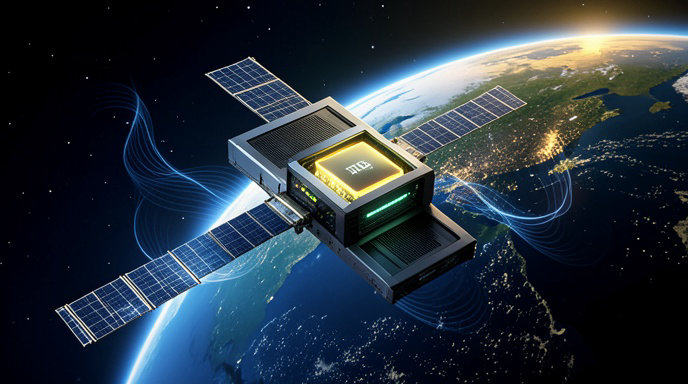
A striking report circulating around Google’s space-computing ambitions describes an experimental satellite equipped with the company’s Tensor Processing Unit, or TPU, and running a Google DeepMind Gemma 4 model. According to the account, the spacecraft generated poetry while in orbit, offering a theatrical demonstration of what an AI data center beyond Earth might look like.
The concept is compelling—but it requires careful qualification. Publicly verifiable information about a launched Google satellite running Gemma 4 in orbit remains limited, and the specific claims about the first space-deployed TPU and poetry generation should not be treated as independently confirmed without an official mission announcement, launch record, or technical documentation.
Still, the idea reflects a genuine technology trend: companies are investigating whether some computing workloads could eventually move from terrestrial data centers into space.
An Orbital Computer With a Dramatic Proof of Concept
The reported experiment centers on a compact satellite carrying an AI accelerator, onboard storage, communications equipment, and power systems. Rather than sending every data stream to Earth for processing, the spacecraft would analyze information locally and transmit only selected results.
The poetry demonstration would be a simple but memorable test. A prompt could be uploaded from the ground, processed by the onboard language model, and returned as text. The poem itself would have little practical value, but it would demonstrate that the satellite could execute an advanced model without relying on a continuously connected terrestrial data center.
Such a demonstration would also test the complete computing chain: model storage, inference, power management, thermal control, communications, and recovery from radiation-related errors.
What Is Gemma?
Gemma is Google DeepMind’s family of openly available generative AI models derived from technologies developed for larger Gemini systems. The models are designed to run on a range of hardware, including local computers and specialized accelerators.
A space-based deployment would likely use a compressed or otherwise optimized model rather than a full-scale cloud system. Engineers would need to balance model capability against memory capacity, processing speed, power consumption, and the satellite’s ability to reject heat.
The reference to “Gemma 4” is especially important because model names and releases need to be verified against official Google documentation. Unless Google has publicly confirmed that version and its orbital deployment, the claim should be regarded as unsubstantiated rather than established fact.
Why Put AI in Space?
The strongest argument for orbital computing is energy. Satellites can receive sunlight without the interruptions caused by night, weather, or seasonal variation. In an appropriate orbit, solar arrays could provide a steady source of electricity for computing systems.
Space could also offer a way to process data closer to where it is collected. Earth-observation satellites generate enormous volumes of imagery and sensor measurements. Sending all of that data to the ground consumes bandwidth and can introduce delays. An onboard AI system could identify fires, storms, crop stress, maritime activity, or unusual changes before transmitting only the most relevant information.
A larger orbital data center could eventually process data from many nearby spacecraft. That architecture might support autonomous satellite operations, scientific analysis, communications services, or specialized workloads that do not need to be performed on Earth.
The idea also appeals to data-center operators facing rising electricity demand. AI training and inference require substantial power, and orbital platforms could theoretically provide access to large solar installations without competing for terrestrial land or local grid capacity.
The Hardest Problem May Be Heat
Space is often described as cold, but cooling electronics in orbit is not straightforward. On Earth, data centers use air or liquid to carry heat away from processors. In vacuum, there is no air for convection. A spacecraft must move heat through conductive paths and ultimately radiate it into space.
That makes radiators essential. As computing power increases, radiator size, mass, and deployment complexity increase as well. A satellite running a powerful accelerator cannot simply add more fans or connect to a chilled-water system.
The spacecraft must also survive dramatic thermal swings. Surfaces exposed to the Sun can become extremely hot, while shaded components can become cold. Engineers must manage heat from the processor, power electronics, batteries, communications hardware, and solar-array systems simultaneously.
Radiation Is a Persistent Threat
Processors in orbit face high-energy particles that can flip bits, corrupt memory, reset systems, or permanently damage hardware. Commercial chips are generally cheaper and faster than radiation-hardened space electronics, but they may require extensive protection and error-correction techniques.
An orbital AI computer could use redundant processors, watchdog systems, memory scrubbing, checkpointing, and carefully designed software to recover from faults. Engineers might also limit the system’s role so that a model failure cannot compromise spacecraft control.
For a poetry experiment, a reset may be an inconvenience. For navigation, collision avoidance, Earth observation, or scientific missions, the consequences could be much more serious.
Launch and Maintenance Remain Expensive
Putting computing hardware in orbit adds costs at nearly every stage. Equipment must survive launch vibration, acceleration, acoustic stress, and the transition to vacuum. Hardware that is inexpensive in a terrestrial data center may become costly once it requires space qualification, redundancy, shielding, and specialized packaging.
Maintenance is another challenge. Traditional data centers can replace failed servers within hours. Most satellites cannot be physically repaired. A practical orbital computing platform would therefore need long-life components, graceful degradation, and possibly robotic servicing or modular replacement.
The economics also depend on launch prices, satellite lifetime, orbital congestion, insurance, and the cost of returning data to Earth. A system that looks attractive on a per-kilowatt basis may still be more expensive overall than a highly optimized terrestrial facility.
Communications Could Decide the Business Case
An orbital data center is useful only if it can receive inputs and deliver results efficiently. High-bandwidth links are expensive in power and hardware, while optical communications can provide greater capacity but require precise pointing and clear line-of-sight conditions.
For onboard satellite data, the case is relatively straightforward: process information where it is collected and send back a summary. For general-purpose AI workloads uploaded from Earth, the communications burden could undermine the benefit of moving computation into orbit.
Latency would also vary by orbit. Low-Earth-orbit satellites can communicate with nearby ground stations quickly but move rapidly across the sky and require large constellations for continuous coverage. Higher orbits provide broader visibility but introduce longer signal delays and more difficult radiation and thermal conditions.
Poetry as a Demonstration, Not a Killer Application
A satellite writing poetry makes for an engaging headline because it turns an abstract infrastructure experiment into something people can understand. The output proves that a language model is running somewhere physically remote, detached from a conventional data center.
But poetry does not demonstrate that orbital AI is economically competitive. It shows that the hardware can execute an inference task and communicate the result. More meaningful benchmarks would measure energy efficiency, sustained processing performance, fault recovery, model reliability, and the value of processing data before it reaches Earth.
Useful applications could include autonomous image triage, disaster monitoring, space-weather analysis, navigation, scientific simulations, and coordination among spacecraft. These tasks benefit more directly from local processing than text generation does.
A Small Satellite Could Be the Beginning
If Google or another company eventually confirms an orbital TPU experiment, the first spacecraft would probably be a technology demonstrator rather than a full-scale data center. Its purpose would be to validate hardware, software, power systems, cooling, communications, and operational procedures.
Future systems could use multiple spacecraft working as a distributed computing cluster. That would introduce new complications, including synchronization, networking across orbital links, radiation-induced inconsistencies, and the need to replace individual satellites without interrupting workloads.
The most realistic early deployments may therefore focus on edge computing: small, specialized systems processing data aboard observation or communications satellites. Large orbital data centers would require major advances in launch economics, space assembly, thermal engineering, and autonomous maintenance.
Separating the Vision From the Verified Record
The prospect of a TPU-powered satellite running Gemma and composing poetry captures the imagination, but the specific mission details need authoritative confirmation. A credible announcement would be expected to identify the spacecraft, launch provider, orbit, processor configuration, model version, power budget, communications system, and test results.
Until those details are published by Google, DeepMind, a launch provider, or an independent mission operator, the story is best understood as a mixture of a plausible technological direction and claims that remain unverified.
The broader proposition is real enough to merit attention. AI is pushing demand for power and computing infrastructure, while satellites are generating more data than they can economically transmit. Space-based processing could eventually address both problems in carefully chosen applications.
For now, however, the poem may be less important than the engineering behind it. The real test for orbital AI will not be whether a satellite can write a verse. It will be whether it can keep computing through radiation, shed heat in vacuum, communicate efficiently, operate for years without maintenance, and deliver results that justify the cost of putting a data center above Earth.

Get All The Latest Updates Delivered Straight To Your Inbox For Free!