
Nvidia May Backstop Nscale’s West Virginia AI Data Center Loan
TL;DR
- Nvidia is reportedly weighing a financial guarantee for debt tied to Nscale’s planned AI data center in West Virginia.
- The backstop could make lenders more comfortable financing the project’s huge power, land and GPU-related costs.
- Any guarantee would deepen Nvidia’s role in the AI infrastructure boom while raising questions about concentration and financial risk.
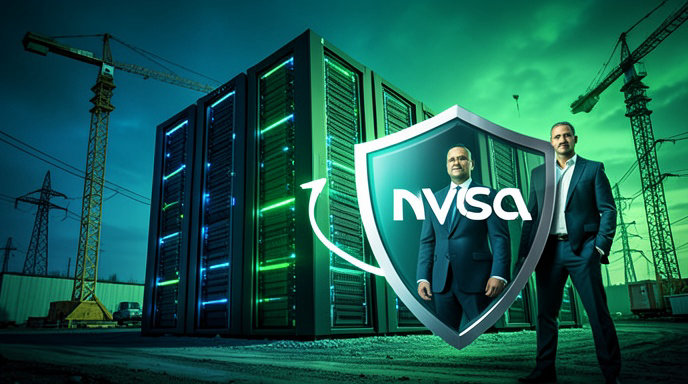
Nvidia is reportedly considering guaranteeing financing for Nscale’s planned artificial-intelligence data center in West Virginia, a move that could help the British AI infrastructure company secure billions of dollars for the project.
The potential arrangement would place Nvidia in an increasingly influential role beyond its core business of designing and selling AI chips. By standing behind some or all of a loan, Nvidia could help reassure banks and other investors that the proposed facility will have the financial support needed to move forward—even as concerns grow over the cost and long-term returns of the global data-center buildout.
The discussions are reportedly preliminary, and the final structure, size and terms of any guarantee have not been settled.
Why the guarantee matters
AI data centers require far more capital than conventional cloud facilities. Developers must secure large tracts of land, arrange power supplies, build specialized cooling systems and purchase or lease enormous volumes of computing equipment before a facility can generate meaningful revenue.
That creates a difficult financing challenge. Lenders may be reluctant to fund projects whose economics depend on sustained demand for AI computing, rapidly changing technology and customers signing long-term capacity agreements.
A guarantee from Nvidia could reduce that perceived risk. It could give lenders greater confidence that the project will receive access to Nvidia’s hardware and technical ecosystem, while also signaling that one of the most important companies in the AI market has a direct interest in the facility’s success.
The arrangement could also lower borrowing costs or increase the amount of debt available to Nscale. For a project requiring billions of dollars in infrastructure spending, even a modest reduction in financing costs could materially affect its overall economics.
Nscale’s West Virginia ambitions
Nscale has been developing plans for a large AI data-center campus in West Virginia. The project is intended to provide high-performance computing capacity for AI model training, inference and other data-intensive workloads.
West Virginia offers potential advantages for data-center development, including available land, industrial infrastructure and access to power markets. Like other large AI facilities, however, the project’s success will depend on obtaining reliable electricity, transmission capacity, permits and long-term commercial customers.
The scale of the proposed development makes financing particularly important. A data center of this type can require substantial spending well before its servers begin operating. Construction costs, electrical equipment, cooling infrastructure and networking systems can quickly add up, while the cost of AI accelerators remains one of the largest individual expenses.
A guarantee could help Nscale bridge the gap between early-stage construction spending and future revenue from customers using the facility.
Nvidia’s expanding role in AI infrastructure
Nvidia already sits at the center of the AI infrastructure market. Its processors power many of the world’s largest AI systems, and its networking products, software and systems increasingly form a complete platform for data-center operators.
A financial backstop would represent a further expansion of that role. Rather than simply supplying equipment, Nvidia could help shape where computing capacity is built and how it is financed.
The company has increasingly pursued arrangements that connect its chips with cloud providers, specialized data-center operators and AI startups. Those relationships can accelerate deployment of Nvidia-powered systems and create more demand for future generations of its hardware.
At the same time, deeper financial involvement could expose Nvidia to risks that differ from those of its traditional semiconductor business. If a data-center operator struggles to attract customers, suffers construction delays or faces unexpectedly high electricity costs, a guarantee could leave Nvidia responsible for some portion of the project’s debt.
The precise scope of any proposed backstop will therefore be critical. A limited guarantee tied to specific equipment or project milestones would carry different risks from a broad commitment covering the facility’s entire financing package.
Investors are questioning the AI buildout
The reported discussions come as investors and lenders are scrutinizing the enormous sums being committed to AI infrastructure.
Technology companies and data-center developers are racing to add computing capacity because demand for generative AI services remains strong. That race has helped drive record orders for GPUs, advanced networking equipment, power systems and data-center construction.
But the spending also raises difficult questions. How quickly will demand translate into cash flow? Will AI customers sign contracts long enough to support the debt used to build facilities? And could computing capacity eventually outpace demand, leaving operators with expensive sites and underutilized equipment?
The concerns have intensified as the industry’s financing needs have grown. Data-center developers increasingly rely on debt, private capital and partnerships with major technology companies. Those structures can make projects possible, but they can also spread exposure across a wider group of investors and suppliers.
Nvidia’s involvement could help answer some of those concerns by providing a powerful corporate signal. It would not eliminate the underlying risks, however. A guarantee cannot solve shortages of electricity, construction delays, weak customer demand or unfavorable changes in AI economics.
Potential benefits for Nscale
For Nscale, Nvidia’s support could improve its position in negotiations with banks, infrastructure funds and prospective customers.
A lender may view the project more favorably if Nvidia is willing to support the financing. Customers may also see the company as a more credible source of advanced AI capacity if the facility is closely connected to Nvidia’s hardware and ecosystem.
The guarantee could also help Nscale compete with much larger cloud and data-center companies. The AI infrastructure market includes hyperscalers with substantial balance sheets, established customer bases and access to relatively low-cost capital. A financial commitment from Nvidia could give Nscale additional credibility as it seeks to build at comparable scale.
However, Nscale would still need to demonstrate that the West Virginia facility can operate profitably. It will likely need firm customer commitments, a workable power strategy and a construction plan capable of delivering capacity on schedule.
Questions surrounding the proposed deal
Several important details remain unclear, including the amount of debt under consideration, the portion Nvidia might guarantee and whether the company would receive financial or commercial benefits in exchange.
It is also unclear whether Nvidia’s support would be tied to purchases of its GPUs, a long-term supply agreement, equity participation or other contractual arrangements. Such conditions could make the guarantee more attractive to Nvidia while limiting its downside.
The timing of the project is another open question. AI data centers are being planned faster than power grids and construction supply chains can always accommodate them. Delays in grid interconnections, transformers, substations or specialized cooling equipment could push back the facility’s launch and increase costs.
Regulatory and accounting treatment could also influence the final structure. A guarantee may create contingent liabilities for Nvidia and would likely receive close attention from investors, particularly if the company became involved in multiple similar projects.
A test for the infrastructure financing model
The Nscale project could become an important example of how the AI industry finances its next phase of expansion.
During the early AI boom, many companies funded new capacity through operating cash flow, venture capital or strategic partnerships. As projects become larger, developers increasingly need conventional debt and infrastructure financing.
That transition requires lenders to become comfortable with assets that depend on fast-moving technology and uncertain demand. Guarantees from chipmakers, cloud companies or other strategic partners could become a common feature of future deals.
Such arrangements may accelerate construction, but they could also make it harder to assess the true distribution of risk. If equipment suppliers help finance the facilities that buy their products, the resulting demand may appear stronger while exposing those suppliers to more credit risk.
For Nvidia, the proposed Nscale backstop would underscore both sides of its market position. The company is benefiting enormously from the AI buildout, but its fortunes are increasingly connected to the ability of customers, cloud providers and data-center operators to finance and monetize new capacity.
For now, the West Virginia project remains subject to financing, construction and commercial milestones. If Nvidia ultimately agrees to guarantee the loan, the decision could provide a significant boost to Nscale—and offer a closely watched signal about how the AI infrastructure boom will be funded.

Get All The Latest Updates Delivered Straight To Your Inbox For Free!