
Putin Praises Elon Musk Amid Claims of Close Contact on Russia’s Rassvet Satellite Network
TL;DR
- No publicly verified evidence establishes that Vladimir Putin and Elon Musk are jointly developing a Russian satellite network called Rassvet.
- Russia has pursued sovereign satellite-connectivity programs, but publicly documented projects include Skif and the broader Sfera initiative rather than a confirmed Rassvet constellation.
- Claims of close Putin–Musk contact and Russian access to Starlink-like technology should be treated cautiously until supported by official documents, company statements, or credible independent reporting.
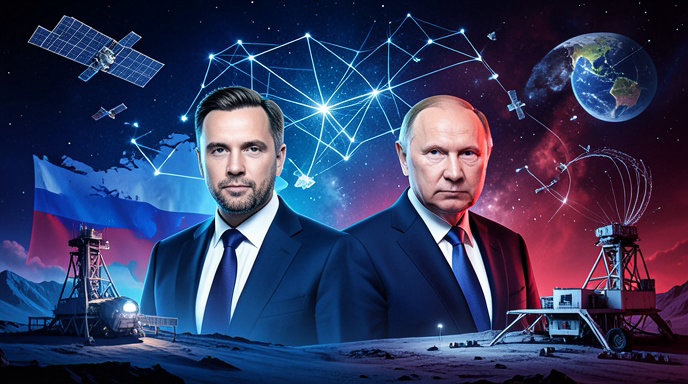
The claim that Vladimir Putin has praised Elon Musk while maintaining close contact with the SpaceX founder has gained attention alongside reports of a proposed Russian satellite-connectivity system called Rassvet. The alleged project is described as a domestic alternative to Starlink, potentially giving Russia broadband coverage in remote regions and a more independent communications infrastructure.
Yet the most important fact is also the least dramatic: there is no broadly verified public evidence confirming that Rassvet exists as a formally approved Russian satellite network, that Musk is involved in it, or that Putin and Musk are coordinating on the project.
Those gaps matter. Satellite communications are strategically sensitive, and claims involving the Russian president, one of the world’s most prominent technology executives, and a Starlink-style network can quickly blur the line between genuine reporting, political messaging, speculation and fabricated content.
What is known about the alleged Rassvet project
Publicly available information does not establish Rassvet as a confirmed operational program comparable to Starlink. There have been references in online discussions and some reports to a Russian satellite initiative using the name, but details about its ownership, financing, satellite design, launch schedule and user terminals remain unclear.
A credible broadband constellation would require much more than a project name. It would need satellite-frequency coordination, orbital filings, launch contracts, ground stations, user equipment, spectrum approvals and a long-term plan for manufacturing and replacing satellites. None of those core details has been publicly tied together in a way that confirms Rassvet as a functioning program.
Russia does have established plans for expanding satellite communications. The country has discussed the Skif broadband constellation and the wider Sfera program, which is intended to combine communications, remote sensing and other space services. Those initiatives are the more clearly documented framework for Russia’s effort to develop domestic space-based connectivity.
The use of the name Rassvet may therefore reflect a separate proposal, an informal label, a rebranding effort or an unverified claim rather than a mature constellation.
Why comparisons with Starlink are significant
SpaceX’s Starlink has demonstrated the advantages of a large low-Earth-orbit network. Hundreds or thousands of satellites can provide lower latency than traditional geostationary systems, while electronically steered terminals allow users to connect without large fixed dishes.
A Russian equivalent would offer several potential benefits. It could connect sparsely populated areas, support Arctic and maritime communications, improve links for industrial sites and provide redundancy when terrestrial networks are unavailable. A national system could also reduce Moscow’s dependence on foreign operators and technologies.
Building such a network, however, would be a major industrial undertaking. Russia would need large-scale satellite production, advanced phased-array antennas, reliable launch capacity and access to specialized electronics. Sanctions and export controls could complicate the supply of components, while the cost of maintaining a constellation would run into billions of dollars over its lifetime.
Starlink’s effectiveness also comes from its scale, software infrastructure and continuously expanding satellite fleet. Matching it would require sustained investment rather than a single launch campaign.
The Putin–Musk contact claims
Reports that Putin and Musk have been in close contact have circulated previously, including claims that the two have spoken regularly. Some international reporting has described alleged conversations between Musk and senior Russian officials, while Kremlin representatives have disputed or downplayed accounts suggesting an unusually close relationship.
The existence, frequency and substance of any private conversations remain difficult to verify. Neither a reported phone call nor a public compliment would demonstrate cooperation on a satellite network.
Putin has at various times spoken favorably about Musk’s engineering achievements and entrepreneurial success. Such praise is not unprecedented. Musk is one of the most visible figures in the global space industry, and Russian officials have often commented on the strategic importance of reusable rockets, satellite broadband and commercial space companies.
Praise, however, should not be confused with a business relationship. There is no publicly confirmed agreement showing that SpaceX, Musk personally or another Musk-affiliated company is helping Russia create Rassvet.
Could Musk legally or technically assist Russia?
Any direct cooperation between Musk-controlled companies and the Russian government would face serious legal, regulatory and geopolitical barriers. SpaceX operates within the United States’ export-control and national-security framework. Technology transfers involving spacecraft, satellite communications, encryption, launch systems or advanced electronics could require government authorization and could be prohibited altogether.
There is also a technical distinction between Starlink and a generic satellite broadband network. Starlink depends on proprietary spacecraft, network-management software, gateways, terminals and spectrum coordination. Even if Russian engineers studied Starlink’s public characteristics, that would not give them access to SpaceX’s underlying technology.
Musk could theoretically provide advice as an individual, but such a role would still raise significant legal and political questions. No reliable public evidence currently demonstrates that he has done so in connection with Rassvet.
The military dimension
The controversy is intensified by Starlink’s role in the war in Ukraine. The system has been used by Ukrainian forces and civilians, making satellite connectivity a central issue in modern conflict. Decisions over service availability, geographic restrictions and battlefield use have placed Musk and SpaceX under intense scrutiny.
A Russian Starlink-style network would have potential military applications. It could support communications for forces operating in remote areas, connect unmanned systems, assist logistics and provide resilience when terrestrial infrastructure is disrupted. It could also strengthen Russian surveillance and command networks.
That does not mean every proposed satellite network is primarily military. Commercial connectivity and defense communications increasingly share the same infrastructure. The dual-use nature of the technology is precisely why any alleged foreign involvement would attract attention from regulators and intelligence agencies.
How to verify the story
The strongest evidence for Rassvet would come from Russian government procurement records, telecommunications licenses, satellite-frequency filings, launch agreements, corporate registration documents or statements from identifiable program officials.
Independent confirmation would also require more than repeating a single source. Credible reporting should identify who proposed the system, which company would operate it, how many satellites are planned, what orbit they would use, where the satellites would be manufactured and when launches are expected.
Claims about Putin and Musk should likewise be checked against direct statements, official travel or meeting records, telecommunications evidence reported by multiple reputable outlets and on-the-record responses from the Kremlin, SpaceX or Musk’s representatives.
Anonymous claims can be important, particularly in national-security reporting, but they should be presented as allegations rather than established facts. Images, videos and screenshots circulating online are especially vulnerable to manipulation or miscaptioning.
A broader race for sovereign connectivity
Regardless of whether Rassvet is real, Russia is not alone in seeking greater control over satellite communications. China is developing large broadband constellations, the European Union has pursued secure connectivity plans, and other countries are examining national or regional alternatives to commercial systems dominated by foreign operators.
The trend reflects a wider shift in space policy. Satellite internet is no longer viewed solely as a consumer service. It is infrastructure with implications for national security, disaster response, economic development and geopolitical influence.
For Russia, a domestic constellation could help support remote communities and strategic industries while reducing exposure to foreign service providers. But the financial, technological and supply-chain challenges are substantial, particularly under sanctions and amid pressure on the country’s broader space sector.
What the evidence currently supports
The available evidence supports three cautious conclusions. Russia has a genuine interest in developing sovereign satellite communications. Putin has publicly recognized Musk’s prominence in the technology and space industries. And claims of contact between the two have appeared in serious reporting as well as in less reliable online sources.
What remains unproven is the central claim that Putin and Musk are working closely on a Russian project called Rassvet. There is no clear public record establishing a formal partnership, technical transfer, financing arrangement or approved constellation under that name.
Until such evidence emerges, Rassvet should be described as a reported or proposed project, not as an operational Russian counterpart to Starlink. The same standard should apply to claims about the Putin–Musk relationship: public praise and alleged conversations may be noteworthy, but they are not proof of a satellite-network deal.

Get All The Latest Updates Delivered Straight To Your Inbox For Free!