
ReBuild Raises $2.1B to Become America’s Answer to Shenzhen After Spinning Out Slate Auto
TL;DR
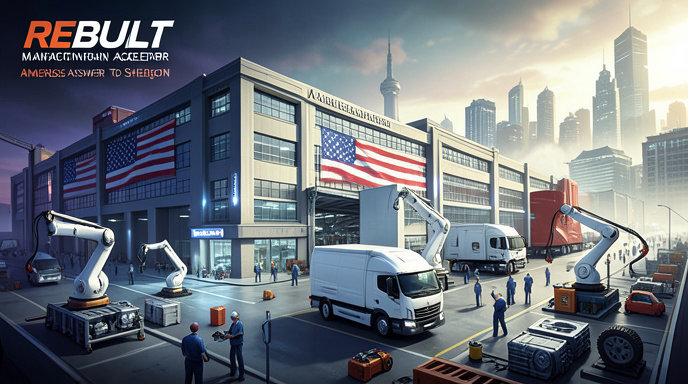
- ReBuild has raised $2.1B to expand its network of U.S. factories, positioning itself as a domestic alternative to Shenzhen's manufacturing ecosystem.
- The raise follows the spinout and breakout momentum of Slate Auto, the low-cost EV truck startup backed by Jeff Bezos, which validated ReBuild's company-creation model.
- The capital will fund new facilities, automation, and workforce development across aerospace, defense, medical, and clean tech hardware.
The Factory Startup Behind the Startup
ReBuild Manufacturing wants to do something no American company has successfully done in decades: beat Shenzhen at its own game.
The Louisville, Colorado-based manufacturing accelerator — best known as the incubator behind Slate Auto, the buzzy $20,000 electric truck maker — has closed $2.1 billion in new funding to scale U.S. industrial capacity, according to company announcements this month.
The raise is one of the largest private investments in American manufacturing in recent years, and it signals a major escalation in the race to onshore critical production. ReBuild says the funding will be used to acquire and modernize factories, deploy advanced automation, and expand its portfolio of industrial companies across the Midwest and Southeast.
Unlike a traditional venture fund or contract manufacturer, ReBuild operates as a Company Creator. It buys struggling small-to-mid sized U.S. manufacturers, injects capital, engineering talent, and shared services, then uses them as a platform to spin out new product companies.
That model got its proof point with Slate.
From Slate Auto to Proof of Concept
Slate Auto began inside ReBuild in 2022 before spinning out as an independent company. Backed by Jeff Bezos, Mark Walter, and Thomas Tull, Slate unveiled its minimalist, customizable electric pickup earlier this year — a $20,000 truck after federal incentives with crank windows, no stereo, and a DIY conversion kit from pickup to SUV.
The concept went viral, racking up more than 100,000 refundable reservations and forcing a rethink of what an affordable American EV could look like.
Slate is now building its first high-volume plant in Warsaw, Indiana, with production targeted for late 2026, and ReBuild facilities are supplying critical tooling and manufacturing know-how. For ReBuild, Slate is more than a portfolio win — it's validation that world-class hardware can be designed, prototyped, and scaled without Shenzhen.
ReBuild CEO Miles Arnone has repeatedly framed the mission in those terms. The idea is not just to build one factory, but to rebuild the dense network of suppliers, toolmakers, and engineers that made Shenzhen the hardware capital of the world.
Why $2.1B, and Why Now
The timing is no accident.
With tariffs on Chinese EVs, batteries, and components rising, federal incentives for domestic clean energy and defense production expanding under both the Biden and second Trump administrations, and automakers scrambling for U.S.-based suppliers, demand for onshore capacity has never been higher.
ReBuild says its order books across aerospace, defense, medical devices, and energy are at record levels. Its current network includes more than a dozen sites employing thousands in states like Colorado, Michigan, Indiana, and Ohio.
The new $2.1 billion — a mix of equity and debt financing from institutional investors, family offices, and strategic partners — will be used to:
- Double down on high-demand sectors like aerospace structures, defense systems, and medical equipment, where U.S. customers are required or incentivized to buy American.
- Roll out ReBuild's Automation and Digitization playbook across acquired plants, bringing robotics, AI-driven quality control, and modern ERP systems to shops that have been underinvested for decades.
- Launch new spinouts modeled on Slate Auto, with at least two more product companies already in stealth in e-mobility and industrial equipment.
Can America Really Build a New Shenzhen
Rebuilding Shenzhen in America is a bold claim, and ReBuild knows it. Shenzhen's advantage isn't just cheap labor — it's speed, density, and supply chain clustering. You can prototype a drone in the morning and have 10,000 units by next month within a 20-mile radius.
The U.S. doesn't have that. What it does have, ReBuild argues, is automation, engineering depth, and now, capital.
By co-locating design engineers directly inside factories, standardizing equipment across sites, and training a new generation of machinists and technicians through its ReBuild Academy workforce programs, the company believes it can close the speed and cost gap.
Critics note the challenges remain steep: skilled labor shortages, higher energy and regulatory costs, and the sheer scale of China's ecosystem. $2.1 billion is massive by U.S. manufacturing standards, but a fraction of what Beijing has poured into industrial policy.
Still, investors are betting the model works.
What It Means for American Manufacturing
If ReBuild succeeds, the implications go far beyond Slate's cheap electric truck.
First, it offers a new template for U.S. industrial renewal — not government-owned mega-projects, but a for-profit, roll-up-and-modernize approach that rescues legacy machine shops instead of letting them die.
Second, it de-risks hardware startups. Founders can build on top of ReBuild's factories instead of flying to China for every prototype run, potentially unleashing a wave of American-made drones, robots, medical devices, and EVs.
Third, it creates jobs where they are needed most. ReBuild has focused on acquiring companies in industrial heartland towns, promising to keep operations local while upgrading pay and training.
The company says it plans to announce two new U.S. factory sites by early 2027 and aims to grow revenue to multi-billion-dollar scale within three years.
For decades, the story of American hardware has been designed in California, built in Shenzhen. ReBuild just raised $2.1 billion to flip that script.
Whether it can truly replicate Shenzhen's magic in Indiana and Michigan remains to be seen. But with Slate Auto about to hit the road, America's answer to Shenzhen finally has wheels.

Get All The Latest Updates Delivered Straight To Your Inbox For Free!