
Runware’s AI Data Center Factory: Can Compute Infrastructure Be Mass-Produced?
TL;DR
- Runware is pursuing factory-built, prefabricated AI data centers intended to make compute deployment faster, more repeatable and less dependent on bespoke construction.
- The approach could reduce installation time and standardize power, cooling and networking, but high-density AI hardware still creates difficult engineering and supply-chain challenges.
- The biggest unanswered questions are whether Runware can secure enough chips and power, maintain reliability at scale and compete economically with hyperscale cloud providers.
A Different Way to Build AI Capacity
The AI infrastructure industry has largely followed a construction model: acquire land, secure electricity, design a facility, install cooling and power systems, and then fill the building with servers. That process can take years, particularly as data centers become larger and more power-intensive.
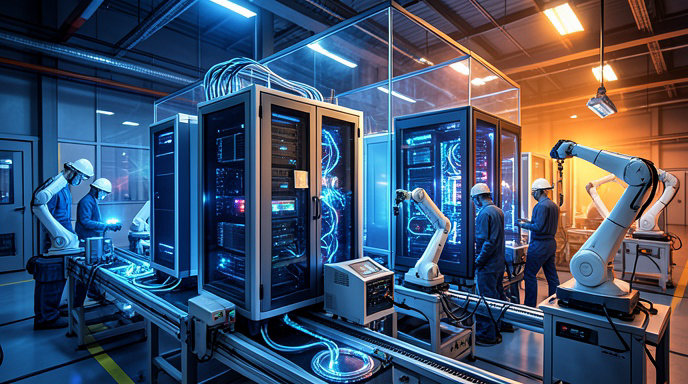
Runware is proposing a different model. Rather than treating every AI facility as a one-off construction project, the company wants to manufacture prefabricated data-center units on an assembly line. The concept borrows from the automotive and industrial-equipment sectors, where standardized modules are built in controlled factory environments and then shipped to their final destinations.
The goal is straightforward: turn data-center deployment from a slow construction exercise into a repeatable manufacturing process.
For an AI industry facing persistent shortages of computing capacity, the attraction is obvious. Demand for graphics processing units, inference servers and high-speed networking continues to expand, while traditional data-center development is constrained by permitting, grid connections, construction labor and specialized engineering.
A factory-built approach could allow operators to deploy capacity in smaller increments, standardize facility designs and reduce the amount of work required at each site.
What a Prefabricated AI Data Center Might Include
A modular AI data center would not simply be a container packed with servers. Modern AI systems require a tightly integrated combination of computing, networking, power delivery, cooling, monitoring and physical security.
A production module could include:
- AI servers equipped with GPUs or other accelerators
- High-speed interconnects for connecting thousands of processors
- Power distribution equipment and backup systems
- Liquid-cooling loops, heat exchangers and pumps
- Network switches and fiber-optic infrastructure
- Fire detection and suppression systems
- Environmental monitoring and remote-management hardware
- Racks, structural frames and factory-tested cabling
Building these elements in a controlled factory environment offers several potential advantages. Wiring and plumbing can be installed under repeatable conditions rather than in a construction site. Equipment can be tested before shipment. Software and control systems can be preconfigured. Design changes can be rolled out across future production batches instead of being reinvented for every facility.
The factory could also become a place where Runware performs system-level testing. That matters because failures in AI clusters are often caused not by a single defective server, but by interactions among power systems, cooling equipment, networking and software.
The Case for Automotive-Style Production
The automotive analogy is useful, but it has limits.
Cars are produced in huge volumes using standardized platforms. Data centers are usually customized for local electricity markets, climate conditions, building codes and network connections. Runware’s opportunity lies in identifying which parts of a facility can be standardized and which must remain site-specific.
A repeatable product architecture could reduce engineering costs and shorten deployment schedules. It might also improve reliability by allowing Runware to collect operational data from every installed unit and feed those lessons back into the manufacturing process.
Mass production could provide other benefits:
- More predictable project costs
- Shorter installation timelines
- Easier maintenance and replacement
- Better quality control
- Faster expansion as demand rises
- A common software and observability layer across locations
The approach is particularly well suited to distributed AI inference. Training clusters often require enormous concentrations of compute and networking, whereas inference capacity can potentially be placed closer to users, enterprise customers or regional markets.
If Runware can ship standardized modules to multiple locations, it could build a geographically distributed network without waiting for a traditional mega-campus to be completed.
AI Hardware Makes the Problem Harder
The same technology that creates demand for modular data centers also makes them difficult to build.
High-end AI accelerators generate substantial heat and consume far more power than conventional enterprise servers. Dense racks can exceed the cooling capabilities of older data-center designs, making direct-to-chip liquid cooling or other advanced thermal systems increasingly important.
Cooling is one of the most significant engineering challenges for a factory-built system. A module designed for one generation of accelerator may need different coolant distribution, pump capacity or heat-rejection equipment when newer chips arrive. If the design is too rigid, the facility could become obsolete before it has paid for itself.
Power is equally difficult. AI clusters need stable, high-capacity electricity, and sudden changes in workload can place unusual demands on power-distribution systems. A modular unit may be easy to manufacture but impossible to operate economically if the destination site lacks sufficient grid capacity.
Networking also raises questions. Large AI workloads depend on extremely fast and predictable communication among accelerators. A facility that works well for ordinary cloud applications may not deliver the low latency and high bandwidth required for distributed model training or demanding inference workloads.
Standardization Versus Customization
Runware’s manufacturing strategy will depend on finding the right level of standardization.
A completely standardized module may be inexpensive to produce but difficult to install in locations with different climates, power standards and regulations. A highly customized module, meanwhile, could lose the economies of scale that justify factory production in the first place.
The most practical design may be a platform approach: a common core containing racks, power distribution, cooling controls and software, combined with configurable elements for local conditions.
That could allow Runware to offer different versions for:
- Warm or cold climates
- Grid-connected or behind-the-meter deployments
- High-density training clusters
- Inference-focused facilities
- Temporary or rapidly deployable capacity
- Enterprise and industrial sites
The company will also need to plan for hardware refreshes. AI accelerators are evolving quickly, and customers may not want a facility locked to a single server configuration. Modular racks, replaceable cooling components and flexible power distribution could become essential features rather than optional extras.
The Supply-Chain Question
Factory production does not eliminate supply-chain constraints. It can make them more visible.
Runware would need dependable access to accelerators, servers, memory, networking equipment, power systems, cooling components and specialized construction materials. The availability of the most important component—AI chips—will largely determine how quickly any facility can be delivered.
There is also a risk that a factory becomes underutilized if demand changes or a particular hardware platform falls out of favor. A traditional data-center developer can sometimes redesign a project during construction. A manufacturing operation may be more exposed to inventory and tooling decisions made months earlier.
The company’s purchasing power will matter as well. Large cloud providers routinely place enormous orders and often receive priority access to hardware. A smaller infrastructure startup may need to differentiate through speed, flexibility, regional deployment or access to customers that hyperscalers do not serve efficiently.
Reliability Is More Than Uptime
Selling a prefabricated data center means selling trust in the entire system.
Customers will want evidence that the modules can operate continuously under high load, tolerate component failures and be serviced without lengthy outages. They will also need clear answers about warranties, replacement parts, remote monitoring and responsibility for failures after installation.
AI workloads can be unusually sensitive to interruptions. A failed cooling pump or networking component may halt a large job, waste expensive accelerator time and create cascading delays. A modular facility therefore needs redundancy not only in servers, but also in power, cooling, networking and control systems.
Factory testing can help, but it cannot reproduce every condition at an operating site. Dust, humidity, extreme temperatures, grid instability and maintenance practices all affect real-world performance.
Runware’s credibility will ultimately depend on operational data: demonstrated uptime, energy efficiency, mean time to repair and performance under sustained AI workloads.
Economics Will Decide the Model
The strongest argument for modular data centers is faster deployment, but speed alone does not guarantee lower costs.
A factory adds its own expenses, including land, tooling, labor, inventory, quality-control systems and transportation. Oversized modules can be expensive to ship, while international deployments may face customs and regulatory complications.
The economics will depend on how much factory repetition reduces engineering and construction costs. Runware must also show that its modules deliver competitive total cost of ownership, including electricity, cooling, maintenance, hardware replacement and eventual decommissioning.
Customers may compare Runware’s offering with several alternatives:
- Renting capacity from a hyperscale cloud provider
- Leasing space in a colocation facility
- Building a dedicated data center
- Deploying servers in an existing industrial or telecom site
- Using specialized GPU cloud providers
- Installing smaller edge-computing systems
A modular unit could be especially attractive where conventional data-center capacity is unavailable or too slow to develop. It may be less compelling in regions where large cloud providers already offer abundant, low-cost compute.
Power Could Be the Real Bottleneck
The limiting factor for AI infrastructure is increasingly electricity rather than floor space.
A factory can produce modules quickly, but those modules still need locations with adequate power, transmission capacity and permission to operate. In many markets, grid interconnection studies and utility upgrades take longer than the physical construction of the facility.
This creates a potential mismatch between manufacturing speed and deployment speed. Runware might be able to build modules faster than customers can connect them to the grid.
The company could address that problem through partnerships involving renewable generation, battery storage, microgrids or existing industrial power infrastructure. Such arrangements might allow facilities to be deployed near available generation rather than in traditional data-center hubs.
However, alternative power strategies introduce new complications. Batteries add cost and maintenance requirements. On-site generation can raise emissions and permitting concerns. Renewable power may be intermittent, requiring storage or grid backup.
Can a Startup Compete With Hyperscalers?
Runware does not need to outbuild the largest cloud companies to make the model work. It could instead focus on markets where flexibility and speed matter more than absolute scale.
Potential customers could include AI developers, enterprises, telecommunications operators, research institutions and regional cloud providers. Some may prefer a dedicated or semi-dedicated facility rather than relying entirely on a distant hyperscale region.
A smaller provider could also offer more tailored hardware configurations, deployment locations or commercial arrangements. That flexibility may appeal to customers with specialized privacy, latency or data-sovereignty requirements.
But the competitive environment is intense. Hyperscalers have access to cheaper capital, large engineering teams, established supply chains and extensive operational experience. Colocation companies are also developing high-density facilities specifically for AI workloads.
Runware’s advantage, if it materializes, will need to come from manufacturing discipline and deployment speed—not merely from placing GPUs into standardized racks.
The Missing Proof Points
The concept is compelling, but several critical details will determine whether it becomes a viable business.
Runware will need to demonstrate the production capacity of its factory, the number of modules it can deliver, the hardware configurations supported and the time required from order to operation. Customers and investors will also want to know whether the company owns the facilities, sells them outright or operates them as a cloud service.
Other important proof points include:
- Confirmed customer deployments
- Measured power usage effectiveness
- Cooling performance at high rack density
- Availability of accelerator supply
- Service and maintenance arrangements
- Financing for large-scale production
- Compliance with local data-center regulations
- Plans for hardware upgrades
- Evidence of sustained uptime
Without those details, the factory remains more of an industrial thesis than a proven infrastructure platform.
A Potential Shift in Data-Center Design
Even if Runware does not become a dominant AI infrastructure provider, its approach reflects a broader change in the industry.
Data centers are becoming products as much as buildings. Operators increasingly care about repeatable designs, standardized power and cooling systems, automated commissioning and software-defined control. The more AI infrastructure is deployed in remote, constrained or rapidly growing markets, the more valuable factory-built systems could become.
The model may also encourage new partnerships between chipmakers, server manufacturers, utilities, construction companies and cloud operators. Instead of selling individual components, these companies could offer integrated compute capacity as a deployable industrial product.
That shift would not eliminate traditional data centers. Large training clusters and hyperscale campuses will continue to require purpose-built sites. But modular facilities could fill the gap between a small server deployment and a multibillion-dollar data-center campus.
The Verdict
Runware’s factory concept addresses a genuine problem: AI demand is expanding faster than conventional data-center construction can respond.
Prefabrication could reduce project complexity, improve consistency and make deployment more predictable. It could also create a feedback loop in which every installed facility improves the next generation of modules.
Yet manufacturing is only one part of the challenge. The company must secure scarce AI hardware, solve high-density cooling, obtain reliable power, support frequent accelerator upgrades and prove that standardized facilities can operate dependably in diverse environments.
The central question is therefore not whether data centers can be mass-produced. They can. The question is whether AI data centers can be standardized enough to manufacture efficiently while remaining flexible, upgradeable and economical at their destination.
Runware’s success will depend on answering that question with operating facilities, measurable performance and repeat orders. Until then, the factory is a promising blueprint for the future of compute infrastructure—but not yet proof that the future has arrived.

Get All The Latest Updates Delivered Straight To Your Inbox For Free!