
Satlyt’s Breakthrough Test Moves Satellites Closer to Becoming Space Data Centers
TL;DR
- Satlyt’s successful in-orbit demonstration shows that more satellite data can be processed onboard instead of transmitted to Earth.
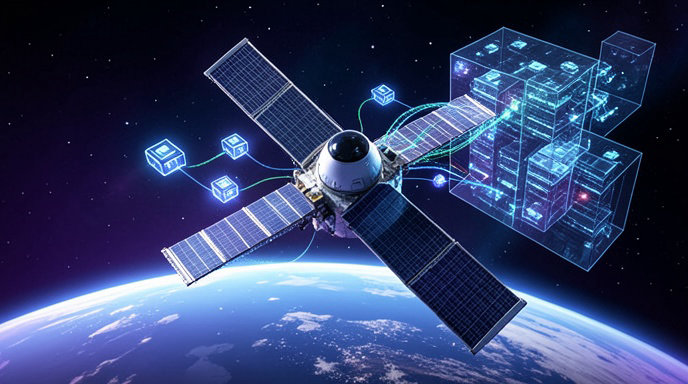
- The company is pursuing a “space data center” architecture built around modular computing, storage, networking and software-defined payloads.
- If the approach scales, satellites could deliver faster insights while reducing bandwidth demand, latency and the cost of moving raw data through ground stations.
Satlyt’s Breakthrough Test Moves Satellites Closer to Becoming Space Data Centers
A satellite’s most valuable asset is increasingly not its camera, radar or communications payload, but the data those systems generate. High-resolution Earth-imaging satellites can collect terabytes of information, while scientific, defense and communications spacecraft are also producing rapidly growing volumes of sensor and network data.
The traditional model is straightforward: gather the data in orbit, transmit it to a ground station and perform the demanding processing on Earth. Satlyt wants to change that model. Its recent successful in-orbit test is intended to demonstrate that spacecraft can perform more of the work before data ever reaches the ground.
That could turn satellites from relatively specialized platforms into distributed computing nodes in space—effectively creating the foundations of virtual data centers in orbit.
What Satlyt tested in orbit
Satlyt’s demonstration focused on validating computing and data-processing technology under real orbital conditions. An in-orbit test is considerably more demanding than a laboratory demonstration because hardware must operate through radiation exposure, extreme temperature changes, limited power availability, vibration constraints and intermittent communications.
The test was designed to show that Satlyt’s technology could execute processing tasks aboard a spacecraft and support the company’s broader space-computing architecture. Rather than treating the satellite as a passive source of raw information, the approach gives the spacecraft a more active role in filtering, analyzing and preparing data for downstream users.
The importance of the demonstration lies less in any single calculation than in proving that commercial computing concepts can operate reliably within the constraints of space hardware.
From satellites to virtual data centers
Satlyt’s vision is based on the idea that future satellites will combine several functions that are normally associated with terrestrial data centers.
Those functions include:
- Processing data close to where it is generated
- Storing information temporarily or persistently in orbit
- Moving data between spacecraft and ground systems
- Running software that can be updated after launch
- Allocating computing resources to different missions as requirements change
In this model, a satellite is no longer limited to one fixed job. A spacecraft carrying an optical sensor could process imagery, identify objects, compress selected scenes and transmit only the most relevant results. A communications satellite could analyze network traffic and dynamically allocate resources. A scientific spacecraft could prioritize unusual measurements before its communications window closes.
Satlyt’s use of the “virtual data center” concept reflects an effort to separate computing capability from a single payload. Instead of building every mission around a bespoke processing unit, operators could deploy shared computing infrastructure and assign workloads through software.
Why onboard processing matters
The biggest immediate benefit is data reduction. Satellites often collect much more information than they can transmit efficiently. A spacecraft may capture an image containing hundreds of megabytes or gigabytes of raw information, even though only a small portion is relevant to the customer.
Processing that data onboard can allow the satellite to transmit:
- A smaller, compressed version of the original file
- Specific objects detected in an image
- An alert about a change or event
- Metadata describing the scene
- A prioritized selection of the most valuable observations
This can reduce pressure on satellite communications links and ground-station networks. It can also make services more responsive. An operator monitoring wildfires, storms, maritime activity or military movements may not need to wait for an entire raw dataset to reach Earth before receiving a useful result.
The benefits are particularly significant for satellites in low Earth orbit. Such spacecraft move quickly relative to the ground and may have only brief communications windows with individual ground stations. Local processing can help the satellite decide what should be sent immediately and what can be stored for later transmission.
Space-based edge computing
Satlyt’s technology fits into the broader movement toward edge computing. On Earth, edge computing places processing close to devices and users rather than routing every workload through a distant cloud data center. In space, the same principle applies, but the constraints are more severe.
A satellite has limited electrical power, thermal-management capacity, processing performance and communications bandwidth. Hardware must also tolerate radiation and function for years without physical maintenance. These restrictions mean that space-based edge computing cannot simply use unmodified terrestrial servers.
Instead, satellite computing platforms must be designed around efficiency and reliability. They may combine general-purpose processors with specialized accelerators for artificial intelligence, image analysis, encryption, compression or signal processing.
Satlyt’s in-orbit test is therefore significant because it addresses the gap between promising space-computing concepts and hardware that has actually operated in the environment where it is intended to work.
The role of artificial intelligence
Artificial intelligence is one of the strongest drivers of onboard processing. Earth-observation satellites are already using machine-learning techniques to identify cloud cover, ships, aircraft, vehicles, fires and infrastructure changes.
Running those models in orbit can reduce the amount of data that must be transmitted. It can also enable faster alerts. For example, a satellite could identify a developing wildfire or suspicious maritime activity during the observation pass, then send an alert before transmitting the full image.
However, AI workloads are computationally expensive. Running them in space requires processors that offer high performance without consuming excessive power. It also requires software that can be tested thoroughly before launch and updated cautiously after deployment.
Satlyt’s broader platform strategy could help operators treat AI processing as one workload among many rather than as a permanently embedded function of a single sensor.
A software-defined spacecraft architecture
The company’s vision also points toward more software-defined spacecraft. Conventional satellites are often designed around fixed hardware and predetermined mission requirements. Once launched, their capabilities may be difficult to change.
A more flexible architecture would allow operators to update applications, assign workloads and adapt processing priorities over the course of a mission. A satellite launched primarily for imaging could later support new analytics applications, partner payloads or additional commercial services.
This could extend spacecraft usefulness and reduce the risk that a satellite becomes obsolete because its original software no longer matches customer needs. It may also allow several customers to share infrastructure, much as businesses share cloud-computing resources on Earth.
That flexibility comes with security challenges. A spacecraft that accepts software updates or runs multiple applications must protect critical systems from malicious code, configuration errors and unauthorized access. Isolation between workloads will be essential if different customers or agencies share the same computing platform.
The technical challenges ahead
A successful orbital test is an important milestone, but it does not eliminate the difficulties involved in building a large-scale space data-center network.
Power is one of the central constraints. High-performance computing generates heat and requires a steady supply of electricity. A satellite’s solar arrays and batteries must support the workload without reducing the energy available to propulsion, communications or other payloads.
Thermal management is equally important. On Earth, data centers rely heavily on air or liquid cooling. In space, heat must ultimately be radiated away. That makes computing density and processor selection critical design decisions.
Radiation presents another challenge. Charged particles can cause temporary faults or permanent damage to electronic components. Space-computing systems need fault-tolerant designs, error correction, redundancy and software capable of recovering from unexpected hardware behavior.
There is also the question of network coordination. A single satellite can process data locally, but a distributed orbital data center would require spacecraft to exchange workloads and information efficiently. That demands reliable inter-satellite links, common software interfaces and methods for scheduling computing resources across changing orbital networks.
Implications for Earth observation and defense
Earth observation is likely to be one of the first markets to benefit. Satellite operators can use onboard analytics to identify valuable images and discard low-value data before transmission. This could increase the effective capacity of existing communications systems without requiring a proportional expansion of ground infrastructure.
Defense and national-security users have similar incentives. Faster processing can support time-sensitive surveillance and tracking missions. A satellite that detects an event and communicates a concise alert may be more useful than one that transmits a large volume of raw data hours later.
Scientific missions could also gain from local analysis. Spacecraft exploring the atmosphere, oceans or deep space may encounter short-lived phenomena that cannot be studied effectively if all decisions must wait for instructions from Earth.
Communications providers could use onboard processing to manage traffic, optimize network performance and coordinate capacity across satellite constellations. As constellations grow, intelligent resource allocation may become increasingly important.
Why the space data-center idea is still emerging
The phrase “space data center” can suggest a literal orbital equivalent of a terrestrial facility packed with conventional servers. In practice, the near-term reality is likely to be more incremental.
The first stage will involve specialized processors embedded in individual satellites. The next may include shared computing platforms capable of supporting multiple payloads or applications. Over time, operators could link those platforms across constellations, creating a distributed network of processing, storage and communications resources.
This network would not replace terrestrial cloud infrastructure. Ground systems will remain essential for large-scale storage, model training, mission control and applications that do not require immediate orbital processing.
Instead, space-based computing would add a new layer to the cloud. Satellites would process data at the point of collection, ground stations would handle larger-scale aggregation and analysis, and terrestrial data centers would provide the bulk of long-term computing capacity.
A step toward more autonomous spacecraft
Satlyt’s test also reflects a broader shift toward spacecraft autonomy. As satellite fleets expand, it becomes impractical for operators to manage every decision from the ground.
Autonomous spacecraft could determine which data is important, respond to changing conditions, diagnose certain faults and coordinate with neighboring satellites. Computing power is a prerequisite for that autonomy.
More capable onboard systems could allow satellites to adapt their missions in real time. A spacecraft might change its observation schedule after detecting an unusual event, redirect processing resources toward a priority target or share results with other satellites in the same network.
That would make satellite constellations less like collections of independent vehicles and more like coordinated, distributed computer systems.
What Satlyt’s milestone means
Satlyt’s successful in-orbit test does not by itself establish a fully operational orbital data center. It does, however, help validate the hardware and software foundations needed to move computing closer to the source of space-generated data.
The company is positioning itself in a market shaped by several converging trends: rapidly increasing satellite data volumes, growing demand for low-latency intelligence, advances in AI accelerators and the rise of commercial satellite constellations.
If Satlyt can demonstrate reliable performance at larger scale, its technology could help spacecraft become more adaptable and economically productive. Operators may be able to launch platforms that support multiple applications, update capabilities throughout a mission and deliver processed information rather than simply raw data.
The long-term outcome could be a hybrid architecture in which satellites, inter-satellite networks, ground stations and terrestrial clouds work as one distributed system. Satlyt’s orbital demonstration is an early step toward that architecture—and toward a future in which the most important part of a satellite may be not only what it sees, but what it can understand before the data reaches Earth.

Get All The Latest Updates Delivered Straight To Your Inbox For Free!