
Aina Smart Ring: The Wearable AI Assistant With a Screen, Joystick, and Voice Control
TL;DR
- Aina is a smart ring designed to put an AI interface on the finger, combining a tiny display, joystick, microphone, and wireless connectivity.
- Its controls are intended for interacting with AI agents, handling calls, and issuing voice commands without constantly reaching for a phone.
- Aina can also support hands-free note dictation on a Mac, positioning it as a compact input device rather than merely a health-tracking wearable.
A New Direction for Smart Rings
Smart rings have traditionally focused on passive health monitoring: counting steps, tracking sleep, measuring heart rate, and collecting other biometric data in the background. Aina takes a different approach.
The ring is being presented as an active interface for interacting with digital assistants and AI agents. Rather than simply collecting information while sitting unnoticed on a finger, it is designed to let users see, hear, and control digital services directly from their hand.
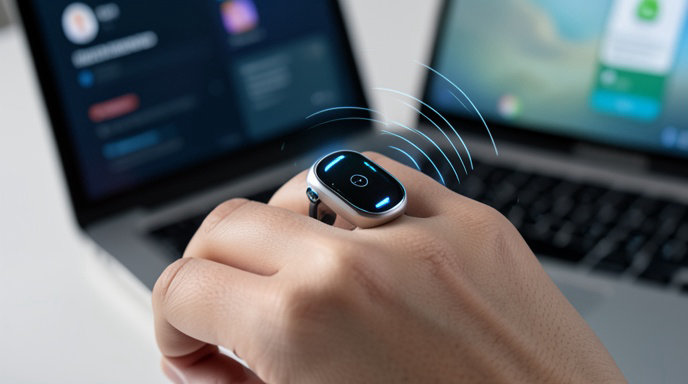
Its most unusual features are a built-in display, a physical joystick, and an integrated microphone. Together, they give Aina capabilities more commonly associated with a smartwatch or wireless headset, while retaining the compact form factor of a ring.
A Display Built Into the Ring
The integrated display is the feature that most clearly separates Aina from conventional smart rings. A small screen can provide visual feedback without requiring the user to pull out a phone or raise a wrist.
The display could show short messages, status updates, prompts, notifications, or responses from an AI agent. It is not intended to replace a smartphone screen. Instead, its value lies in presenting brief, glanceable information at the moment it is needed.
That distinction is important. A ring display is naturally constrained by its size, battery requirements, and viewing angle. Aina’s design appears better suited to compact interactions than extended reading, browsing, or media consumption.
For AI assistants, however, short responses may be enough. A user might check whether an action was completed, view a reminder, confirm a calendar detail, or receive a concise answer without opening another device.
The Joystick Brings Physical Control
Aina also incorporates a small joystick for navigation and interaction. Physical controls are unusual on a ring, where space is extremely limited, but they may solve a problem faced by touch-only wearables: precision.
A joystick can allow users to move through menus, select options, dismiss notifications, or navigate an AI response. It may also make interaction possible when the user cannot comfortably look at or touch a phone.
The control could prove especially useful for short, deliberate commands. Instead of tapping a tiny surface repeatedly, users may be able to make a directional input, press to confirm, and return to whatever they were doing.
This approach also gives Aina a more tactile character. Many wearable interfaces depend on swipes and taps that can be difficult to perform accurately on a miniature surface. A physical control offers feedback through movement and resistance, potentially making the ring easier to use without looking directly at it.
Voice Control Through a Built-In Microphone
The microphone is central to Aina’s AI-focused design. Voice input allows users to communicate with an assistant without typing on a phone or navigating a small wearable screen.
A wearer could speak a question, issue a command, start a note, or ask an AI agent to perform a task. The ring would then transmit the request to a connected device or online service, with the result presented through the ring’s display or another paired device.
The combination of voice input and joystick control is significant. Voice is convenient for creating a request, while the joystick and display can be used for confirmation and navigation. This creates a multimodal interface rather than forcing users to rely exclusively on speech.
That may be useful in situations where speaking is acceptable but fully vocal interaction is awkward. A user could dictate a request, then use the joystick to select a suggested action or approve a response.
Phone Calls Without Holding a Phone
Aina is also being positioned as a tool for handling phone calls. The microphone can capture the wearer’s voice, while the ring’s connection to a smartphone can help manage incoming or active calls.
The concept is more complicated than simply adding a microphone. A practical calling experience requires dependable wireless connectivity, clear voice pickup, low latency, and a way to hear the other person. The ring therefore needs to work alongside a phone, earbuds, a nearby speaker, or another audio device depending on the configuration.
Aina’s role appears to be focused primarily on call control and voice input rather than replacing a full headset. The ring could allow a user to answer or reject a call, interact with the phone through voice, and speak commands without immediately reaching into a pocket.
Whether it can independently provide two-way call audio will depend on the final hardware and software implementation. A microphone handles the outgoing voice, but users also need a practical way to hear the caller. That limitation is one of the key questions surrounding any ring-based calling experience.
Dictating Notes Directly on a Mac
One of the more compelling demonstrations of Aina is its ability to help dictate notes directly on a Mac.
In this scenario, the ring acts as a compact voice-input device. The user speaks naturally, and the audio is passed to the computer for transcription or processing. This could be useful for capturing ideas, drafting messages, recording reminders, or writing notes while away from the keyboard.
The workflow has the potential to be more immediate than opening a dedicated note-taking app. A user could begin speaking, have the words converted into text, and continue working without interrupting the task at hand.
For writers, developers, designers, and office workers, this could make Aina valuable as an always-available dictation tool. It may also be helpful during brainstorming sessions, when preserving an idea quickly matters more than formatting it perfectly.
The quality of this experience will depend on several factors, including microphone performance, background-noise reduction, transcription accuracy, and how smoothly Aina communicates with macOS. A good system must also handle punctuation, corrections, and the transition between spoken commands and dictated text.
An AI Agent Interface on the Finger
Aina’s broader ambition is to serve as a front end for AI agents. Instead of treating artificial intelligence as a chatbot that users open manually, the ring is designed to make AI available through quick, contextual interactions.
An AI agent could help answer questions, summarize information, create reminders, control software, or carry out tasks across connected devices. The ring’s hardware gives users several ways to interact: speak through the microphone, view brief feedback on the display, and use the joystick to make selections.
This could make AI feel less like a separate application and more like a service layered across everyday computing. The ring might be particularly useful for commands that do not justify opening a laptop or phone.
At the same time, an AI-powered wearable must address privacy carefully. A microphone designed for continuous availability raises questions about when audio is being captured, where recordings are processed, and whether voice data is stored. Clear microphone indicators, physical mute controls, transparent permissions, and strong data policies will be important to user trust.
The Practical Challenges
Aina’s feature list is ambitious for such a small device. A display, joystick, microphone, wireless radios, processor, and battery all have to fit into a ring-sized enclosure.
Battery life will be a major consideration. Active voice processing and frequent wireless communication typically consume more power than passive health tracking. Aina’s usefulness will depend on whether it can last through a normal day without requiring frequent charging.
Comfort and durability matter just as much. A ring must remain comfortable during typing, exercise, sleep, and daily activities. The joystick must be easy to use without accidentally triggering commands, while the display must remain visible in different lighting conditions.
Software integration may be even more important than the hardware. The Mac dictation experience, phone-call support, and AI-agent functions all require reliable companion software. Poor pairing, delayed responses, or inconsistent transcription could undermine the advantages of the form factor.
A New Category of Wearable
Aina is entering a market where smart rings are usually judged by health features and battery life. Its emphasis on active interaction gives it a different identity.
The device is closer to a miniature remote control, voice interface, and AI companion than a traditional fitness tracker. Its screen provides immediate feedback, its joystick adds physical navigation, and its microphone enables hands-free commands and dictation.
That combination could appeal to people who want quick access to digital tools without being surrounded by large screens. It may also attract users interested in ambient computing, where technology remains available but less visually demanding.
The remaining question is execution. Aina’s concept is distinctive, but its success will depend on whether the ring can make these interactions feel natural, dependable, and worth the compromises of a smaller device.
If the hardware, battery life, software integration, and privacy controls come together, Aina could represent a notable shift in wearable design: from a ring that quietly records data to one that actively helps users communicate with computers and AI.

Get All The Latest Updates Delivered Straight To Your Inbox For Free!