
Amazon Partners With Uber Eats to Deliver New Prime Member Benefits
TL;DR
- Amazon is making Uber Eats its U.S. restaurant-delivery partner for Prime members, replacing Grubhub.
- Eligible Prime subscribers can receive Uber One benefits, including reduced delivery costs and member-only savings, through a promotional offer.
- The deal gives Uber Eats access to Amazon’s massive Prime base while ending Grubhub’s high-profile integration with the retailer.
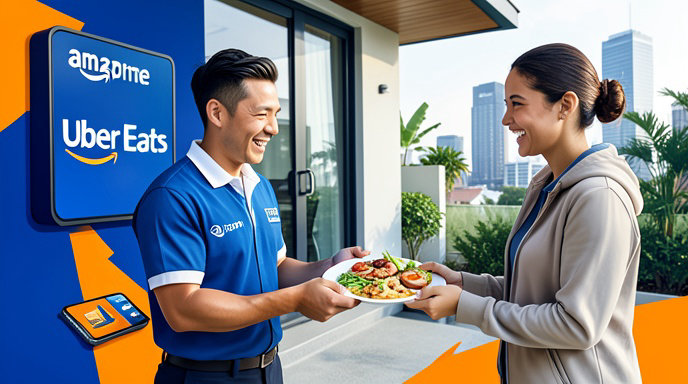
Amazon is shifting its restaurant-delivery strategy in the United States, naming Uber Eats its official partner for Prime members and ending the company’s partnership with Grubhub.
The agreement brings Uber Eats into Amazon’s Prime benefits ecosystem, giving subscribers a new way to save on restaurant orders while strengthening Uber’s position in the competitive food-delivery market. For Grubhub, the change removes one of its most visible distribution partnerships and adds pressure as it competes with DoorDash and Uber Eats for customers, restaurants and delivery workers.
A New Delivery Benefit for Prime Members
Under the partnership, eligible U.S. Prime members will be able to access Uber One benefits through a promotional offer. Uber One typically includes $0 delivery fees on qualifying restaurant and grocery orders, reduced service fees on eligible purchases, member-only pricing and other discounts.
The exact value and duration of the offer may depend on the customer’s eligibility, account status and the terms presented during enrollment. Members generally need to activate the benefit through Amazon or Uber and link their accounts before using it.
The benefit applies to qualifying orders placed through Uber Eats rather than orders made directly through Amazon. Delivery fees, service fees, minimum order requirements, taxes, tips and geographic restrictions may still apply. Restaurants and orders must also meet Uber’s eligibility rules.
For Prime subscribers who already use Uber Eats, the arrangement could reduce the cost of frequent delivery orders. It also gives Amazon another way to make Prime membership feel more valuable without having to build and operate a nationwide restaurant-delivery network itself.
Why Amazon Is Moving Away From Grubhub
Amazon’s relationship with Grubhub became a prominent Prime perk when the companies offered subscribers access to Grubhub’s paid membership program. That arrangement helped Grubhub reach millions of Amazon customers and gave Amazon a restaurant-delivery option without owning the underlying delivery infrastructure.
The shift to Uber Eats suggests that Amazon is looking for a broader and potentially more scalable partner. Uber operates a large global transportation and delivery platform, has an established consumer app and can connect restaurant orders with a wider set of mobility and logistics services.
The move may also reflect the changing economics of food delivery. Customer acquisition is expensive, delivery margins are thin and promotional programs can be costly. By partnering with a large platform rather than maintaining a standalone restaurant-delivery offering, Amazon can provide a Prime benefit while limiting operational exposure.
For Amazon, the deal is primarily about increasing Prime engagement. Members who use Uber Eats more often may see greater value in keeping their subscriptions, while Amazon can use the partnership to expand the range of everyday services associated with Prime.
How the Uber One Offer Works
Prime members who qualify for the promotion are expected to enroll through an Amazon or Uber sign-up flow. After activation, the Uber One benefits apply within the Uber and Uber Eats ecosystem, subject to the program’s terms.
The main restaurant-delivery advantages can include:
- No delivery fee on eligible orders that meet the applicable minimum.
- Reduced service fees on qualifying purchases.
- Exclusive pricing or promotions at participating restaurants.
- Credits, discounts or other promotional benefits offered by Uber.
- Potential savings across other eligible Uber services, depending on the offer.
The benefit is not the same as free food delivery in every circumstance. Restaurants may set different minimums, certain locations may be excluded and additional charges can remain on an order. Customers should review the final checkout total rather than assuming that every fee will be removed.
Uber One membership terms can also change after the promotional period ends. Prime members may need to cancel before renewal if they do not want to continue paying the standard subscription price.
What Uber Eats Gains
For Uber, the Amazon agreement offers direct access to one of the largest paid-membership communities in the United States. Prime members are already accustomed to receiving bundled benefits, making them a potentially attractive audience for Uber One.
The partnership could help Uber Eats increase order frequency, improve customer retention and convert Prime users into longer-term Uber One subscribers. It may also encourage customers who use Uber for rides but not food delivery to try the restaurant service.
Uber can further benefit from the relationship between its mobility and delivery businesses. Customers familiar with the Uber app may be more likely to use both services, while Uber can promote a broader membership proposition rather than selling food-delivery savings alone.
The challenge will be turning promotional users into profitable, recurring customers. Food delivery remains a highly competitive business, and discounts that attract new users do not automatically translate into sustainable margins.
What the Deal Means for Grubhub
Grubhub loses an important customer-acquisition channel as Amazon turns to Uber Eats. The company’s Prime integration gave Grubhub a prominent place in Amazon’s subscription offering and helped it reach consumers who might not otherwise open the Grubhub app.
Without that relationship, Grubhub will need to rely more heavily on restaurant partnerships, its own consumer promotions and other distribution deals. It may also face greater pressure to differentiate itself through pricing, campus delivery, corporate accounts, loyalty programs or restaurant tools.
The loss is significant not only because of the Prime audience, but also because Amazon helped present Grubhub as a mainstream membership benefit. Replacing that exposure could be difficult in a market where DoorDash and Uber Eats have stronger consumer visibility in many regions.
Still, the end of the Amazon arrangement does not eliminate Grubhub’s business. The company continues to serve restaurants and diners in the United States and can compete in markets where it has strong local coverage or specialized partnerships.
A Strategic Win for Amazon Without Building a Delivery Network
Amazon has experimented with food and grocery delivery in several ways, but restaurant delivery is operationally complex. It requires courier supply, dispatch technology, restaurant integration, customer support and dense local demand.
The Uber Eats partnership lets Amazon offer a restaurant-delivery benefit while leaving those functions to a specialized operator. That model resembles Amazon’s broader approach to Prime, where the company combines services it operates directly with benefits delivered by outside partners.
The arrangement also fits Amazon’s effort to make Prime useful beyond shipping and video streaming. Prime benefits now span entertainment, shopping, groceries, pharmacy services and other consumer categories. A restaurant-delivery perk adds another frequent-use benefit that could reinforce the subscription’s everyday value.
The Competitive Stakes in Food Delivery
The U.S. food-delivery market is dominated by a small group of major platforms, with DoorDash, Uber Eats and Grubhub competing for customers and restaurants. Partnerships with large retailers, banks, wireless carriers and subscription programs have become an important way for those companies to reduce acquisition costs.
Amazon’s decision gives Uber a powerful distribution advantage. It also raises the stakes for rival platforms, which may respond with their own membership bundles or partnerships.
For restaurants, the deal could increase order volume, but more delivery demand does not necessarily mean higher profits. Restaurants remain concerned about commission rates, marketing costs, refunds and the difficulty of managing orders across multiple platforms. Some may welcome the additional reach, while others could limit participation in promotional programs depending on the economics.
What Prime Members Should Know
Prime subscribers should check their eligibility and the activation deadline for the Uber One promotion. The offer may be limited to new or returning Uber One members, and customers who already subscribe may receive different terms.
Members should also review:
- The length of the promotional period.
- The subscription price after the offer expires.
- The minimum order required for delivery-fee savings.
- Whether grocery and other Uber services are included.
- Which restaurants and locations qualify.
- Whether cancellation is required to avoid automatic renewal.
The biggest practical benefit will likely go to members who order delivery regularly. Occasional users may save less, particularly when service fees, small-order charges or other checkout costs remain.
The Bottom Line
Amazon’s move from Grubhub to Uber Eats changes the company’s restaurant-delivery strategy while giving Prime members a potentially valuable new benefit. Uber gains a major customer funnel and an opportunity to grow Uber One, while Grubhub loses an influential partnership that helped expand its reach.
The deal does not fundamentally change how restaurant delivery works: customers will still face eligibility rules, order minimums and additional fees. But it does show how subscription programs are becoming increasingly important battlegrounds in the delivery industry.
For Amazon, the partnership strengthens Prime without requiring the company to operate its own restaurant-delivery network. For Uber, it could accelerate membership growth and order volume. For Grubhub, it is a reminder that distribution partnerships can be as important as the delivery platform itself.

Get All The Latest Updates Delivered Straight To Your Inbox For Free!