
Anthropic Launches Claude Meetings to Turn Workplace Discussions Into Action Plans
TL;DR
- Anthropic’s Claude Meetings is designed to turn live workplace conversations into plans, timelines, and task lists.
- The feature reportedly lets participants ask Claude questions during meetings and retrieve relevant information from connected workplace applications.
- Its value will depend on accuracy, permissions, privacy protections, and how reliably it converts discussion into follow-through.
From Conversation to Coordination
Anthropic is expanding Claude beyond a general-purpose chatbot with Claude Meetings, a workplace-focused feature intended to transform live discussions into structured, actionable work.
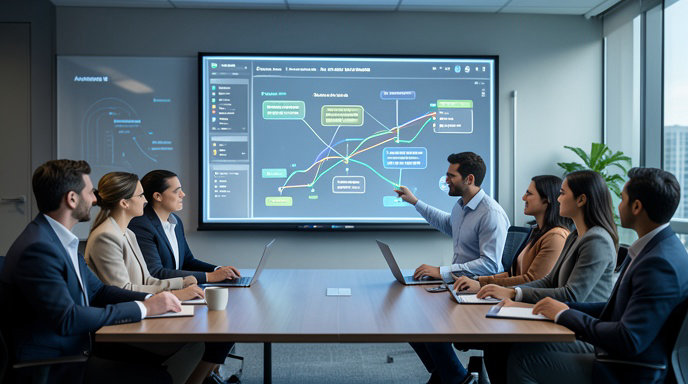
Rather than leaving employees with scattered notes and ambiguous follow-ups, Claude Meetings is designed to identify decisions, organize priorities, assign tasks, and establish timelines as a conversation unfolds. The result is intended to be a practical record of what was discussed and what should happen next.
The feature reflects a broader shift in workplace AI. Early meeting assistants largely focused on transcription and summaries. Newer tools are increasingly expected to interpret conversations, connect them to company knowledge, and help teams move directly from discussion to execution.
Plans, Deadlines, and Task Lists
A central capability of Claude Meetings is its ability to convert unstructured workplace dialogue into operational documents.
During or after a meeting, Claude can organize important points into formats such as:
- Decisions that were made
- Open questions requiring follow-up
- Assigned responsibilities
- Project milestones
- Proposed deadlines
- Dependencies between tasks
- Risks and unresolved issues
This structure could be particularly useful for project reviews, planning sessions, sales meetings, hiring discussions, and executive briefings. Instead of asking employees to reconstruct a meeting from memory, the system can provide a working plan that teams can review and refine.
The distinction between a summary and an action plan is important. A conventional summary explains what happened. An action-oriented meeting record is meant to help determine what happens next.
Claude as a Meeting Participant
Claude Meetings also positions Claude as an interactive assistant during a conversation, rather than a tool that only processes meeting content afterward.
Participants can use the meeting chat to ask for clarification, request a recap of an earlier point, or ask Claude to identify commitments that have been made. They may also be able to request structured outputs, such as a list of decisions, a project timeline, or a breakdown of unresolved issues.
This could reduce the need for one person to act as a dedicated note-taker. It may also help participants stay focused on the discussion while Claude handles organization and retrieval.
However, interactive assistance introduces a challenge: the AI must distinguish between confirmed decisions, tentative suggestions, and ordinary brainstorming. Treating an offhand comment as an approved commitment could create confusion, particularly in meetings involving multiple teams or senior leadership.
Searching Connected Work Apps
One of the feature’s more significant capabilities is its reported ability to retrieve information from connected workplace applications, including historical business data.
With appropriate access, Claude could help participants locate earlier project updates, customer information, previous decisions, documents, or related conversations without requiring them to search through multiple systems manually.
For example, a team might ask whether a similar issue was discussed in a previous meeting, when a customer last received an update, or what assumptions were used in an earlier project plan. Claude’s usefulness would come not only from generating text, but from connecting a live discussion with the organization’s existing knowledge.
This capability also makes permissions and data governance especially important. The quality of an answer depends on the sources Claude can access, while the appropriateness of an answer depends on whether the requesting employee is authorized to view those sources.
Historical Context Could Improve Decisions
Business discussions often suffer from incomplete context. Employees may remember that a decision was made but not why, or know that a customer issue existed without being able to locate its previous resolution.
Claude Meetings could help address that problem by bringing historical information into the conversation. A meeting about a delayed project, for instance, could draw on earlier milestones, previous risk assessments, and related internal discussions.
That context could make meetings more efficient and reduce duplicated work. It may also help new employees understand how a project reached its current state.
Still, historical business data can be outdated, contradictory, or incomplete. Claude would need to make the origin and age of retrieved information clear so that users do not mistake an old plan for the current one.
The Accuracy and Trust Challenge
Turning a meeting into an action plan requires more than accurate transcription. The system must understand who said what, identify the difference between a proposal and a decision, and correctly associate tasks with people and deadlines.
Errors in any of these areas could have practical consequences. A wrongly assigned task might be missed. An incorrectly recorded deadline could affect a launch. An incomplete summary could leave stakeholders with an inaccurate understanding of a decision.
For that reason, Claude Meetings should be treated as an assistant whose output requires review, particularly for sensitive or high-impact discussions. Teams may need workflows that allow participants to approve, edit, and distribute meeting records before they become official project documentation.
Privacy and Enterprise Controls
Meeting assistants operate in some of the most sensitive parts of an organization. Conversations may include confidential financial information, employee matters, customer data, product plans, or legal discussions.
Anthropic’s approach will therefore be judged not only by its productivity features but also by its controls around data access, retention, administrative oversight, and model training. Organizations will want clear answers about where meeting content is stored, who can access generated summaries, how connected-app permissions are enforced, and whether enterprise data is used to improve models.
The ability to retrieve historical business information makes these questions more urgent. A system that can search across workplace applications must preserve existing access boundaries rather than create a new route around them.
A Step Toward AI-Native Meetings
Claude Meetings arrives as software companies increasingly compete to make AI a routine part of workplace collaboration. The goal is moving beyond isolated chat prompts toward systems that participate in workflows, understand organizational context, and help complete work.
Anthropic’s feature is notable because it combines several functions: meeting assistance, structured planning, conversational retrieval, and access to historical business information. Together, those capabilities could make Claude a more persistent layer across workplace operations.
The long-term test will be whether teams trust its outputs enough to incorporate them into everyday processes. If Claude can consistently separate facts from suggestions, preserve context, and produce reliable next steps, it could reduce administrative work and improve accountability.
What Comes Next
Claude Meetings’ impact will depend on the breadth of its integrations, the quality of its real-time assistance, and the safeguards surrounding workplace data. Integrations with project management, messaging, customer relationship management, document storage, and calendar tools could make the feature more useful by allowing plans to flow directly into existing systems.
Organizations will also likely look for support for approvals, audit trails, role-based access, and corrections when meeting records are inaccurate. These features could determine whether Claude Meetings remains a convenient note-taking tool or becomes a trusted system for coordinating work.
Anthropic’s broader ambition appears clear: make Claude useful not just for answering questions, but for helping teams turn conversations into measurable progress. If the technology can deliver that reliably while respecting privacy and organizational boundaries, Claude Meetings could become an important example of how generative AI is reshaping collaboration.

Get All The Latest Updates Delivered Straight To Your Inbox For Free!