
Big Tech’s Midterm Strategy: From White House Alliances to Democratic Outreach
TL;DR
- Big Tech is trying to repair ties with Democrats after cultivating unusually close relationships with the Trump White House.
- The outreach faces pressure from antitrust regulators, state officials, labor groups, privacy advocates, voters, and communities affected by artificial-intelligence expansion.
- For technology companies, the 2026 midterm cycle will test whether political repositioning can produce durable credibility—or merely look like opportunistic risk management.
A Political Reset Underway
Silicon Valley is entering the 2026 midterm cycle with a complicated political balance sheet.
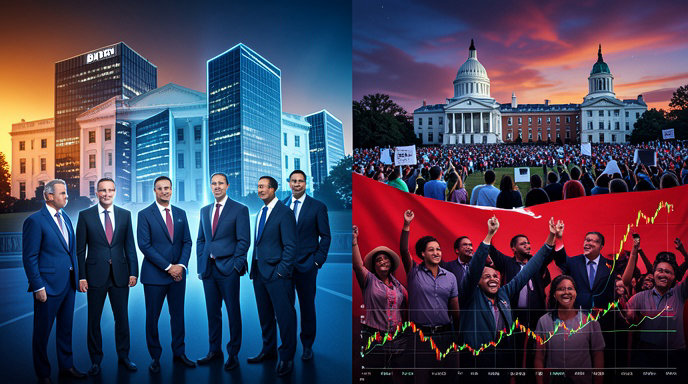
Major technology companies spent the first two years of the Trump administration building unusually visible relationships with the White House. Chief executives appeared at presidential events, participated in policy discussions, and backed initiatives involving artificial intelligence, data centers, energy, manufacturing, and deregulation. Several companies and executives also made high-profile contributions, donations, or public gestures that signaled a willingness to work with the administration.
Now, many of those same companies are attempting to reopen channels with Democrats.
The effort is not necessarily a return to the technology industry’s earlier alignment with liberal politics. Instead, it reflects a more transactional strategy. Companies want access to both parties as Democrats prepare for congressional and state-level contests, regulators continue scrutinizing their business models, and investors demand protection from political and legal shocks.
The central question is whether Democrats will see the outreach as evidence of a genuine change in corporate behavior or as a temporary adjustment designed to protect profits and market access.
From Democratic Ally to Washington Operator
For much of the 2010s, technology companies were closely associated with Democratic policymakers. Their executives supported Democratic candidates, employees made large political donations to progressive campaigns, and companies promoted positions on immigration, climate policy, voting rights, and social issues that generally aligned with the party’s coalition.
That relationship deteriorated over the past decade.
Democratic officials increasingly turned against the industry’s concentration of power, its influence over public discourse, its treatment of workers, and its handling of personal data. Antitrust investigations and lawsuits targeted some of the largest technology platforms. Lawmakers from both parties criticized content-moderation decisions, online advertising practices, and the spread of misinformation.
At the same time, technology executives became more willing to engage with conservative leaders. The shift accelerated as artificial intelligence, energy demand, industrial policy, and national security moved to the center of Washington’s technology agenda.
The result has been a new political posture: companies that once emphasized cultural alignment now emphasize economic growth, American competitiveness, national security, and regulatory flexibility.
Why Democrats Still Matter
Even with Republicans controlling the White House, technology companies cannot afford to abandon Democrats.
Democrats retain substantial influence in major technology states, including California, Washington, New York, Massachusetts, and parts of the Northeast. They also hold power in many cities and states where companies operate data centers, semiconductor facilities, offices, laboratories, and logistics networks.
State governments can impose privacy rules, regulate artificial-intelligence systems, restrict data-center development, establish labor standards, and challenge mergers. Attorneys general and state regulators can pursue cases even when federal enforcement priorities change.
Democratic lawmakers also remain influential on issues that directly affect technology companies, including semiconductor subsidies, scientific research, broadband funding, antitrust enforcement, online safety, labor rights, and clean-energy investment.
For executives, maintaining relationships with Democrats is therefore less about ideology than coverage. A company that depends on one party can face substantial risk when control changes in Washington or when a state-level coalition becomes hostile.
The Outreach Playbook
The industry’s Democratic outreach is likely to focus on economic and local issues rather than partisan culture-war debates.
Technology companies can point to investments in data centers, chip manufacturing, cloud infrastructure, artificial-intelligence research, and high-skilled jobs. They can emphasize partnerships with universities, hospitals, small businesses, and local governments. They can also highlight programs intended to expand access to digital tools and workforce training.
Artificial intelligence provides both an opportunity and a problem.
Companies want lawmakers to support rapid deployment and limit rules that could slow development. Democrats, however, are demanding stronger protections against discrimination, job displacement, surveillance, consumer exploitation, and unsafe automated decision-making.
A company seeking Democratic credibility will need to demonstrate that its AI strategy includes more than voluntary commitments. That may mean accepting independent audits, clearer disclosures, stronger privacy safeguards, worker protections, and greater transparency over training data and model behavior.
Executives are also expected to present themselves as practical partners on infrastructure. Data centers require electricity, water, land, and new transmission capacity. Companies that offer funding for grid improvements or local infrastructure may find a more receptive audience than those that simply announce large projects and ask communities to absorb the consequences.
State Governments Become the First Test
The political reset will be tested most immediately outside Washington.
Governors and state legislatures are weighing rules covering AI, privacy, online platforms, children’s safety, facial recognition, automated hiring, and consumer protection. Some states are also reviewing the environmental and economic consequences of data-center construction.
The patchwork creates both opportunity and danger for technology companies. Businesses can work with friendly states to establish favorable standards, but they also face the possibility of conflicting rules that raise compliance costs.
Democratic state officials are unlikely to be persuaded by campaign donations alone. They are more likely to judge companies by whether they negotiate with communities, disclose energy and water use, respect labor organizing, and respond to complaints about local impacts.
A company that presents itself as a national champion of innovation while fighting every state-level safeguard may find that its political makeover has limited value.
The Antitrust Problem Has Not Disappeared
Democratic outreach also runs into the industry’s most persistent liability: market power.
Across the political spectrum, officials have questioned whether dominant platforms use acquisitions, distribution agreements, app-store rules, advertising systems, and default settings to suppress competition. Democrats generally frame the issue around corporate concentration and consumer harm, while many Republicans focus on perceived bias, censorship, or the influence of large platforms over public debate.
The different arguments do not necessarily produce different outcomes. Both parties have shown greater willingness than in the past to scrutinize the largest technology companies.
That makes it difficult for companies to repair relations with Democrats through messaging alone. Any outreach campaign will be judged against active litigation, merger reviews, investigations, and proposed changes to platform practices.
Technology companies may seek compromise on selected issues, but they are unlikely to voluntarily surrender the business models that generate their highest returns. This gap between public diplomacy and corporate incentives could become the defining weakness of the strategy.
Wall Street Wants Stability, Not Partisanship
Financial markets add another layer of pressure.
Investors generally prefer political predictability. They want companies to secure access to energy, avoid disruptive lawsuits, preserve favorable tax treatment, and maintain the freedom to invest in AI infrastructure. They are less concerned with whether an executive is welcomed by Democrats or Republicans than with whether political exposure threatens growth.
That calculation encourages companies to diversify their relationships. A firm that is closely identified with one administration may face regulatory retaliation, reputational damage, or a costly policy reversal when power changes hands.
At the same time, investors may resist concessions that could reduce margins. Stronger privacy controls, labor agreements, local infrastructure spending, and compliance requirements can increase costs. Restrictions on acquisitions or platform practices can threaten future growth.
The result is a narrow path. Companies must appear responsive to Democrats without alarming shareholders or undermining their relationships with the White House.
Communities Are Demanding More Than Jobs
Local communities may be the hardest audience to persuade.
Data centers and semiconductor facilities can create construction work, tax revenue, and long-term employment. They can also strain electric grids, consume water, increase traffic, raise housing costs, and alter land use. In some areas, residents have objected to projects they believe were negotiated without adequate public input.
Artificial intelligence has intensified these concerns. Communities are being asked to host the physical infrastructure behind a technology whose economic benefits may flow primarily to distant shareholders and highly skilled workers.
Technology companies that want lasting political support will need to demonstrate tangible local benefits. That could include utility upgrades, public revenue-sharing agreements, workforce development, lower-cost connectivity, environmental monitoring, and commitments to hire locally.
Democratic officials are likely to use these disputes as evidence that technology policy is not only about innovation. It is also about who bears the costs and who receives the gains.
Voters Are Watching the Contradictions
Voters may be less impressed by corporate political repositioning than executives expect.
Many Americans support technological innovation while expressing concern about corporate power, layoffs, privacy violations, online harms, and the effect of AI on employment. They may welcome new investment but oppose companies that appear to influence public policy without accepting meaningful accountability.
The industry’s image problem is therefore broader than its relationship with either party. Companies must convince voters that they are not simply using political access to avoid oversight.
This is particularly important for technology leaders who have cultivated personal political brands. Individual executives may attract attention, but their public statements can also create liabilities for the companies they run. A leader who is celebrated by one political coalition may alienate customers, employees, or lawmakers in another.
The midterm cycle will make those tensions more visible. Candidates can portray technology companies as engines of growth, symbols of corporate excess, or both, depending on the district and the issue.
What Would Genuine Democratic Outreach Look Like?
A durable relationship with Democrats would require more than meetings, donations, and carefully staged announcements.
It would likely involve cooperation on competition policy, labor standards, privacy, AI accountability, and local investment. Companies would need to accept that some regulation is not an existential threat and that public trust cannot be rebuilt solely through philanthropy or political spending.
They would also need to engage with Democratic constituencies beyond elected officials. Labor unions, civil-rights organizations, environmental groups, consumer advocates, local governments, and researchers increasingly shape the party’s technology agenda.
That may be uncomfortable for companies accustomed to negotiating primarily with senior policymakers. But grassroots opposition can delay projects, influence state legislation, and create reputational risks that Washington lobbying cannot easily solve.
The Limits of Political Flexibility
Technology companies have become highly effective at moving between political environments. They can emphasize national security with Republicans, innovation with business-friendly Democrats, economic opportunity with local officials, and responsible AI with civil-society groups.
The danger is that flexibility can begin to look like insincerity.
If a company supports deregulation in one setting and responsible oversight in another, it must explain where its principles actually lie. If it celebrates free expression while removing content under political pressure, or promotes American workers while relying on aggressive cost cutting, critics will highlight the contradiction.
Democrats are likely to ask whether the industry’s new outreach reflects a substantive change or simply a response to electoral uncertainty. Republicans, meanwhile, may view renewed Democratic engagement as evidence that companies are still trying to preserve influence across the political spectrum.
In that environment, no amount of political access guarantees protection.
The Midterm Test
The 2026 midterms will not produce a single verdict on Big Tech’s political strategy. The industry operates across too many states, sectors, and policy debates for one election to settle the question.
But the campaign will reveal which relationships are real.
Companies that have invested in local partnerships, accepted meaningful oversight, and delivered visible economic benefits may be able to rebuild trust with Democrats. Those that rely mainly on executive meetings, political donations, and broad promises about innovation may find the reception far colder.
The most successful technology companies will probably be those that treat political engagement as part of governance rather than public relations. They will need to manage relationships with both parties while addressing the concerns of regulators, workers, communities, consumers, and investors.
Big Tech’s midterm strategy is therefore not simply a story about moving from one party to another. It is a test of whether the industry can remain politically influential while operating under far greater public scrutiny.
After two years of close White House alignment, Democratic outreach may help technology companies reopen doors. Whether those doors remain open will depend on what they do once they are inside.

Get All The Latest Updates Delivered Straight To Your Inbox For Free!