
China’s Graphite Monopoly Faces Disruption as Molten Industries Builds Oakland Battery-Anode Factory
TL;DR
- China controls most of the world’s battery-grade graphite processing, leaving electric-vehicle and energy-storage manufacturers exposed to export restrictions and supply shocks.
- Molten Industries is developing an Oakland, California, factory intended to convert carbon feedstocks into battery-anode graphite, offering a potential domestic alternative.
- The project could strengthen the U.S. battery supply chain, but it must still prove its technology, secure financing and feedstock, reach commercial scale, and compete on cost.
China’s Graphite Advantage Is Built on Processing
Graphite is a critical material in lithium-ion battery anodes, the negative electrodes that store and release lithium ions during charging and discharging. Although graphite is naturally abundant, producing battery-grade material requires extensive purification, shaping, coating, and quality control.
That processing infrastructure is where China has established its strongest advantage. Chinese companies dominate the conversion of mined and synthetic graphite into the spherical, purified graphite used by battery manufacturers. Industry estimates have generally placed China’s share of global graphite processing at roughly 90% or more, while its share of natural graphite mining is lower.
The distinction matters. A country may have graphite reserves or mines, but that does not necessarily mean it can supply finished anode material. Battery producers need material with tightly controlled particle size, purity, surface chemistry, and electrochemical performance. China’s large refining and manufacturing base gives it influence over this higher-value stage of the supply chain.
That influence became more visible when Beijing introduced export controls on certain graphite products in late 2023. Exporters were required to obtain government approval before shipping covered materials overseas. The policy was not a total ban, but it demonstrated how quickly graphite could become a strategic pressure point in the battery industry.
A Vulnerability for EVs and Energy Storage
Graphite is the dominant commercial anode material in lithium-ion batteries. Silicon-enhanced anodes are gaining attention, but most near-term silicon technologies still use substantial graphite. As a result, graphite demand is expected to grow alongside electric vehicles, grid batteries, consumer electronics, and other electrification technologies.
Supply disruptions could affect more than raw-material prices. Battery manufacturers need consistent material specifications, and switching suppliers can require qualification testing, production-line adjustments, and lengthy reliability reviews. A shortage of suitable anode material could therefore create delays even when graphite exists elsewhere in the world.
The concentration of processing also complicates efforts to build batteries outside China. Automakers and battery companies may assemble cells in North America or Europe while continuing to depend on Chinese anode materials. That leaves a gap in the supply chain and exposes manufacturers to shipping disruptions, trade restrictions, tariffs, and geopolitical tension.
The U.S. has responded with a mix of subsidies, tax incentives, trade measures, and critical-minerals policy. The Inflation Reduction Act’s battery provisions have encouraged companies to establish domestic and allied supply chains, while restrictions tied to foreign entities of concern are increasing pressure on automakers to reduce dependence on Chinese inputs.
Molten’s Oakland Strategy
Molten Industries is pursuing a different route from conventional graphite mining. The Oakland-based company has been developing a process designed to produce graphite from carbon-rich industrial feedstocks rather than relying solely on newly mined natural graphite.
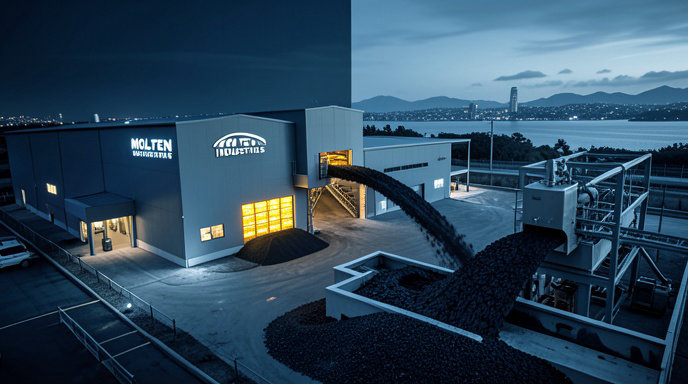
The company’s planned Oakland factory is intended to manufacture battery-anode material domestically. Its approach is based on transforming carbon feedstocks into graphite and then producing material suitable for lithium-ion battery anodes. If the process performs as intended, it could reduce dependence on imported natural graphite and help create a U.S. source of anode material closer to battery plants and automotive customers.
Using industrial carbon feedstocks could offer several potential advantages. It may provide a more geographically diverse raw-material base, reduce exposure to mining bottlenecks, and make use of materials already generated by industrial activity. A domestic process could also simplify logistics for North American cell manufacturers and reduce the need to ship finished anode material across the Pacific.
However, the Oakland project is not automatically a substitute for China’s mature supply chain. Producing graphite at laboratory or pilot scale is substantially different from running a consistent commercial plant. Molten must demonstrate that its material meets battery manufacturers’ performance requirements across large production volumes and sustained operating periods.
The company will also need to prove that its feedstocks are reliable, that its process can operate economically, and that its environmental footprint compares favorably with imported alternatives. Battery customers will likely demand extensive testing before approving a new anode supplier.
The Cost and Scale Challenge
China’s position is supported not only by technology but also by scale. Large processing networks, established supplier relationships, experienced labor, integrated chemical operations, and comparatively low production costs have helped Chinese graphite producers remain competitive.
A new U.S. factory faces higher construction, labor, energy, compliance, and financing costs. Those disadvantages could be offset by government incentives, domestic-content requirements, customer demand for secure supplies, and the value automakers place on avoiding geopolitical risk. But incentives alone cannot guarantee long-term competitiveness.
Molten’s economics will depend on several variables: the price and consistency of its carbon feedstock, energy consumption, yield, purification requirements, equipment utilization, and the cost of bringing material to battery-grade specifications. The company must also demonstrate that its product performs well over thousands of charge-and-discharge cycles.
The first customers may be willing to pay a premium for supply-chain security. Over time, however, the material must either approach the cost of Chinese imports or provide clear technical and regulatory advantages. Battery manufacturers operate under intense cost pressure, particularly as electric vehicles move into more price-sensitive market segments.
Why Oakland Matters
The choice of Oakland gives the project access to a major industrial and logistics region, technical talent, transportation infrastructure, and proximity to California’s large clean-technology market. The Bay Area also offers connections to venture capital, research institutions, climate-focused investors, and companies developing next-generation battery technologies.
A local factory could help establish a domestic anode-material ecosystem. It could supply nearby battery developers, support pilot-line testing, and provide a platform for future expansion. California’s policies promoting zero-emission vehicles and energy storage may create a strong regional market for domestically produced battery materials.
At the same time, an urban industrial site can bring permitting, land-use, environmental, and community-relations challenges. Graphite production involves high-temperature processing and, depending on the feedstock and chemistry, may require careful management of emissions, waste, and chemical inputs. Molten will need to show that the facility can meet regulatory requirements while gaining support from the surrounding community.
An Alternative to Mining—Not an End to Mining
Molten’s process could diversify graphite production, but it is unlikely to eliminate the need for mining. Natural graphite remains an important source of anode material, and global demand is expected to require multiple production pathways.
The broader solution will probably include new mines in North America and allied countries, expanded synthetic-graphite capacity, recycling of used batteries, improved anode designs, and reduced graphite intensity in future cells. No single factory can replace an entire international supply chain.
Recycling could become increasingly important as the first large wave of electric-vehicle batteries reaches end of life. Recovered graphite is not yet as central to battery recycling economics as lithium, nickel, or cobalt, but improved processes could eventually return more anode material to manufacturing.
Battery innovation could also reduce dependence on graphite. Silicon, lithium-metal, and other anode chemistries are being developed, although many remain limited by swelling, degradation, manufacturing complexity, or cost. For the foreseeable future, graphite is likely to remain the workhorse anode material for mainstream lithium-ion cells.
The Geopolitical Stakes
China’s graphite controls underscored the strategic value of materials that receive less public attention than lithium or cobalt. Processing capacity can be as important as mineral reserves, and governments are increasingly treating the ability to refine and manufacture battery materials as an industrial-security priority.
For the United States, domestic graphite production could support more than electric vehicles. Grid-scale batteries, defense systems, aerospace equipment, power tools, and consumer electronics all depend on reliable lithium-ion battery supply chains.
For automakers, the issue is also about planning. A diversified supplier base can reduce the risk that a single policy decision, shipping disruption, or diplomatic dispute affects vehicle production. Domestic anode production could become particularly valuable as manufacturers seek to comply with North American sourcing requirements and avoid restrictions associated with foreign entities of concern.
What to Watch Next
The most important milestones for Molten will be technical and commercial rather than simply architectural. Key indicators include the completion and commissioning of the Oakland facility, production of consistent battery-grade material, independent testing by cell manufacturers, customer qualification agreements, and evidence of large-scale operating economics.
Investors and policymakers will also need clarity on the factory’s financing, construction schedule, production capacity, feedstock agreements, environmental permits, and plans for expansion. A successful pilot plant would be an encouraging step, but the strategic impact would depend on whether Molten can scale into meaningful volumes.
The company’s progress will be measured against the size of the market. A modest initial plant may not materially change global graphite trade, but it could prove the technology and support larger facilities in the United States or allied countries. In that sense, Oakland’s importance may lie as much in demonstrating a repeatable manufacturing model as in the volume produced at the first site.
A Potential Crack in China’s Dominance
China’s graphite advantage was built over decades, and it will not disappear because of one new factory. Chinese producers still possess enormous scale, deep technical expertise, and established relationships with battery manufacturers.
Molten Industries nevertheless represents the kind of challenger needed to diversify the market. By attempting to manufacture battery-anode graphite in Oakland from domestic industrial inputs, the company is targeting the supply-chain bottleneck that has allowed China to dominate even when graphite resources exist elsewhere.
If Molten can achieve reliable quality, competitive costs, and commercial scale, its project could become a model for a more distributed battery-materials industry. The result would not be the end of China’s role in graphite, but a reduction in the world’s dependence on a single processing hub.
For the electric-vehicle and energy-storage industries, that distinction is significant. Resilient supply chains do not require one country to lose all influence. They require enough credible alternatives that a policy decision or production disruption in one market no longer threatens the entire battery economy.

Get All The Latest Updates Delivered Straight To Your Inbox For Free!