
Data Centers Turn to Retired Jet Engines Amid Growing Power Grid Delays
TL;DR
- Data center developers are turning to refurbished aircraft-derived gas turbines to generate on-site power while utility grid connections and new-generation equipment face multiyear delays.
- The engines can be deployed faster and occupy less space than conventional power plants, but they generally cost more to operate, produce electricity less efficiently, and require specialized maintenance.
- Their increased use raises questions about natural-gas dependence, carbon emissions, local air pollution, noise, and whether temporary backup systems could become long-term infrastructure.
Power-Hungry Data Centers Look Beyond the Grid
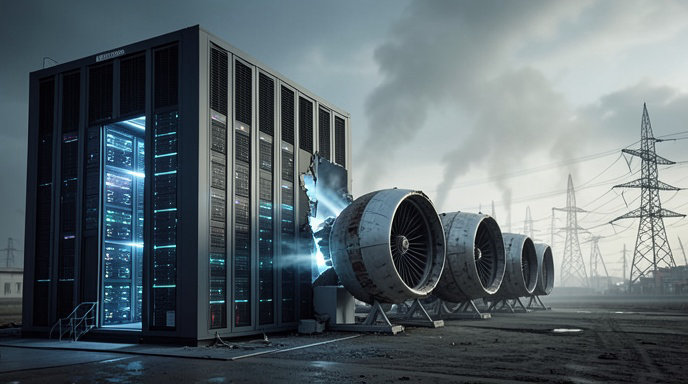
The race to build artificial-intelligence data centers is pushing developers toward an unusual source of electricity: retired jet engines.
As utilities struggle to complete transmission upgrades, approve new interconnections, and procure turbines, some data center operators and power developers are examining refurbished aircraft-derived gas turbines as a faster route to on-site generation. The technology is not new. Similar engines have powered offshore platforms, industrial facilities, and remote power systems for decades. What is changing is the scale of demand from data centers—and the urgency with which operators need dependable electricity.
Large AI facilities can require hundreds of megawatts, comparable to the consumption of a small city. Training and serving AI models also create unusually steady loads, with computing equipment operating around the clock. Developers that cannot secure sufficient grid capacity risk delaying projects worth billions of dollars.
Retired jet engines offer a possible bridge. They can be installed in modular power plants, fueled primarily by natural gas, and brought online faster than major utility-scale generation and transmission projects.
Why Aircraft Engines Are Attractive
Aircraft-derived turbines are adaptations of commercial or military jet engines. Instead of producing thrust, they drive electrical generators. Their compact design, high power-to-weight ratio, and ability to ramp output relatively quickly make them attractive for constrained sites.
Refurbished engines can also be sourced from an established global maintenance ecosystem. Aircraft engines are routinely removed from service, overhauled, and returned to operation. A power developer can use that existing industrial supply chain rather than wait for newly manufactured heavy-duty turbines, many of which have lengthy backlogs.
The systems are particularly appealing where land is scarce or where a facility needs power before a utility can complete a substation or transmission connection. Several modular turbine units can be installed in stages, allowing generation capacity to grow alongside a data center campus.
For developers, the central advantage is time. A project that can generate electricity in months may be more valuable than a more efficient plant that will not be available for several years.
Grid Connections Are Becoming a Critical Bottleneck
Electricity demand is rising faster than many power systems were designed to accommodate. AI-focused data centers are accelerating that trend, joining manufacturing, electric vehicles, building electrification, and cryptocurrency operations as major sources of new load.
In many regions, the challenge is not simply a shortage of generation. Data centers may be located in areas where power is available in theory but cannot be delivered without new transmission lines, substations, transformers, and protection equipment. Interconnection studies can take years, while equipment procurement and permitting add further delays.
Utilities are also under pressure to maintain reliability for existing customers. Connecting a large new load may require expensive grid upgrades, and regulators increasingly want assurances that those costs will not be shifted to households and smaller businesses.
This has created an incentive for developers to build “behind the meter,” producing at least part of their electricity on-site. Jet-derived turbines are one option alongside conventional gas engines, fuel cells, batteries, solar installations, and small modular power systems.
Faster Deployment Comes at a Price
The speed advantage of refurbished turbines does not make them cheap. Aircraft-derived engines often have higher operating costs than newer, purpose-built utility turbines. Fuel consumption, maintenance requirements, and the cost of overhauls can significantly affect the price of electricity.
Their efficiency can also decline as the engines age. Turbines designed for aviation prioritize power density and responsiveness rather than maximum fuel efficiency in continuous stationary operation. A used engine may therefore consume more natural gas for each megawatt-hour than a modern combined-cycle power plant.
That difference matters for data centers, which need power continuously rather than only during short periods of peak demand. A facility relying heavily on less-efficient turbines could face a substantial fuel bill over the life of the project.
Developers may accept those costs because delayed access to power can be even more expensive. AI companies and cloud providers compete to bring new capacity online quickly, and the revenue associated with operating a facility may outweigh the premium for temporary or supplemental generation.
Reliability Depends on More Than the Engine
Aircraft engines have a reputation for reliability, but stationary power installations introduce different operating conditions. A turbine used in a data center may run for long periods at high output, unlike an aviation engine that operates through a range of flight conditions and receives maintenance according to flight hours and cycles.
Refurbishment quality, operating history, fuel quality, ambient temperature, and maintenance practices all influence performance. Hot weather can reduce turbine output, a significant concern because electricity demand and data center cooling requirements often rise simultaneously during heat waves.
A data center cannot tolerate frequent or unpredictable interruptions. Operators therefore need redundancy, spare parts, maintenance contracts, fuel-storage arrangements, and backup systems. Diesel generators and batteries may still be required even when jet-derived turbines serve as the primary on-site source.
The result is a more complicated power architecture rather than a complete replacement for the grid. A typical facility may combine utility electricity, gas turbines, battery storage, conventional emergency generators, and demand-management systems.
Efficiency and Water Considerations
Simple-cycle aircraft-derived turbines are generally less efficient than combined-cycle plants, which capture exhaust heat to produce additional electricity. Adding heat-recovery equipment can improve performance, but it also increases cost, complexity, construction time, and the physical footprint of the project.
Some installations may use combined heat and power, supplying useful heat or steam to nearby industrial customers. Data centers, however, have limited need for high-temperature process heat, so the economic case depends heavily on local conditions.
Water use can be lower than in some conventional thermal power plants, particularly when air-cooled systems are used. That may be an advantage in drought-prone regions. But air cooling can reduce efficiency and increase noise, while water-cooled systems may deliver better performance at the cost of greater water consumption.
Environmental Concerns Move to the Fore
The environmental trade-offs are becoming more important as on-site generation expands. Most refurbished jet engines used for data center power are expected to burn natural gas, which produces carbon dioxide and can also emit nitrogen oxides, carbon monoxide, and other pollutants.
Natural gas generation generally produces fewer carbon emissions at the plant than coal, but it is not a zero-carbon solution. Climate impacts also depend on methane leakage during gas production and transport. If turbines operate for years rather than serving as a short-term bridge, their emissions may become a significant part of a data center’s overall footprint.
Local air quality is another concern. Nitrogen oxides contribute to smog and can be subject to strict permitting limits. Communities near proposed data centers may also object to turbine noise, exhaust stacks, increased gas infrastructure, and the possibility that supposedly temporary generators will become permanent.
Environmental reviews could slow projects that were initially marketed as rapid deployments. Developers may need emissions controls, operating restrictions, offsets, or agreements to retire older generation elsewhere. In densely populated areas, those requirements can materially affect the economics of the project.
The Risk of Locking In Fossil Fuel Capacity
The immediate argument for refurbished turbines is that they fill a temporary gap until the grid catches up. The longer-term risk is that temporary generation becomes embedded in the data center’s operating model.
A gas turbine plant can operate for decades. Once installed, it may be economically attractive to keep running even after a grid connection becomes available. That could make it harder for companies and utilities to meet emissions-reduction targets, particularly if electricity demand continues rising.
Some developers are presenting turbines as part of a transition strategy. They may begin with natural gas and later explore hydrogen blends, renewable natural gas, carbon capture, or other lower-carbon fuels. Each option carries technical and economic uncertainties.
Hydrogen, for example, can reduce carbon emissions at the point of use but may require new supply infrastructure and can present combustion, storage, and cost challenges. Renewable natural gas is limited in supply and may not be available at the scale required by the largest data center campuses. Carbon capture adds substantial equipment and energy requirements.
A Bridge, Not a Complete Solution
Jet-derived turbines can help developers overcome a near-term power shortage, but they do not resolve the larger problems facing electricity infrastructure. Transmission construction, utility planning, transformer supply, permitting, and regional generation capacity still need to expand.
The technology is best understood as one element in a broader portfolio. Batteries can handle short-duration fluctuations and reduce the need to run turbines during brief peaks. Renewable generation can lower fuel consumption when available. Demand-response systems can adjust noncritical computing workloads. Utility connections remain essential for balancing, redundancy, and long-term growth.
Data center operators are also exploring locations with abundant existing power, including areas near nuclear plants, hydroelectric facilities, and major renewable-energy projects. Those choices may reduce the need for on-site fossil generation but can introduce their own challenges involving transmission capacity, water availability, permitting, and competition with other electricity users.
A New Test for Data Center Economics
The adoption of refurbished jet engines highlights how urgently the data center industry needs power. It also exposes the trade-off between speed and efficiency.
Developers may be willing to pay more for electricity if faster deployment allows them to serve customers and secure scarce AI capacity. Investors and cloud companies, however, will need to account for fuel-price exposure, engine refurbishment cycles, emissions compliance, and the possibility that grid upgrades eventually make on-site generation less valuable.
Utilities and regulators face a related question: whether behind-the-meter turbines should be treated as temporary emergency infrastructure or as a new class of large power plant. The answer will influence air permits, gas-system planning, reliability standards, and who pays for associated grid improvements.
For now, retired aircraft engines are gaining attention because they offer something the conventional power market cannot reliably provide in every region: a chance to generate substantial electricity before the grid is ready. Their deployment may help keep AI construction schedules alive, but the higher cost, lower efficiency, and environmental impact ensure that the solution will remain a compromise rather than a technological breakthrough.

Get All The Latest Updates Delivered Straight To Your Inbox For Free!