
Drogue’s Ocean-Powered Floating Data Centers Could Transform Sustainable Computing
TL;DR
- Startup Drogue is developing floating data centers that would use the ocean’s natural temperature difference to generate electricity and provide cooling.
- The approach could reduce the land, freshwater, and grid requirements associated with conventional data-center construction, but it still faces major engineering and permitting challenges.
- Drogue is targeting an ocean-based prototype within roughly two years, with investor support intended to move the concept from demonstration to commercial-scale deployment.
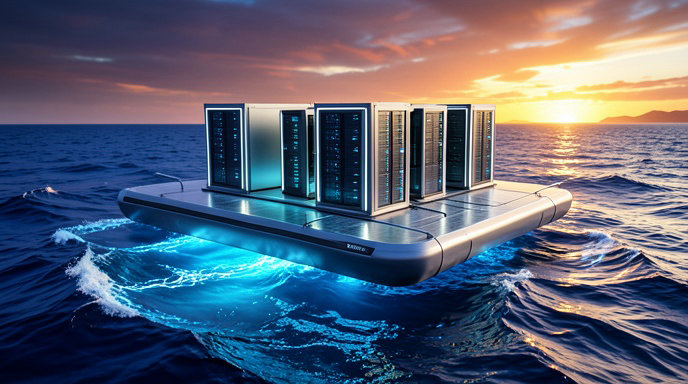
A new generation of data-center companies is looking beyond conventional power grids, industrial parks, and desert campuses. Drogue is pursuing a more radical alternative: placing data centers on floating vessels and using the ocean itself as both an energy source and a cooling system.
The startup’s concept is based on ocean thermal energy conversion, or OTEC. Tropical and subtropical oceans contain a persistent temperature difference between warm surface water and cold water found hundreds of meters below. Drogue aims to exploit that gradient to generate electricity for computing equipment while using the surrounding seawater to remove heat.
If the technology works at the required scale, it could offer data-center operators a new way to address three of the industry’s most pressing constraints: electricity availability, cooling demand, and access to suitable land.
The Ocean as a Giant Thermal Battery
OTEC systems generally work by using warm surface water to vaporize a working fluid, such as ammonia, in a closed-cycle system. The vapor drives a turbine to generate electricity before being condensed again using cold deep-sea water.
An alternative open-cycle design uses warm seawater itself. The water is placed in a low-pressure environment, where it boils at a lower temperature. The resulting steam can drive a turbine and may also be condensed into fresh water.
Drogue’s floating-data-center concept is expected to combine the power-generation and cooling advantages of this arrangement. Warm ocean water could provide the heat needed to produce electricity, while cold seawater could absorb heat from servers and other power electronics.
That could be particularly valuable for artificial-intelligence workloads. Modern AI systems rely on densely packed accelerators that consume large amounts of electricity and generate substantial heat. Many high-performance facilities are already moving toward liquid cooling because air-based systems are becoming less efficient at higher rack densities.
A vessel surrounded by seawater would have a potentially abundant heat sink. It could reduce dependence on large cooling towers and limit the need for freshwater, an increasingly important consideration as data centers expand into water-stressed regions.
Why Put Data Centers on Floating Vessels?
Building offshore would allow Drogue to separate computing infrastructure from some of the limitations of land-based development. A vessel would not require a large industrial site, extensive real-estate acquisition, or the same level of connection to an already-congested power grid.
The platform could theoretically be assembled in a shipyard, fitted with servers and power systems, and towed to an operating location. That approach might shorten construction schedules compared with building a hyperscale campus piece by piece.
Offshore deployment could also place computing capacity closer to renewable-energy resources. Depending on location, a vessel could potentially operate alongside offshore wind, floating solar, wave-energy systems, or other marine infrastructure. Drogue’s central proposition, however, is that the ocean’s thermal gradient could provide a more constant source of energy than intermittent renewables alone.
That distinction matters for data centers. Cloud and AI customers generally require reliable, around-the-clock power. OTEC is attractive in theory because the temperature difference between surface and deep water is available continuously, rather than only when the sun is shining or wind is blowing.
The Efficiency Question
The environmental case for Drogue’s approach will depend on the complete energy balance of the system.
OTEC is not a high-efficiency technology in conventional terms. The temperature difference between warm surface water and cold deep water is relatively small, meaning that large volumes of seawater must be moved to produce useful power. Pumps, pipes, heat exchangers, turbines, and water-treatment systems all consume energy and add complexity.
Drogue’s design therefore has to optimize more than electricity generation. The same infrastructure must also deliver cooling, reduce freshwater consumption, and support dense computing equipment. A system that produces modest net power but eliminates much of a facility’s cooling load could still be commercially compelling.
The company will also need to demonstrate a favorable power-usage effectiveness, or PUE, once pumps, communications systems, navigation equipment, corrosion protection, and other marine systems are included. The headline efficiency of the thermal cycle will matter less than the net energy available to servers.
Investor Backing and the Commercial Push
Drogue’s investor backing is intended to help finance the difficult transition from laboratory-scale thermal systems to an operational marine prototype. The company has presented its funding as support for engineering, vessel development, and the construction of an initial ocean-based demonstrator.
The precise scale and terms of private startup financing can be difficult to assess because early-stage companies do not always disclose complete details. What is clear is that Drogue’s fundraising reflects growing investor interest in infrastructure that links energy, computing, and climate technology.
The company’s pitch is aimed at more than data-center operators. Potential stakeholders include cloud providers, AI companies, shipping and offshore engineering firms, energy developers, and governments seeking new digital infrastructure without committing scarce land and freshwater resources.
Investors will likely judge Drogue on whether it can prove three things: that the platform can generate meaningful net power, that it can protect computing equipment in a harsh marine environment, and that the economics can compete with established grid-connected data centers.
A Two-Year Prototype Target
Drogue has set an ambitious goal of launching its first ocean-based prototype within approximately two years. Reaching that milestone would give the company an opportunity to test its technology under real-world conditions rather than relying solely on simulations or small laboratory installations.
The prototype would be expected to answer practical questions that cannot be resolved on paper. These include how efficiently the system can move warm and cold water, how the platform handles storms and waves, how heat exchangers perform over time, and how reliably the vessel can maintain network connectivity and power quality.
It would also provide data on the operational impact of saltwater exposure. Seawater is highly corrosive, and marine organisms can accumulate on submerged surfaces, a process known as biofouling. Both problems can reduce performance and increase maintenance costs.
The prototype’s computing payload may initially be modest. That would not necessarily undermine the concept. For Drogue, an early platform’s primary role is likely to validate the energy and cooling architecture, establish operating procedures, and generate the performance data needed to attract larger commercial partners.
The Hardest Engineering Problems
The ocean is a powerful resource, but it is also an unforgiving operating environment.
A floating data center must withstand waves, storms, salt spray, humidity, vibration, and potentially severe weather. Servers and power electronics require controlled conditions, while offshore equipment must be designed for long service intervals and limited access to technicians.
Deep-water pipes present another major challenge. OTEC systems need access to cold water at significant depths, requiring large-diameter intake pipes, pumps, structural supports, and flexible connections capable of moving with the vessel. Those systems must be strong enough to survive storms without becoming prohibitively expensive.
Maintenance is equally important. Traditional data centers are designed around regular access to equipment, replacement of failed components, and gradual expansion. A vessel at sea makes each of those tasks more complicated. Server modules may need to be highly standardized and hot-swappable, while critical equipment may require redundancy well beyond that used in ordinary facilities.
Environmental Questions and Regulation
Any project that pumps large quantities of seawater must address its ecological effects. Intake systems can harm marine organisms, while discharged water may differ in temperature, salinity, or nutrient content from the surrounding environment. The scale and location of those effects will determine the extent of environmental review.
Offshore data centers would also face a complex regulatory landscape. Depending on the deployment area, Drogue could need approvals relating to maritime safety, environmental protection, telecommunications, energy generation, vessel certification, and territorial waters.
Cable routes would require their own planning. A floating platform serving cloud customers would need resilient fiber connections, potentially through multiple undersea cable paths. Satellite links could provide backup connectivity, but they are unlikely to replace the bandwidth and latency characteristics of fiber for large-scale cloud and AI workloads.
Where Drogue Could Fit
The most plausible early markets may be locations with warm surface waters, access to deep cold water, strong digital demand, and limited availability of land or electricity.
Island nations and coastal industrial zones are obvious candidates. A floating platform could provide local computing capacity without requiring a new land-based campus and could potentially support desalination as a secondary benefit if the system uses an open-cycle design.
Another possibility is specialized offshore computing. Certain workloads, such as batch processing, scientific simulations, model training, and data analysis, may tolerate greater network latency than consumer-facing applications. A floating platform could process data near offshore wind farms, ocean-monitoring systems, shipping routes, or remote industrial operations.
The economics may also improve if Drogue can integrate several functions into one platform: power generation, cooling, fresh-water production, and computing. Multiple revenue streams could help offset the cost of building and maintaining marine infrastructure.
A Technology That Still Needs Proof
Drogue’s concept is compelling because it addresses several data-center bottlenecks at once. It offers a potential source of continuous renewable power, an abundant cooling medium, reduced freshwater demand, and a new path to deployment where land and grid capacity are scarce.
But the same integration that creates the opportunity also creates risk. The platform must function as a power plant, data center, ship, cooling system, communications hub, and environmental installation. Failure in any one of those areas could undermine the business case.
The company’s prototype target will therefore be more than a product launch. It will be a test of whether ocean thermal energy can support modern computing outside the controlled environment of a conventional facility.
If Drogue can demonstrate reliable net power, efficient cooling, manageable maintenance, and acceptable environmental performance, floating data centers could move from speculative climate-tech idea to a viable infrastructure category. If it cannot, the project will still reveal how difficult it is to combine marine engineering with the demands of energy-intensive computing.
For now, Drogue’s proposal remains an ambitious bet. Yet as AI increases the world’s appetite for electricity and cooling, unconventional data-center designs are becoming less experimental and more necessary. The ocean may not replace traditional data centers, but it could become an important part of the next generation of sustainable computing infrastructure.

Get All The Latest Updates Delivered Straight To Your Inbox For Free!