
Europe’s Tech Powerhouse: Atomico Urges the Continent to Own Its Startup Success Stories
TL;DR
- Atomico’s State of European Tech analysis argues that Europe has become a credible source of globally dominant technology companies, not merely a follower of Silicon Valley.
- The continent’s startup ecosystem is increasingly capable of turning research, engineering talent and ambitious founders into companies with worldwide reach.
- Europe’s challenge is to celebrate and retain its technology leaders while improving late-stage funding, stock-market access and cross-border growth conditions.
A stronger case for European technology
Europe’s technology industry is entering a more confident phase. For years, the continent’s startup ecosystem was often described in terms of what it lacked: fewer venture-capital dollars than the United States, less access to late-stage funding and a fragmented market divided by national borders.
Atomico’s State of European Tech work presents a different interpretation. Europe is not simply a promising market waiting to produce its first generation of world-class technology companies. It has already done so.
The report’s central message is both optimistic and challenging: Europe has created companies capable of competing globally, but it has not always been willing to claim them as European success stories. That matters because a strong technology ecosystem depends not only on founding new companies, but also on retaining talent, capital, headquarters and experienced leaders as businesses mature.
Stripe as a symbol of Europe’s potential
Stripe is one of the clearest examples of Europe’s ability to produce companies with global influence.
Founded by Irish brothers Patrick and John Collison, Stripe developed payment infrastructure that became essential to internet businesses around the world. Its customers range from early-stage startups to large multinational companies, and its products now support online payments, billing, fraud prevention and other elements of digital commerce.
Stripe’s story is frequently told through a Silicon Valley lens because the company built a major presence in the United States and attracted significant American investment. Yet its origins, founders and early connection to Ireland are an important part of the European technology story.
The company demonstrates how European founders can combine local roots with global ambition. It also shows that successful technology businesses do not need to choose between being European and being international. They can build across continents while preserving meaningful ties to the ecosystem in which their ideas first developed.
A growing record of global companies
Stripe is far from an isolated case. Europe has produced major companies in financial technology, enterprise software, online marketplaces, cybersecurity, gaming, artificial intelligence and climate technology.
Companies such as Spotify, Adyen, Revolut, Klarna, Wise, UiPath, Arm, Booking.com and DeepL have helped establish the continent as a source of globally competitive products. Some were founded in Europe and expanded internationally; others grew through a combination of European engineering, global capital and international markets.
The broader pattern is significant. Europe’s technology sector is no longer defined only by small, promising startups. It includes businesses with millions of customers, multinational workforces and the ability to shape entire industries.
That progress has also created a deeper pool of experienced founders and operators. Employees of successful startups often go on to establish new companies, invest in younger businesses or join venture funds. Over time, this creates a compounding effect: each generation of successful companies makes it easier for the next one to emerge.
Europe’s distinctive ecosystem
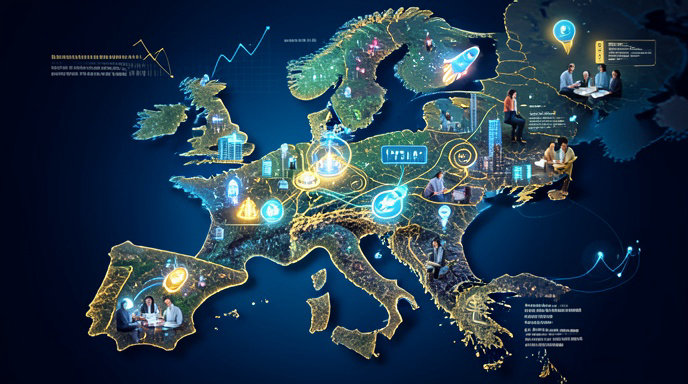
Europe’s technology advantage does not come from a single city or country. It is distributed across a network of startup hubs, research institutions and specialist markets.
London remains one of the continent’s largest centers for financial technology and venture capital. Paris has strengthened its position in artificial intelligence, deep tech and software. Berlin continues to attract founders and international talent, while Stockholm, Amsterdam, Dublin, Zurich, Cambridge, Munich, Barcelona, Lisbon, Tallinn and other hubs contribute expertise in areas ranging from climate technology to gaming and industrial engineering.
This geographic diversity can be an advantage. Europe offers access to a wide range of universities, technical talent, industrial companies and regulated markets. Its engineering base is particularly important in sectors such as robotics, aerospace, semiconductors, energy and healthcare.
The region also benefits from a large combined consumer market. Although Europe’s countries operate under different legal, tax and cultural conditions, the presence of the European Union’s single market gives companies a platform for expansion that is larger than any individual national economy.
The problem is that this potential is not always easy to unlock. A startup may need to navigate different languages, employment rules, tax systems, financial regulations and procurement processes as it expands. Europe can produce globally ambitious companies while still making their early growth more complicated than it needs to be.
The funding gap has moved beyond early-stage venture capital
European startups have made progress in attracting seed and early-stage investment. The more persistent challenge is scaling.
Once companies move from product development to international expansion, they often require far larger amounts of capital. This is where Europe has historically lagged behind the United States. American technology companies have benefited from deeper pools of growth capital, a larger domestic market and a stronger tradition of public-market investment in high-growth businesses.
European founders have sometimes responded by moving headquarters, listing shares overseas or accepting acquisition offers before their companies reach their full potential. These decisions can be rational for individual businesses, but they may weaken Europe’s ability to retain its most valuable technology companies.
Atomico’s argument is therefore not simply that Europe needs more startups. It needs more scaleups: companies that can grow from regional businesses into enduring global leaders while maintaining strong connections to Europe.
That requires more institutional investment, better access to late-stage funding and public markets that can support technology companies through periods of rapid expansion. It also requires pension funds and other large investors to participate more actively in venture and growth capital.
Keeping talent and leadership in Europe
Capital is only one part of the equation. Europe must also retain the people who know how to build large technology companies.
A successful startup creates a valuable network of engineers, product managers, sales leaders, designers, lawyers and finance professionals. When those people leave for the United States or other markets, Europe loses more than a headquarters. It loses accumulated knowledge that could otherwise support the next generation of businesses.
Immigration policy is consequently central to the technology debate. European companies compete globally for highly skilled workers, and complex visa systems can make it difficult to recruit the people they need. Easier movement for founders, researchers and specialist employees would strengthen the entire ecosystem.
Employee share ownership is another important issue. Stock options can help startups compete with established multinational companies, but tax treatment varies widely across Europe. Making equity compensation simpler and more attractive could help younger companies recruit and retain key employees.
Celebrating European success matters
The cultural dimension of Atomico’s message is just as important as the economic one.
European technology companies are often treated as exceptions rather than evidence of a broader trend. Their founders may be praised for overcoming European constraints instead of being recognized as products of European strengths, including world-class universities, technical education, public research and sophisticated industrial markets.
That narrative can influence ambition. If entrepreneurs believe the largest opportunities exist only in the United States, they may build with an early exit in mind or move elsewhere before their companies reach maturity.
Celebrating companies such as Stripe as European success stories does not require ignoring their international operations. In fact, their global reach is precisely what makes them valuable examples. The point is to acknowledge that European founders and institutions helped create businesses capable of competing on a worldwide stage.
A stronger narrative can also encourage more people to become founders, investors and employees in technology. Success creates confidence, and confidence helps ecosystems attract talent and capital.
Artificial intelligence raises the stakes
The debate has gained urgency because artificial intelligence is reshaping the technology industry.
Europe has significant strengths in AI research, mathematics, engineering and industrial applications. It is home to prominent AI companies and research groups, while its manufacturing, automotive, energy and healthcare sectors provide potential customers for new technologies.
However, AI also demands enormous computing resources, specialized talent and access to capital. European companies risk losing their best researchers and most promising startups if they cannot secure the resources needed to compete with large American and Asian technology groups.
The opportunity is not limited to building consumer-facing AI assistants. Europe could become especially influential in applied AI for manufacturing, medicine, scientific research, logistics, defense, energy and climate technology.
To realize that potential, policymakers will need to balance regulation with experimentation. Clear rules can build trust, but fragmented or unpredictable requirements may make it harder for startups to develop and deploy products. Europe’s ambition should be to create an environment where responsible innovation can happen at scale.
From fragmented markets to a connected ecosystem
Europe’s next phase will depend on whether its national technology hubs become more connected.
Founders should be able to recruit across borders, raise capital from investors throughout the continent, sell into a genuinely unified market and eventually list or remain headquartered in Europe without facing unnecessary structural disadvantages.
That will require continued work on digital-market rules, financial regulation, company formation, tax policy and public procurement. It will also require closer links between universities, research institutions, established industries and startups.
The continent does not need to copy Silicon Valley. Europe’s ecosystem can develop its own model, combining technical excellence with strengths in industrial technology, sustainability, healthcare and financial services.
But a distinct model should not become an excuse for accepting weaker growth conditions. European companies must have the freedom and resources to become as large and influential as their American and Asian competitors.
The next chapter belongs to Europe
Atomico’s broader message is that Europe has reached a point where modesty is no longer an advantage. The continent has demonstrated that it can produce companies with global reach, durable technology and enormous economic value.
The task now is to build the conditions that allow more of those companies to remain European as they scale.
That means celebrating founders such as the Collison brothers, recognizing the European roots of companies such as Stripe and investing in the networks that make similar outcomes more likely. It means treating technology as a core part of Europe’s economic future rather than as a niche sector concentrated in a handful of cities.
Europe’s startup story is already impressive. The next challenge is ensuring that its best chapters are not written elsewhere.

Get All The Latest Updates Delivered Straight To Your Inbox For Free!