
Google Dreambeans Comes to India with AI-Generated Personal Stories in 13 Languages
TL;DR
- Google’s DreamBeans experiment is coming to India with AI-generated personal stories in 13 Indian languages.
- Users can turn personal memories, ideas, and cultural references into illustrated narrative experiences.
- The project highlights Google’s effort to make generative AI more accessible across India’s diverse linguistic landscape.
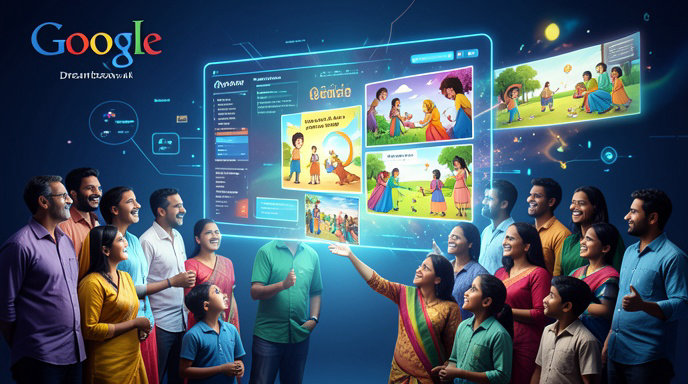
A new Google AI experiment is bringing personalized, machine-generated storytelling to India, allowing people to transform their memories, ideas, and everyday experiences into original stories.
Called DreamBeans, the project is designed to make generative AI feel more personal and approachable. Rather than focusing only on productivity or search, it explores how artificial intelligence can help people create stories rooted in their own lives, languages, and cultural settings.
The India launch supports 13 Indian languages, a significant step for a country where language remains one of the biggest barriers to accessing digital services and emerging technologies.
A Storytelling Experiment Built Around Personal Memories
DreamBeans invites users to provide a prompt or personal idea that can be developed into a customized story. That starting point might be a childhood memory, a family tradition, a travel experience, a dream, or an imagined adventure.
The system then uses generative AI to shape the idea into a narrative. Depending on the experience, the resulting story may include characters, settings, plot developments, and visual elements designed to make it feel more immersive.
The goal is not simply to generate generic fiction. DreamBeans is intended to make the output feel connected to the individual using it, creating stories that reflect personal details and interests while demonstrating how AI can support creative expression.
Designed for India’s Multilingual Audience
The experiment’s support for 13 Indian languages is central to its launch. India has hundreds of spoken languages and dialects, but many digital products still work best in English or a small number of widely supported languages.
By making DreamBeans available in a broad selection of Indian languages, Google is testing whether generative AI storytelling can reach users who may not be comfortable interacting with technology in English.
Language support also affects more than translation. A convincing personal story must account for local expressions, names, cultural references, family relationships, and storytelling traditions. The quality of the experience will therefore depend on how naturally DreamBeans handles the nuances of each supported language.
For users, the ability to describe an idea in a familiar language could make the technology feel less like a technical demonstration and more like a creative tool for everyday use.
From Prompt to Personalized Narrative
Generative AI storytelling typically involves several stages. A user supplies a prompt, the system interprets the subject and tone, and an AI model produces a narrative based on those instructions. Additional systems may help organize the story, generate images, or adapt the final result to a particular language.
DreamBeans places the emphasis on the personal input behind the prompt. A simple request can be expanded into a richer narrative, potentially allowing users to see ordinary experiences from a new perspective.
That approach could appeal to families creating stories for children, students experimenting with creative writing, or people looking to preserve memories in a more imaginative format. It also offers a way for users to explore AI without needing specialist knowledge of prompting or software development.
Google’s Broader AI Push in India
The DreamBeans launch comes as Google continues to expand its artificial-intelligence products and research initiatives in India. The company has been adding support for Indian languages across search, translation, mobile services, and generative AI tools.
India is strategically important for technology companies because of its large online population, fast-growing digital economy, and linguistic diversity. Products that work well in the country can provide valuable insight into how AI should be designed for multilingual and multicultural markets.
DreamBeans is particularly notable because it focuses on creativity and entertainment rather than a conventional business task. It gives Google an opportunity to study how people use AI to express themselves, share experiences, and build content in their preferred languages.
The experiment may also help Google understand how users respond to AI-generated material when the subject is deeply personal. That includes questions about tone, cultural sensitivity, accuracy, and the boundary between a helpful creative tool and an automated system that invents details users never provided.
The Challenges of AI-Generated Personal Stories
Personalization can make an AI experience engaging, but it also introduces risks. Generative systems may add details that are inaccurate, misunderstand a prompt, or produce language that sounds unnatural or culturally inappropriate.
These issues can become more noticeable when stories involve family members, regional traditions, religious references, or emotionally significant memories. A story that feels imaginative in one context could feel insensitive or misleading in another.
Privacy is another important consideration. Users may share names, locations, family histories, or other personal information when creating a story. As with any generative AI service, people should understand how their inputs are handled and avoid submitting sensitive information unless they are comfortable with the relevant terms and protections.
Google’s experiment will also need to address the uneven performance of AI models across languages. A system may generate fluent output in one language while producing awkward phrasing, incorrect grammar, or limited vocabulary in another. The India launch provides a real-world test of how well multilingual storytelling can work beyond English.
A More Inclusive Direction for Generative AI
The significance of DreamBeans extends beyond storytelling. It reflects a broader shift in the AI industry toward making advanced tools accessible through local languages and familiar cultural contexts.
For many users, the value of AI will not be determined only by the sophistication of the underlying model. It will also depend on whether the system understands how people communicate at home, in their communities, and in everyday life.
By supporting 13 Indian languages, DreamBeans positions storytelling as a way to introduce more people to generative AI. The format is approachable, visual, and personal, making it easier for users to experiment with the technology without treating it as a complex technical platform.
What Comes Next for DreamBeans
As an experiment, DreamBeans may evolve based on user feedback and usage patterns. Google could eventually expand its language coverage, add more control over characters and story styles, or connect the experience with other creative tools.
Future versions might also offer ways to edit, share, narrate, or turn stories into short animated experiences. However, those possibilities will depend on how Google evaluates the experiment and whether users find the generated stories genuinely useful and enjoyable.
For now, DreamBeans represents an exploration of what happens when generative AI is placed in a highly personal and multilingual setting. Its success will depend not only on the novelty of creating an AI-generated story, but on whether the stories feel natural, respectful, and meaningful to the people who inspire them.

Get All The Latest Updates Delivered Straight To Your Inbox For Free!