
Meta, Google, and TikTok Challenge California’s Under-16 Social Media Law
TL;DR
- Meta, Google and TikTok are challenging California’s new restrictions on social-media access for children under 16, arguing that the law violates the First Amendment and is too broad.
- California says the measure is designed to limit addictive platform features and protect children from harms linked to excessive social-media use.
- The case could determine how far states may go in regulating recommendation algorithms, age verification, parental consent and children’s online privacy.
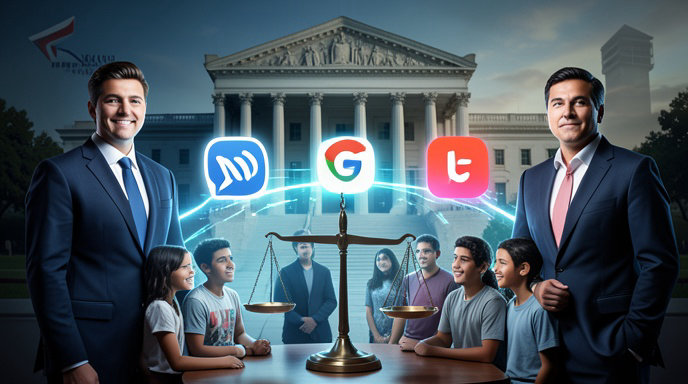
California’s effort to limit social-media access for children under 16 is facing a major legal challenge from some of the technology industry’s largest companies.
Meta, Google and TikTok are suing California Attorney General Rob Bonta, arguing that the state’s child-safety law improperly restricts constitutionally protected speech and places unrealistic obligations on online platforms. California, meanwhile, maintains that the law is a reasonable response to evidence that some social-media services are designed to maximize engagement among young users, even when prolonged use may harm their mental health or well-being.
The dispute is likely to become one of the most consequential technology cases in the country. Beyond California, the lawsuit could influence how states regulate recommendation systems, age assurance, parental consent and the collection of data about children.
A Fight Over Access and Addictive Features
The California law is aimed at limiting young teenagers’ access to social-media services and the features that keep users returning. Depending on how the statute is ultimately interpreted and enforced, platforms could be required to impose age-based restrictions, obtain parental permission or disable certain personalized and engagement-driven functions for younger users.
Those functions can include algorithmically recommended feeds, autoplay, push notifications, personalized suggestions and other tools designed to increase the amount of time people spend on a service.
California lawmakers have framed the legislation as a child-protection measure rather than a general ban on speech. The state says children would still be able to access information and communicate online, but platforms would face tighter limits on how they use recommendation systems and engagement mechanics with younger users.
The companies challenging the law argue that this distinction is not as clear as California suggests. Recommendation systems, they say, are part of the platforms’ editorial and expressive choices. Requiring services to replace personalized feeds with chronological or otherwise limited feeds could therefore amount to government control over the way platforms organize and present speech.
The Companies’ First Amendment Arguments
The technology companies are expected to make several overlapping arguments in court.
First, they contend that the law regulates protected expression. Social-media platforms do more than host user posts, the companies say. They select, rank and present content, and those decisions are a form of editorial judgment protected by the First Amendment.
Second, the companies argue that the statute is too broad. A rule aimed at harmful or addictive design could also affect educational content, news, political discussion, entertainment and ordinary communication between young people. In the companies’ view, California cannot restrict large categories of lawful online activity simply because some features may be misused or may present risks to certain users.
The lawsuit may also challenge the law as vague. Platforms could face uncertainty over which products qualify as social media, which features are considered addictive, how age restrictions must operate and what steps are sufficient to demonstrate compliance. Vague requirements can create legal risk and encourage companies to remove or limit lawful content, the industry argues.
The companies are also likely to contend that California has attempted to regulate services used nationwide. If platforms must create special systems for California users, they say, the state could effectively impose its rules on the design of products available throughout the country.
California’s Child-Safety Case
California says the companies’ arguments overlook the special risks faced by children and teenagers online.
State officials point to research associating heavy or problematic social-media use with sleep disruption, anxiety, depression, cyberbullying, body-image concerns and other harms. They also argue that many platforms use sophisticated behavioral techniques to prolong engagement, including notifications, streaks, personalized recommendations and automatically refreshed feeds.
From California’s perspective, the law does not prohibit companies from carrying speech. Instead, it regulates the way platforms interact with children and limits design choices that can encourage compulsive use.
The state is also expected to argue that it has a strong interest in protecting minors, an interest courts have historically recognized in areas such as advertising, privacy and consumer safety. California may emphasize that the law focuses on platform conduct and product design rather than on suppressing particular viewpoints.
The legal challenge will test whether courts accept that framing. If judges view the law as a restriction on how platforms organize speech, the First Amendment analysis could become substantially more demanding.
The Difficult Problem of Age Verification
Enforcing an under-16 restriction creates a major privacy problem of its own: platforms must determine who is under 16 without collecting excessive personal information.
Basic methods such as self-declared birth dates are easy to evade. More rigorous approaches could require government identification, biometric analysis, third-party age-estimation services or the use of information from app stores and operating systems.
Each option carries risks. Identity checks can expose sensitive personal data, while facial or voice analysis can produce inaccurate results and raise concerns about biometric surveillance. Age-estimation tools may also perform differently across demographic groups. Parents and civil-liberties advocates worry that systems introduced to protect children could eventually be used to track or profile everyone online.
The technology companies are likely to argue that California’s requirements force them to build extensive age-verification systems without providing clear privacy safeguards. The state will counter that platforms already collect substantial amounts of data and should not be allowed to use privacy concerns as a reason to avoid protecting children.
The conflict illustrates the central tension in online child-safety regulation: effective enforcement generally requires more information about users, while strong privacy protection requires companies to collect and retain less.
What the Law Could Mean for Families
For families, the practical effects could vary significantly by platform and by the final outcome of the lawsuit.
Children under 16 could encounter blocked accounts, restricted recommendations, limited messaging or prompts asking them to involve a parent. Parents might gain more control over time limits and account settings, but they could also face additional verification steps and more responsibility for approving or managing access.
Some families may welcome stronger default protections, particularly parents who struggle to monitor how much time their children spend online. Others may object to government involvement in family decisions or worry that age checks will prevent teenagers from accessing support communities, educational resources or information about sensitive subjects.
The law could also affect children who use social platforms for creative work, small businesses, school activities or communication with relatives. A blunt restriction may create obstacles for legitimate uses even if its primary goal is to curb harmful engagement patterns.
Possible Consequences for Platforms
If the law survives, platforms may have to create California-specific products or apply the restrictions more broadly across the United States.
Large companies could absorb the compliance costs by redesigning feeds, changing notification systems and building parental-control tools. Smaller services may find those requirements more difficult to meet, potentially encouraging consolidation in the social-media market or prompting some companies to stop serving younger users altogether.
Platforms may also respond by limiting functionality for all users in order to avoid determining who is under 16. That could reduce privacy risks associated with age checks, but it would also mean that adults lose access to features because of rules intended to protect children.
The case could further accelerate a shift away from personalized feeds for minors. Services might provide chronological timelines, stronger default filters, reduced notifications and narrower messaging options. Whether those changes improve children’s well-being will depend on how they are implemented and whether young users simply move to less-regulated services.
A Broader State-by-State Battle
California is part of a growing national effort to regulate children’s online experiences. States have pursued laws addressing social-media design, parental consent, online privacy, age verification and platform liability.
The technology industry has challenged many of these measures, often arguing that states are creating conflicting obligations for services that operate across the country. Courts have reached different conclusions, producing uncertainty for both lawmakers and platforms.
A ruling in California could provide a framework for deciding whether states may regulate recommendation algorithms as product features, expressive conduct or consumer-protection matters. It could also influence whether similar laws in other states move forward or are rewritten to avoid constitutional problems.
Congress has considered children’s online-safety legislation for years, but the absence of a single federal standard has left states to experiment with their own approaches. That patchwork increases the importance of the California lawsuit.
What Happens Next
The court will first consider whether the law should be blocked while the lawsuit proceeds. A preliminary ruling could determine whether platforms must begin preparing for the law’s effective date or whether enforcement will be paused during years of litigation.
The case may then focus on the law’s definitions, its enforcement mechanisms and the constitutional status of algorithmic recommendations. The Supreme Court could ultimately be asked to decide how the First Amendment applies to the design of large online platforms when the affected users are children.
The outcome is far from certain. California may be able to defend targeted requirements involving parental controls, notifications or data practices while losing broader restrictions on access or recommendations. The companies, meanwhile, may succeed in delaying enforcement even if they do not win a complete judgment invalidating the law.
For now, the lawsuit places California’s child-safety strategy—and the technology industry’s preferred model of online personalization—on a collision course. The decision will help establish whether protecting children online permits governments to regulate the architecture of social media, or whether those rules go too far into the editorial and expressive choices of private platforms.

Get All The Latest Updates Delivered Straight To Your Inbox For Free!