
OpenAI and the 2028 Election: Chris Lehane’s Vision for AI and a New Social Contract
TL;DR
- OpenAI executive Chris Lehane has argued that AI could become a major intermediary between voters, government and political candidates by the 2028 U.S. election.
- The vision could make public services, policy research and voter information more accessible, but it also raises serious questions about manipulation, bias, privacy and democratic accountability.
- OpenAI’s commercial interests complicate the proposal: a company seeking a central role in civic life would also control the systems, infrastructure and rules that shape political participation.
A New Role for AI in American Politics
The debate over artificial intelligence and elections is moving beyond concerns about deepfakes, automated propaganda and campaign chatbots. A more ambitious question is emerging: Could AI become part of the basic infrastructure through which Americans understand government, evaluate policy and interact with public institutions?
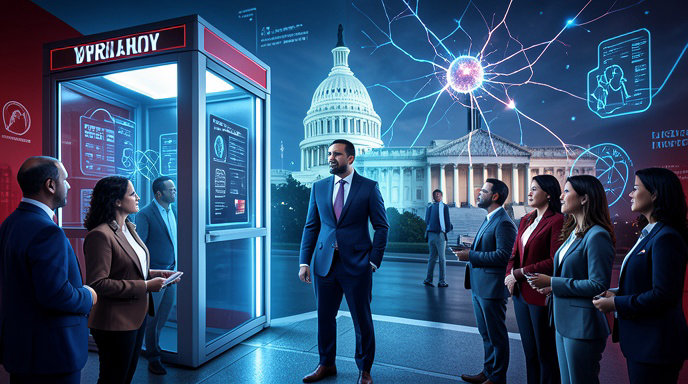
That question sits at the center of Chris Lehane’s vision for the 2028 U.S. election. Lehane, OpenAI’s global-affairs executive, has described a future in which AI plays a defining role in the relationship between citizens and the state. In that model, AI would not merely help campaigns write speeches or target advertisements. It could help voters compare proposals, navigate government services, understand complex legislation and communicate their priorities to elected officials.
The idea amounts to a proposed new social contract between technology companies, governments and the public. It also places OpenAI at the center of a debate over who should build and govern the tools that increasingly mediate public life.
From Election Tool to Civic Infrastructure
Political technology has traditionally focused on persuasion. Campaigns use data to identify likely supporters, tailor messages and mobilize voters. Lehane’s concept points toward a broader role for AI: an always-available civic assistant capable of translating policy into plain language and helping individuals participate in government.
A voter could, in theory, ask an AI system to explain how a tax proposal would affect a household, compare candidates’ positions, locate relevant public benefits or summarize the arguments surrounding a ballot measure. The same systems might help people draft comments on proposed regulations, contact representatives or track whether officials followed through on campaign commitments.
For Americans who find government difficult to navigate, such tools could offer practical benefits. Government programs are often divided among agencies, written in technical language and accessed through outdated digital systems. An effective AI assistant could make those systems easier to use, particularly for people with limited time, language barriers or disabilities.
AI could also lower the cost of political participation. Citizens would not need to read hundreds of pages of legislation or follow every procedural development in order to form an informed view. In principle, an AI system could provide background information, identify trade-offs and present competing perspectives in a more accessible format.
The critical qualification is “in principle.” Whether these systems genuinely broaden participation would depend on how they are trained, what sources they use and whose interests influence their design.
The Promise of More Informed Voters
Supporters of AI in civic life see a chance to address one of democracy’s persistent weaknesses: the gap between the amount of information available to voters and the limited time they have to interpret it.
An AI system could synthesize public records, campaign platforms, legislative histories, economic data and local reporting. It could personalize explanations without necessarily reducing them to slogans. A user interested in housing, for example, might receive a structured comparison of zoning proposals, their likely effects on rents and the arguments offered by supporters and opponents.
The technology could also help correct an imbalance in political attention. National campaigns and well-funded interest groups have sophisticated communications operations, while local governments and ordinary citizens often lack comparable resources. Public-interest AI tools could help residents monitor local decisions, understand budgets and identify opportunities to participate.
Government agencies might benefit as well. AI could assist with translating documents, answering routine questions, detecting fraud and helping officials manage large volumes of public input. Properly designed systems could free civil servants from repetitive administrative work and allow them to focus on more complex cases.
That vision is attractive because it treats AI as a potential public utility rather than solely as a commercial product. But making that transition would require more than deploying a chatbot on a government website. It would require transparent standards, independent oversight and clear rules governing the system’s authority.
The Influence Problem
The same system that helps voters understand politics could also influence what they believe matters. An AI assistant does not need to endorse a candidate explicitly to shape an election. It could influence users through the questions it asks, the sources it highlights, the issues it treats as central and the language it uses to describe competing proposals.
Search engines and social-media platforms have already demonstrated that information systems can affect public attention without issuing direct political instructions. Generative AI could make that influence more personal and persuasive. Instead of showing the same list of links to millions of users, an AI system could deliver individualized explanations in a conversational tone, adapting its response to each person’s concerns and assumptions.
That creates a difficult distinction between assistance and persuasion. If an AI system helps a voter clarify their own priorities, it may strengthen democratic agency. If it subtly steers the voter toward a preferred interpretation, it becomes a political actor—whether or not the company describes it that way.
Transparency would therefore be essential. Users would need to know which sources an AI system consulted, how it handles uncertainty and whether its responses are affected by commercial relationships or political partnerships. They would also need meaningful ways to challenge errors and obtain competing viewpoints.
Trust, Accuracy and the Problem of False Confidence
AI systems can produce incorrect or misleading information while presenting it with confidence. In an election, a fabricated policy quotation, inaccurate voting instruction or distorted summary could cause real harm.
The danger is not limited to obvious hallucinations. A response can be technically accurate while still misleading because it omits important context, presents a disputed claim as settled or gives disproportionate attention to one side. Political issues often involve judgments and trade-offs that cannot be reduced to a single objectively correct answer.
The 2028 election could also be a test of how AI systems respond to rapidly changing events. Candidates may alter their positions, courts may issue major rulings and election officials may publish new procedures. Systems that rely on outdated information could mislead voters at precisely the moments when accurate guidance matters most.
Any civic AI platform would need robust source verification, clear timestamps and prominent uncertainty notices. It would also need processes for correcting errors quickly. Those safeguards are harder to implement when a system operates across thousands of jurisdictions with different laws, voting procedures and administrative practices.
Democratic Accountability and the Private-Sector Gatekeeper
A central concern is accountability. Elected officials can be challenged by voters, investigated by journalists and constrained by law. Technology companies are accountable primarily to executives, boards, investors and regulators.
If a private AI platform becomes the main way millions of people receive political information, the company could acquire a role resembling that of a public institution without being governed like one. Decisions made by product teams—such as which sources to trust, how to handle controversial questions or when to refuse a response—could influence democratic debate on a large scale.
That power would be particularly sensitive during an election. A platform might be pressured by governments, campaigns, activists or its own employees. It could face demands to remove alleged misinformation, suppress foreign influence operations or limit political manipulation. Each intervention might be defensible in isolation, while the overall system becomes increasingly difficult for the public to inspect.
OpenAI and other AI companies have argued that safety measures are necessary to prevent abuse. Critics respond that safety decisions can themselves become forms of political power. The challenge is to establish rules that protect elections without allowing a small number of companies to define the boundaries of acceptable political speech.
OpenAI’s Business Interests
OpenAI’s role in this debate cannot be separated from its business model and strategic ambitions. The company is competing to make its models a foundational layer for consumer software, enterprise services and public-sector applications. Civic use cases could increase adoption, strengthen relationships with governments and reinforce the idea that OpenAI’s systems are essential infrastructure.
That creates an unavoidable conflict of interest. A company may sincerely believe that its technology can improve democracy while also benefiting financially and strategically from widespread dependence on it.
The issue is not unique to OpenAI. Search companies, social networks, cloud providers and data brokers have all faced questions about whether commercial incentives distort the information environments on which public life depends. AI makes the issue more consequential because conversational systems can do more than distribute information. They can interpret, prioritize and respond.
Any proposal that gives OpenAI a prominent role in elections would therefore need safeguards that go beyond the company’s own policies. Independent audits, public reporting, conflict-of-interest rules and enforceable limits on political targeting could help. So could interoperability requirements that allow governments and civic organizations to use multiple systems rather than relying on one provider.
The Risk of Unequal Access
AI could expand participation, but it could also deepen inequality. Wealthier campaigns, organizations and communities may gain access to more capable models, better data and specialized political analysis. Voters using free tools could receive generic or limited assistance while influential groups deploy systems optimized for fundraising, persuasion and turnout.
Language access presents another challenge. An AI platform may support major languages while performing less reliably in regional dialects or minority languages. Errors could be especially damaging when systems are used to interpret legal rights, registration requirements or public benefits.
Accessibility must also be considered. Voice interfaces could help people with visual or motor disabilities, but automated systems may struggle with speech differences or assistive technologies. A civic AI system that becomes the default gateway to government should never be the only gateway.
Human institutions would still matter. Voters need access to election officials, public records, independent journalism, libraries, advocacy groups and community organizations. AI should supplement those institutions, not quietly replace them.
A New Social Contract Requires Public Rules
Lehane’s proposal is significant because it frames AI as part of a broader renegotiation of the relationship between citizens, government and technology. The central question is not simply whether AI will be used in the 2028 election. It almost certainly will be. The question is who will set the terms.
A credible social contract for civic AI would need several elements.
First, systems should disclose when users are interacting with AI and identify the sources behind factual claims. Second, political recommendations should not be personalized in ways that conceal their persuasive intent. Third, companies should maintain auditable records of major system changes during election periods.
Fourth, governments and independent researchers should have access to testing environments and relevant performance data. Fifth, voters should have a right to appeal or correct significant errors. Finally, essential election information must remain available through human-run and noncommercial channels.
These principles would not eliminate disagreement over bias or misinformation. They would, however, make the systems’ power more visible and contestable.
The 2028 Test
By the 2028 election, AI may be embedded in campaign operations, news production, government services and everyday voter research. The technology could help Americans participate more effectively—or create a new layer of invisible influence between citizens and political institutions.
Chris Lehane’s vision asks the public to imagine the more ambitious possibility: AI as a civic intermediary and a defining component of democratic life. That vision deserves serious consideration because it identifies real problems, including inaccessible government, information overload and the high cost of political participation.
But the proposal also highlights a central paradox. The more useful AI becomes as a guide to public life, the more power its creators acquire. A system designed to help voters make independent decisions could become one of the most influential political actors in the country without appearing on any ballot.
The future of election AI should therefore be judged not only by what the technology can do, but by who controls it, how its decisions can be challenged and whether citizens remain capable of participating without it. A new social contract will succeed only if AI serves democracy without becoming its unelected gatekeeper.

Get All The Latest Updates Delivered Straight To Your Inbox For Free!