
Orbital Matter 3D-Prints First Rigid Beam in Space, Advancing In-Orbit Construction
TL;DR
- Orbital Matter reports that it 3D-printed a rigid structural beam in the vacuum of space, a milestone for manufacturing hardware away from Earth.
- The demonstration could help future missions build larger structures in orbit instead of launching them fully assembled.
- The technology remains an early proof of concept: durability, scale, automation, inspection and long-term performance still need to be demonstrated.
A small beam could represent a major change in how spacecraft and orbital infrastructure are designed.
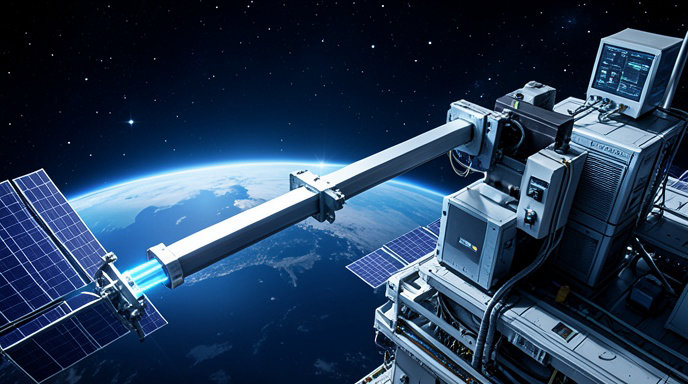
Orbital Matter has reported successfully 3D-printing a rigid beam in the vacuum of space, demonstrating that structural components can be manufactured outside Earth’s atmosphere. The achievement is being presented as an important step toward in-orbit construction, where spacecraft, platforms and other large systems could be assembled or expanded after launch.
The demonstration does not yet amount to a space-based factory. However, it addresses one of the central challenges of orbital manufacturing: whether a printing process can create a solid, load-bearing part without the controlled conditions available on Earth.
A Structural Part Made in Vacuum
Most 3D-printing systems operate in air and depend on carefully managed temperature, pressure and material flow. Printing in space introduces a different set of problems. In a vacuum, volatile compounds can evaporate, materials can behave differently as they cool, and the absence of gravity changes how liquids and partially formed layers move.
Orbital Matter’s reported result indicates that its process can deposit and solidify material into a beam-like structure under those conditions. The significance lies not only in producing a recognizable shape, but in creating a rigid component that could potentially serve a structural purpose.
The company has described the result as the first rigid beam 3D-printed in space. As with many emerging space demonstrations, the claim should be understood in the context of the specific material, equipment and mission conditions involved. Independent testing will be important to establish the beam’s mechanical strength, dimensional accuracy and resistance to the harsh orbital environment.
Why Manufacturing in Orbit Matters
Launch vehicles impose strict limits on the size and shape of anything sent into space. Large spacecraft and antennas must fit inside a rocket’s fairing, then unfold or deploy once they reach orbit. That approach works, but it adds complexity and places constraints on the final structure.
Manufacturing components in orbit could offer a different model. Rather than launching a fully assembled structure, operators could send up compact feedstock and produce parts when and where they are needed. Robotic systems could then join those parts into larger platforms.
This could be particularly useful for long beams, trusses, antenna supports, solar-array structures and protective frameworks. Such components may be difficult to fold efficiently but relatively straightforward to fabricate or assemble in space.
The approach could also reduce the need to launch spare structures from Earth. A spacecraft equipped with manufacturing equipment and raw material might produce replacement parts or modifications during a mission, potentially improving resilience and extending operational lifetimes.
From a Beam to Larger Infrastructure
A single printed beam is far removed from a complete orbital construction system. Future platforms would require many additional capabilities, including precise robotic handling, joining methods, inspection tools and software capable of coordinating construction without continuous human supervision.
The printed parts would also need to meet demanding engineering requirements. A structural component in orbit must tolerate launch vibration if it is produced before deployment, thermal cycling between sunlight and shadow, radiation exposure and the mechanical stresses created during assembly and operation.
Connections may prove just as important as the printed components themselves. A strong beam is of limited use if it cannot be reliably joined to other beams, panels or equipment. Orbital construction systems may therefore combine additive manufacturing with robotic assembly, welding, fastening or other bonding techniques.
Quality assurance is another major hurdle. On Earth, manufacturers can use large inspection machines, destructive testing and human technicians. In orbit, inspection must be compact, automated and highly reliable. Cameras, laser scanners, ultrasound systems and other sensors could be used to verify each part before it becomes part of a larger structure.
The Potential Role of Orbital Data Centers
The demonstration arrives as the space industry considers whether some computing workloads could eventually move into orbit. Companies and researchers have proposed orbital data centers powered by solar energy, with the vacuum of space providing a naturally cold environment for heat rejection.
Large orbital data centers would require more than servers. They would need extensive solar-power systems, radiators, communications equipment, shielding and structural support. Launching all of that as a completed facility could be expensive and operationally restrictive.
In-orbit manufacturing could make larger computing platforms more practical by allowing their supporting infrastructure to be built or expanded over time. Beams and trusses could support additional solar arrays, radiators and equipment modules, while robotic systems could perform much of the construction.
There are still significant unanswered questions. Space-based data centers would need reliable high-bandwidth links, secure operations, radiation-tolerant hardware and an economically viable way to replace or upgrade equipment. Their environmental impact, orbital congestion and end-of-life disposal would also require careful consideration.
The demonstration does not prove that orbital data centers are commercially ready. It does show why structural manufacturing is relevant to the concept: large facilities may be easier to assemble in stages than to launch in one piece.
The Challenges Ahead
The first challenge is scaling. Printing one beam is a useful demonstration, but future construction systems may need to manufacture components measured in meters or more while maintaining consistent quality across long print runs.
Material selection will be equally important. A feedstock must be light enough to launch economically, stable during storage and capable of producing parts with predictable mechanical properties. It must also tolerate the temperature and radiation conditions expected during the mission.
Thermal control presents another difficulty. A printer in vacuum cannot rely on convection to remove heat. The system must manage heat through conduction and radiation, potentially affecting print speed and the quality of each layer.
Automation will be essential. Communication delays and limited crew time mean that many manufacturing tasks must be completed autonomously. The equipment will need to detect defects, compensate for variations and pause safely when conditions fall outside operating limits.
Finally, the economics remain uncertain. In-orbit manufacturing will compete with improved folding mechanisms, lighter materials, larger launch vehicles and increasingly capable robotic assembly systems. The technology will need to offer a clear advantage in cost, performance or mission flexibility.
A Step Toward Construction Beyond Earth
Orbital Matter’s reported rigid-beam demonstration is best viewed as an enabling milestone rather than a finished product. It suggests that additive manufacturing can move beyond producing small experimental objects and begin addressing the structural requirements of future spacecraft.
If subsequent tests confirm the beam’s strength and durability, the technology could contribute to a broader shift in spacecraft design. Missions might launch compact manufacturing systems and raw materials, then build structures tailored to their destination and purpose.
That vision could support larger antennas, expanded solar-power platforms, servicing facilities and eventually more ambitious orbital infrastructure. It could also reduce the pressure to design every spacecraft around the dimensions of a rocket fairing.
The path from one printed beam to a functioning orbital construction yard will be long. But by demonstrating that a rigid structural element can be produced in the vacuum of space, Orbital Matter has highlighted a key possibility: future infrastructure may not have to be fully built on Earth before it begins its journey into orbit.

Get All The Latest Updates Delivered Straight To Your Inbox For Free!