
Pokémon Go to the Polls: How Hillary Clinton’s 2016 Gaffe Became a Gen Z Rallying Cry
TL;DR
- Hillary Clinton’s July 2016 “Pokémon Go to the polls” line fused a presidential campaign with the summer’s biggest mobile-game craze.
- The remark became a meme because it captured both the promise and awkwardness of politicians trying to speak to young, internet-native voters.
- In 2026, the phrase endures less as a gaming reference than as shorthand for youth turnout, political disappointment and the hope that participation can still change the map.
A Campaign Sound Bite Finds a Second Life
In the summer of 2016, Pokémon Go was everywhere. Players crossed parks, college campuses and city streets hunting virtual creatures through their phone cameras. Businesses tried to lure players with in-game bonuses, while public officials debated the safety and social effects of augmented-reality gaming.
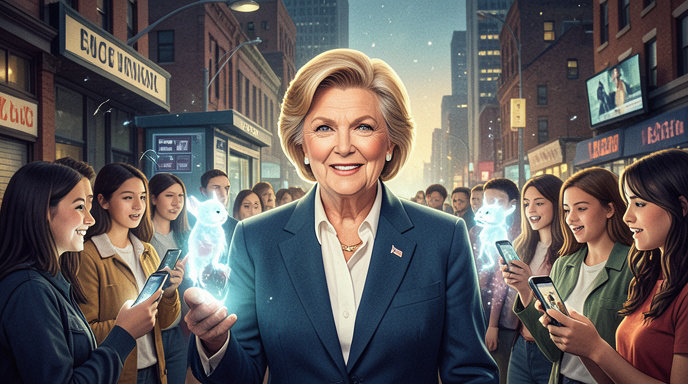
Hillary Clinton’s presidential campaign quickly noticed the cultural moment. During a campaign appearance that July, Clinton joked that the game’s players should “Pokémon Go to the polls.”
The line was intended as a lighthearted appeal to young voters. Instead, it became one of the most recognizable political memes of the 2016 election.
The joke worked because it compressed several forces into a single sentence: a presidential campaign attempting to sound digitally fluent, a new generation being courted through pop culture and the persistent belief that technology could make civic participation more engaging.
It also sounded slightly forced. That tension helped the phrase travel.
Why the Line Went Viral
The remark arrived at the perfect moment for internet circulation. Pokémon Go had become a global phenomenon almost overnight, and social platforms were still particularly effective at turning short clips and screenshots into shared cultural references.
Clinton’s line was easy to repeat, remix and parody. It could be used sincerely by people encouraging voter registration, ironically by critics of campaign messaging or humorously by anyone comparing electoral politics with a mobile game.
The phrase also exposed a familiar problem in political communication: the difference between understanding a culture and borrowing its vocabulary.
For many younger voters, Pokémon Go was not merely a popular app. It was a shared experience that temporarily changed how people occupied public space. Players organized meetups, walked farther than usual and formed communities around a game that blended nostalgia with location-based technology.
When a politician used that experience as a metaphor for voting, the result felt both clever and conspicuously strategic.
The 2016 Internet Meets Electoral Politics
The Pokémon Go remark belonged to an era when campaigns were becoming more attentive to online culture but had not yet fully adapted to the language of meme politics.
Candidates were no longer communicating only through speeches, television advertisements and newspaper interviews. They were speaking into a fragmented media environment shaped by YouTube clips, Facebook posts, Twitter jokes and rapidly changing online communities.
Yet many campaign messages still followed older rules. They were written by consultants, delivered at rallies and designed to generate a favorable headline. The “Pokémon Go to the polls” line landed differently because internet culture rewards spontaneity, absurdity and remixability more than polished messaging.
That made it unusually durable. The phrase was not just a slogan. It became evidence in an argument about whether political institutions could genuinely connect with younger citizens.
To supporters, it was a playful and memorable turnout message. To detractors, it was an example of a candidate trying to translate a youth phenomenon into campaign branding. To observers, it was a snapshot of a political class learning that cultural relevance cannot be manufactured simply by mentioning the right app.
From Gaffe to Cultural Artifact
Calling the remark a “gaffe” is somewhat misleading. Clinton did not make a major factual error, and the comment was clearly intended as humor. Its transformation into a gaffe came from the way it was clipped, repeated and detached from its original context.
Online culture often treats awkwardness as a form of authenticity. A line that sounds overly calculated can become more memorable than a carefully written policy speech. In that sense, the remark succeeded on the internet even if it was not a conventional campaign triumph.
It also reflected the political mood of 2016. The election was marked by distrust of institutions, anxiety about the future and a sense that traditional political language was losing its power. A reference to a mobile game could seem refreshingly accessible—or painfully inadequate to the seriousness of the moment.
That ambiguity kept the meme alive. It could mean “politicians should meet young people where they are,” but it could also mean “politicians do not understand young people at all.”
Why the Phrase Resonates With Gen Z
For Gen Z, the line is partly historical trivia and partly a compact symbol of the contradictions surrounding youth politics.
Many members of the generation were children or teenagers in 2016. They encountered the phrase through memes, retrospective videos and discussions of the election rather than through the original campaign event. Its meaning has therefore been inherited and reinterpreted.
The phrase now evokes a period when social media promised to make politics more participatory. Young people were told that their voices mattered, that digital organizing could challenge established power and that a new generation could reshape public life.
At the same time, many of those promises have collided with political fatigue. Young voters have faced economic insecurity, rising housing costs, climate anxiety, conflicts abroad and a sense that major institutions often respond slowly to urgent problems.
“Pokémon Go to the polls” captures that contradiction. It is optimistic because it imagines voting as an active, collective adventure. It is ironic because it came from a campaign moment that now represents the limits of branding, technology and electoral rhetoric.
A Meme About Participation
The phrase’s staying power is not really about Pokémon Go. It is about participation.
The original joke assumed that a clever cultural reference could help turn attention into action. That assumption remains central to political communication in 2026, even as the platforms have changed.
Campaigns now rely on short-form video, creators, livestreams, group chats and personalized digital advertising. Young voters encounter politics through entertainment feeds and online communities rather than through a single shared media system.
The basic challenge, however, is unchanged: attention is not the same as engagement, and engagement is not the same as voting.
A meme can make politics visible without making it persuasive. A viral video can prompt a conversation without producing registration or turnout. The gap between cultural recognition and civic action remains one of the defining problems of digital campaigning.
The Pokémon Go line became memorable because it dramatized that gap in a harmless, funny way. It asked whether electoral participation could be made as immediate and social as a game. The answer, more than a decade later, remains complicated.
The Changing Relationship Between Young Voters and Elections
Young voters have never been politically uniform, and their relationship with elections has always depended on the candidates, issues and circumstances of a particular cycle. Still, the period since 2016 has made youth politics more visible and more volatile.
Younger voters have demonstrated that they can shape public debate, especially on climate, racial justice, reproductive rights, labor and digital privacy. They have also shown frustration with both major parties and with a political system that often asks for enthusiasm without delivering rapid results.
That frustration does not necessarily translate into apathy. It can produce organizing, protest, issue-based campaigns and new forms of participation outside Election Day. But it can also produce skepticism toward messages that treat voting as a lifestyle accessory or a branding opportunity.
For this audience, the lasting lesson of the Pokémon Go moment may be that cultural fluency is not enough. A candidate can reference the right game, platform or meme and still fail to establish trust. Young voters are more likely to respond when the cultural message is matched by clear positions, credible action and respect for their intelligence.
The Technology Has Changed, the Metaphor Has Not
Pokémon Go itself has evolved from its 2016 peak. The game remains active, supported by live events, new content and a dedicated player base, but it is no longer the universal cultural event it was during its launch.
The broader technology landscape has moved on as well. Augmented reality has become more familiar, mobile games have grown into persistent social platforms and generative artificial intelligence has transformed online content creation. Political campaigns increasingly use data systems and algorithmic tools to identify, segment and reach voters.
Yet the basic metaphor still works because games and elections share a vocabulary of movement, teams, maps, objectives and rewards. Both ask participants to show up repeatedly, make choices and believe that individual actions contribute to a larger outcome.
The danger is that elections are not games. There is no reset button, no neutral scoring system and no guarantee that effort will produce a satisfying result. Treating politics like a game can make participation feel approachable, but it can also flatten real stakes and obscure the people affected by policy decisions.
An Ironic Rallying Cry for 2026
In 2026, “Pokémon Go to the polls” can be read in several ways at once.
It is a relic of a specific internet era, when a mobile game briefly seemed capable of bringing strangers together in the physical world. It is a reminder of how quickly campaign language can become meme material. It is an example of the way young voters are often addressed through references rather than through substantive persuasion.
But it is also a hopeful phrase.
Its underlying argument—that participation is more powerful when it is social, accessible and connected to everyday life—has not disappeared. Voting drives, peer-to-peer outreach, creator-led education and online organizing all rely on versions of that idea.
The phrase survives because it expresses an aspiration that politics has repeatedly struggled to fulfill: that civic participation can feel less like a distant obligation and more like something people do together.
That is why the line has outlived the campaign moment that produced it. Its comedy comes from the awkwardness of a politician borrowing youth culture. Its emotional force comes from the possibility that young people might still turn shared attention into collective power.
A Meme That Refuses to Stay in the Past
The “Pokémon Go to the polls” remark was never a comprehensive theory of youth engagement. It did not explain why young people vote, why they stay home or what they expect from elected officials.
Its importance lies elsewhere. The phrase became a cultural shorthand for the hopes and failures of digitally mediated politics. It captured a moment when campaigns began treating online culture as central to democracy, while also revealing how easily that culture could be misunderstood.
Nearly a decade later, its meaning is still unsettled. For some, it is an embarrassing campaign relic. For others, it is a nostalgic reminder of a more playful internet. For Gen Z, it can function as both joke and challenge: a reminder that political institutions may be awkward at speaking their language, but that participation still belongs to the people willing to claim it.
The game changed. The platforms changed. The voters grew older.
The question behind the meme remains the same: Can political energy move from the screen, through the streets and into the institutions that shape everyday life?

Get All The Latest Updates Delivered Straight To Your Inbox For Free!