
Researchers Solve the Mystery Behind Coordinated Power Grid Disturbances
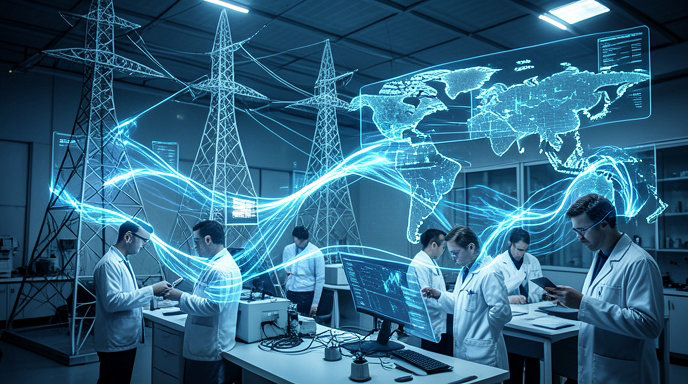
TL;DR
- German researchers say synchronized power disturbances are most likely driven by fast, system-wide interactions between grid controls, power electronics and long-distance transmission links.
- Small local changes can spread as frequency and voltage waves, producing simultaneous-looking power drops across widely separated networks.
- The findings point to faster detection, better coordination of protection systems and new stability rules for grids dominated by renewable generation.
Why Synchronized Power Drops Have Puzzled Grid Operators
Electricity grids do not behave like isolated collections of generators and substations. They are enormous, tightly coupled machines in which a change in one location can alter frequency, voltage and power flows far away.
That interconnectedness has produced a long-standing puzzle. Grid operators have repeatedly observed short-lived frequency disturbances and power deviations appearing at nearly the same time in geographically distant systems. The events are not necessarily large blackouts, but they can look coordinated: generation briefly falls, power flows shift and grid frequency moves away from its target value.
Researchers in Germany now say they have identified a likely mechanism behind these episodes. Their work points to the interaction of fast electronic controls, long transmission corridors and synchronized grid-management systems rather than to a single mysterious source sending a disturbance around the world.
The finding offers a new way to understand disturbances that previously appeared unrelated or too widely separated to share a common cause.
The Grid Is Becoming Faster—and More Sensitive
Traditional power systems were dominated by large rotating generators powered by coal, gas, nuclear energy or hydropower. The spinning mass of those machines provided inertia, helping the grid resist sudden changes in supply or demand.
Modern systems increasingly rely on solar farms, wind turbines, battery storage and high-voltage direct-current links. These technologies connect to the grid through power electronics. Instead of responding according to the natural behavior of a rotating machine, they follow software-controlled rules that can react in milliseconds.
That speed is valuable. Inverters can support voltage, adjust active power and help stabilize frequency much faster than conventional generators. But the same speed can also create new forms of interaction. If many devices respond to a disturbance using similar control settings, their actions can reinforce one another rather than cancel out.
The result may be a fast power shift that travels through the network as a disturbance wave.
How a Small Disturbance Can Spread
A disturbance can begin with an ordinary grid event: a transmission line changes state, a generator trips, a converter alters its output or a protection system temporarily disconnects equipment.
The initial change modifies power flows and electrical angles across the network. Neighboring devices detect the resulting frequency or voltage movement and react through their control systems. Those responses then affect other parts of the grid.
This sequence can produce oscillations or abrupt changes that move through interconnected networks. Because the systems are linked by transmission lines, interconnectors and converter stations, the disturbance may appear in multiple monitoring regions within a very short period.
The effect is similar to waves moving through a connected physical system. The energy does not travel instantaneously, and distant grids are not necessarily experiencing the same event. Instead, a common disturbance can trigger related responses whose timing makes them appear synchronized.
Why the Events Can Look Worldwide
Power grids in different countries are often operated independently, but they increasingly share similar technologies and operating practices. Many use comparable frequency-control algorithms, digital protection equipment, market-driven dispatch procedures and inverter controls.
This common architecture can make otherwise separate systems respond in similar ways. A disturbance in one region may also alter scheduled flows on an interconnector, prompting automatic controls elsewhere to react.
High-voltage direct-current links are particularly important. They can transfer large amounts of power between asynchronous networks and can respond rapidly to changes in system conditions. That makes them useful for balancing renewable generation, but it also means their control systems can influence several grids at once.
Researchers say the apparent global coordination should therefore not be interpreted as a single electrical pulse traveling across the planet. It is better understood as a combination of shared control behavior, interconnected infrastructure and fast feedback.
The Stability Challenge
The central problem is that protection systems are designed to act quickly. If a line, generator or converter behaves abnormally, relays may disconnect it within fractions of a second to prevent equipment damage or a wider collapse.
But a disturbance caused by control interaction may not look like a conventional fault. It can involve oscillating frequency, rapidly changing power flows or voltage behavior that crosses protection thresholds only briefly.
If several protection devices respond to the same transient, they may disconnect equipment unnecessarily. That can remove additional generation or transmission capacity at precisely the moment the system needs support, turning a manageable disturbance into a larger event.
The opposite risk is also serious. If protection settings are made too tolerant, equipment may remain connected during a genuine fault, increasing the chance of damage or instability.
The German research suggests that protection cannot be designed solely around local measurements. Grid operators may need to consider how devices in different regions respond collectively and how rapidly changing inverter behavior alters the stability of the wider system.
What the Findings Could Mean for Grid Protection
One immediate implication is the need for improved disturbance detection. Conventional monitoring often focuses on local frequency, voltage and current. Those measurements remain essential, but they may not reveal whether a local anomaly is part of a broader system-wide pattern.
Wide-area monitoring can provide a more complete picture by comparing synchronized measurements from substations across large areas. Operators could use those data to distinguish a local equipment fault from a coordinated oscillation or control interaction.
Protection systems may also need more adaptive settings. Instead of applying fixed thresholds under all operating conditions, future systems could adjust their response according to network topology, power flows, available inertia and the amount of inverter-connected generation online.
Another priority is coordination among manufacturers and grid operators. An inverter that behaves safely on its own can still contribute to instability when thousands of similar devices react at once. Testing must therefore move beyond individual components and examine how wind farms, solar plants, batteries, transmission links and conventional generators interact as a complete system.
Renewables Are Not the Sole Culprit
The research does not mean that solar panels or wind turbines are inherently destabilizing. Renewable resources can provide valuable grid services, including fast frequency response, voltage support and synthetic inertia.
The concern is how those services are implemented and coordinated. Poorly tuned controls can amplify disturbances, while well-designed controls can damp them. The same principle applies to conventional generators, HVDC systems, battery inverters and automated demand-response equipment.
As renewable penetration rises, the key issue is not simply how much renewable power is connected. It is whether the entire control ecosystem has been designed to operate coherently under rapidly changing conditions.
That distinction matters because replacing renewable generation with older technology is neither practical nor necessarily desirable. The more promising approach is to make inverter controls predictable, interoperable and capable of supporting system stability.
A New Role for Digital Twins and Grid Simulation
The findings are also likely to influence how future networks are modeled. Traditional planning studies often examine a limited number of severe but clearly defined scenarios, such as a major line failure or generator outage.
Control-driven disturbances require more detailed simulations. Engineers must model the behavior of individual inverters, protection relays, HVDC links and communication systems, sometimes at millisecond or even microsecond resolution.
Digital twins—software replicas of electrical networks that are updated using live operational data—could help operators identify dangerous combinations of equipment and operating conditions before they occur.
Such models would also make it easier to test firmware updates, new protection strategies and large renewable projects. A control change that appears harmless in a laboratory or isolated plant could be evaluated against the behavior of the entire interconnected system.
From Mystery to Manageable Engineering Problem
The significance of the German work is not that it reveals a single hidden switch controlling power grids worldwide. Its importance is that it reframes synchronized disturbances as an understandable consequence of modern grid architecture.
The apparent coordination emerges from networks that are more interconnected, more automated and faster-responding than the systems for which many protection rules were originally developed.
That reframing gives operators a practical path forward. Better synchronized measurements can reveal how disturbances spread. More realistic simulations can expose unstable control interactions. Adaptive protection can reduce unnecessary disconnections. And common technical standards can ensure that equipment from different manufacturers responds in compatible ways.
The transition to renewable electricity will continue to increase the role of power electronics. Understanding their collective behavior will therefore be essential to maintaining reliable service.
The mystery may not disappear entirely—large power systems are too complex for that—but disturbances once considered inexplicable can increasingly be analyzed, predicted and controlled.

Get All The Latest Updates Delivered Straight To Your Inbox For Free!