
Science Corporation Valued at $3.5 Billion After $400 Million Series D for Brain Tech
TL;DR
- Science Corporation has reportedly raised $400 million in Series D funding at a valuation of $3.5 billion, strengthening its position in the emerging brain-computer interface market.
- The company is focused initially on restoring sight through its Prima retinal implant, designed to help people with certain forms of severe vision loss.
- The new capital is expected to support clinical development, regulatory work, manufacturing scale-up and broader research into neural implants.
A Major Financing Round for Brain Technology
Science Corporation has raised $400 million in a Series D financing round that values the brain-technology company at approximately $3.5 billion, according to reports surrounding the deal.
The financing represents a significant vote of confidence in a sector that has attracted growing interest from investors, researchers and technology companies. While brain-computer interfaces are often associated with devices that allow people to control computers using neural signals, Science Corporation is pursuing a different—and more immediately clinical—entry point: restoring vision.
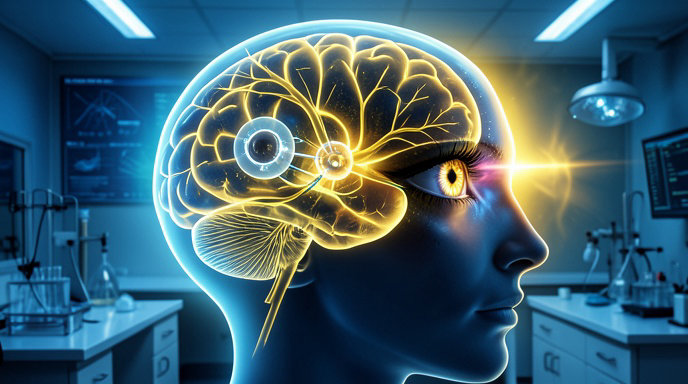
The company’s work centers on neural implants capable of communicating with the visual system. Its approach is intended to help people with profound vision loss perceive visual information even when the eye’s light-sensing cells are no longer functioning normally.
The Anti-Blindness Business
Science Corporation’s lead product is Prima, an implantable visual prosthesis developed to address certain forms of severe vision loss, including geographic atrophy associated with dry age-related macular degeneration.
Prima is designed to work with specialized glasses. A camera mounted on the glasses captures visual information, while a processing system converts that information into a form that can be transmitted to an implant positioned near the retina. The implant then uses electrical stimulation to activate remaining retinal pathways.
The system does not restore ordinary eyesight in the conventional sense. Instead, it is intended to create an artificial form of vision that can help users identify shapes, patterns and high-contrast objects. That information could potentially support practical tasks such as locating objects, recognizing boundaries or navigating indoor environments.
This distinction is important. Neural and retinal implants are not yet equivalent to replacing a healthy eye. They provide a limited visual signal that users must learn to interpret, often through training and repeated use.
Still, even partial visual restoration could have a substantial effect on people who have lost functional sight. For patients with advanced retinal disease, the ability to detect objects or distinguish outlines could improve independence and quality of life.
From Retinal Implant to Neural Platform
Science Corporation is positioning its technology as more than a single medical device. The company’s longer-term ambition is to develop a platform for interacting with the nervous system.
That strategy reflects the broader evolution of brain-computer interfaces. The field includes noninvasive systems such as electroencephalography headsets, implantable devices that record neural activity and stimulation technologies designed to influence the brain or peripheral nerves.
Vision restoration is often viewed as a relatively focused application because the visual system has well-defined pathways and because the commercial need is substantial. It may also offer a clearer clinical endpoint than more ambitious applications such as restoring movement, treating psychiatric disorders or enabling general-purpose communication with computers.
A successful visual implant could therefore provide Science Corporation with clinical, manufacturing and regulatory experience that might be applied to future neural technologies.
Plans to Scale the Business
The Series D funding is expected to give Science Corporation the resources to move its technology through additional clinical development and toward broader commercialization.
Scaling an implantable medical device is substantially more complicated than producing a conventional software product. The company must refine the implant and external hardware, demonstrate safety and effectiveness, establish reliable manufacturing and train surgeons and clinical teams.
It will also need to navigate regulatory review and reimbursement challenges. Even if a device receives authorization, adoption may depend on whether hospitals, insurers and public healthcare systems consider the technology sufficiently effective and economically justified.
The new capital could support larger clinical studies, expanded patient recruitment, manufacturing infrastructure and the development of the software and accessories that make the implant usable in daily life.
Science Corporation will also need to build a support system for patients. Neural implants often require fitting, calibration, rehabilitation and ongoing technical assistance. Those services can be as important to real-world outcomes as the implant itself.
The Competitive Neural-Implant Market
Science Corporation’s funding arrives as competition in neural technology intensifies.
Companies including Neuralink, Synchron and Precision Neuroscience are developing systems aimed primarily at recording brain signals and translating them into commands for computers or other devices. Those technologies could eventually help people with paralysis communicate, control assistive equipment or interact with digital systems.
Science Corporation’s focus on vision restoration gives it a distinct commercial and medical strategy, although the underlying challenges overlap. All implant developers must address biocompatibility, surgical risk, device durability, data processing and long-term patient safety.
The sector is also drawing attention from major technology investors because successful neural interfaces could create entirely new ways for people to interact with computers. However, the path from a promising laboratory demonstration to a widely adopted medical product remains long and uncertain.
What Neural Implants Can—and Cannot—Do
Neural implants are sometimes described as technologies that could “restore” a lost sense or function. In practice, restoration is likely to be gradual and highly specific.
A visual implant may provide a simplified representation of the environment rather than natural, high-resolution vision. Users may need extensive training to associate electrical stimulation patterns with meaningful visual information. Performance can vary based on the health of a patient’s remaining neural pathways, the placement of the implant and the quality of the device’s signal processing.
There are also unresolved questions about long-term use. Researchers and regulators must evaluate whether implants remain stable over many years, whether performance changes over time and how safely devices can be removed or replaced.
These limitations do not eliminate the technology’s potential. Medical devices do not always need to reproduce normal biological function to deliver meaningful benefits. A system that helps someone detect a doorway, find a cup or avoid an obstacle could represent a major improvement over complete blindness.
The Road Ahead
The $3.5 billion valuation places Science Corporation among the most closely watched private companies in brain technology. It also raises expectations around the company’s ability to convert technical progress into a scalable medical business.
The next milestones are likely to include further clinical evidence for Prima, regulatory progress, manufacturing expansion and a clearer commercialization strategy. Investors will be watching not only whether the implant works in controlled studies, but also how consistently patients can use it in everyday settings.
For the broader neural-implant industry, the company’s progress could help demonstrate whether vision restoration is one of the first commercially viable applications for brain technology. Success would provide momentum for other efforts to repair or augment the nervous system.
For patients with irreversible vision loss, the significance is more direct. Neural implants remain an emerging and imperfect technology, but Science Corporation’s latest financing suggests that the effort to turn artificial visual perception into a practical medical treatment is entering a more ambitious phase.

Get All The Latest Updates Delivered Straight To Your Inbox For Free!