
SNL’s Elon Musk Impression Signals a New Roast of Tech Executives
TL;DR
- Saturday Night Live’s latest Elon Musk parody turns his South African origins, wealth and public image into a pointed political punchline.
- The “worst thing South Africa has ever done” joke reflects growing scrutiny of billionaire technology leaders as cultural and political power brokers.
- SNL’s tech satire increasingly targets not only individual personalities, but the influence, contradictions and consequences of the companies they control.
A Sharper Kind of Musk Joke
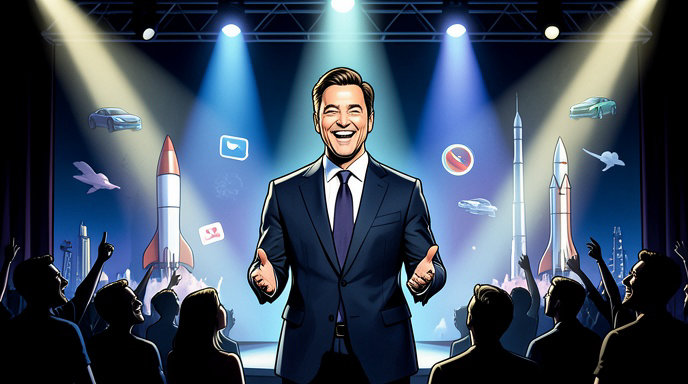
Saturday Night Live’s latest portrayal of Elon Musk is less interested in imitating his mannerisms than in compressing his public reputation into a single, deliberately brutal joke.
The line describing Musk as “the worst thing South Africa has ever done” works because it connects several familiar elements of his biography and public image at once: his South African upbringing, his extraordinary wealth, his influence over major technology platforms and his increasingly visible role in political and cultural debates.
Like much of SNL’s political comedy, the joke is designed to be instantly understandable. It does not require viewers to follow every development at Tesla, SpaceX, X or Musk’s other ventures. Instead, it relies on the broader impression that Musk has moved from eccentric technology entrepreneur to a near-permanent fixture in the global news cycle.
The result is a portrayal that treats Musk less as a conventional business executive and more as a symbol of the billionaire era.
From Innovator to Cultural Character
Musk has long been an unusually easy target for comedians. His companies are associated with ambitious technological projects, while his personal online presence is marked by impulsive posts, public disputes and frequent changes in direction.
That contrast gives writers a rich source of material. Musk can be presented as a visionary one moment and a chaotic internet personality the next. He is linked to electric vehicles, reusable rockets and artificial intelligence, but also to online feuds, political endorsements and controversial decisions affecting the platform formerly known as Twitter.
SNL’s impression draws comedy from that tension. The character is recognizable not simply because of a voice or gesture, but because audiences already associate Musk with a long list of contradictions: futurist and provocateur, industrialist and influencer, engineering advocate and culture-war participant.
The South Africa reference adds another layer. It turns a biographical detail into a national punchline, while also exaggerating the idea that Musk’s reputation has become so outsized that his birthplace is now discussed through him.
Why Tech Executives Are Becoming Prime Targets
SNL has mocked powerful business leaders for decades, but technology executives now occupy a different cultural position. Their companies shape communication, entertainment, transportation, work and public debate. As a result, their decisions often produce consequences that extend well beyond the marketplace.
Musk is the clearest example, but he is not the only one. Mark Zuckerberg, Jeff Bezos, Sam Altman and other technology leaders have become recognizable public characters whose companies are intertwined with questions about privacy, artificial intelligence, labor, misinformation and political influence.
That makes them especially useful subjects for satire. A joke about a technology executive can address corporate power, public policy and personal celebrity at the same time.
The shift also reflects a change in how executives present themselves. Earlier generations of corporate leaders often cultivated distance and discretion. Today’s prominent technology founders frequently communicate directly with the public through social media, interviews, product launches and political appearances. Their personalities are part of their companies’ identities.
That visibility creates more opportunities for parody—and more material when the public mood turns against them.
The Billionaire CEO as a Political Figure
Musk’s SNL treatment also reflects the growing overlap between business leadership and political influence. Billionaires are no longer portrayed only as wealthy entrepreneurs or industrialists. They increasingly function as public commentators, political donors, media owners and agenda setters.
Musk’s ownership of X has intensified that perception. His decisions about moderation, account access and platform policy have made him a participant in debates that were once handled largely by media companies and regulators. His political statements have also turned personal opinion into a news event.
For critics, that concentration of wealth and influence raises questions about accountability. Supporters often describe it as an example of free expression or entrepreneurial independence. SNL does not resolve that debate; it turns the contradiction into comedy.
The joke works because it assumes the audience understands the central unease: a small number of extremely wealthy individuals can now affect public conversation on a scale traditionally associated with governments, broadcasters and major institutions.
Satire After the “Techno-Optimist” Era
For years, popular culture often treated Silicon Valley leaders as eccentric geniuses whose unconventional behavior was justified by technological success. That image has weakened.
The technology industry remains capable of producing remarkable innovations, but public attention has increasingly shifted toward its costs and side effects. Layoffs, platform instability, artificial-intelligence risks, privacy concerns, content moderation disputes and the environmental footprint of large-scale computing have complicated the industry’s optimistic narrative.
SNL’s Musk impression belongs to that broader reassessment. The character is not merely a spoof of an unusual billionaire. It is a response to the fading assumption that technological achievement automatically grants social credibility.
In this version of the joke, Musk’s accomplishments are part of the background rather than the punchline. The comedy focuses on what happens when technological power is combined with celebrity, political ambition and an unfiltered public persona.
Why the Joke Resonates
The “worst thing South Africa has ever done” line is intentionally excessive. Its force comes from the mismatch between a national history and the absurdly sweeping judgment placed on one individual.
That kind of exaggeration is central to late-night political comedy. It does not offer a literal historical claim. Instead, it communicates the comedian’s assessment of Musk’s current reputation in a way that is memorable, shareable and immediately legible.
The joke also benefits from Musk’s unusual status. He is famous enough that viewers do not need an introduction, controversial enough that the insult feels plausible within the logic of satire and influential enough that a television parody can become part of the conversation it is mocking.
In an era when social-media posts can move markets, trigger political disputes or dominate a news cycle, a television sketch can serve as a cultural shorthand. It packages a complicated public debate into a few seconds of comedy.
A Broader Challenge to Corporate Power
The significance of the impression extends beyond Musk. SNL is increasingly portraying technology executives as characters in a larger story about concentrated power.
That story includes the widening gap between ordinary consumers and billionaire owners, the growing role of private companies in public life and the difficulty of holding influential executives accountable. Comedy can make those issues accessible, but it can also flatten them into personality-driven narratives.
That is both its strength and its limitation. Viewers may leave with a clearer sense that Musk is controversial, while learning little about the regulatory, labor or technological questions behind that controversy. Still, satire can influence the emotional framework through which those questions are understood.
By presenting tech leaders as vain, impulsive or detached, SNL helps establish a cultural vocabulary for skepticism. The jokes may not change policy, but they can weaken the aura of inevitability that has often surrounded the technology industry’s most powerful figures.
The New Executive Roast
SNL’s Musk impression signals a broader change in the way television comedy approaches corporate power. The technology executive is no longer an obscure figure behind a company logo. He or she is increasingly a public personality, a political actor and a potential source of social disruption.
That evolution gives comedians an expanding target. The most effective sketches will likely continue to mix personal imitation with criticism of the systems these leaders control.
Musk remains the ideal subject because he embodies nearly every contradiction associated with the modern billionaire CEO. He is celebrated for technological ambition, criticized for public behavior, followed as a celebrity and scrutinized as a political force.
SNL’s roast captures that contradiction in its most compact form. The joke is not only about Elon Musk. It is about a culture increasingly willing to question whether extraordinary wealth, technological success and personal fame should translate into extraordinary influence.
And for technology executives accustomed to being portrayed as the heroes of the future, that may be the most uncomfortable punchline of all.

Get All The Latest Updates Delivered Straight To Your Inbox For Free!