
Tesla’s €3 Billion Berlin Expansion Puts Cybercab at the Heart of Europe’s EV Future
TL;DR
- Tesla is reportedly considering an investment of roughly €3 billion to expand its Grünheide factory near Berlin, although the company has not publicly confirmed a final project or Cybercab production plan.
- The expansion could strengthen Tesla’s European manufacturing base and create capacity for lower-cost, software-led vehicles, but regulatory approvals, demand and the Cybercab’s development timetable remain major uncertainties.
- If robotaxis are approved for European roads, Berlin could become an important production and testing hub—but autonomous operation will depend on safety validation, local laws and Tesla’s ability to deliver its promised technology.
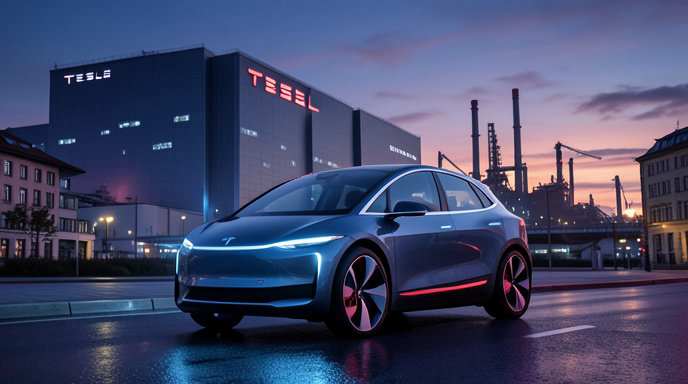
Tesla’s reported plan to invest around €3 billion in its Berlin-area manufacturing complex is drawing attention far beyond the company’s existing Model Y production. The proposed expansion could become a decisive test of Tesla’s strategy in Europe—particularly if the factory is eventually assigned a role in building the company’s planned Cybercab autonomous vehicle.
The project has not been fully detailed or formally confirmed in public disclosures. That makes the €3 billion figure a reported estimate rather than an established spending commitment. Even so, the possibility of a major expansion at Tesla’s Grünheide site comes at a critical moment for the company, Europe’s electric-vehicle industry and the emerging robotaxi market.
A larger European base for Tesla
Tesla’s factory in Grünheide, southeast of Berlin, is the company’s main manufacturing site in Europe. It currently builds vehicles for the regional market, most notably the Model Y. Since production began, Tesla has also pursued plans to increase the site’s capacity and expand its local manufacturing footprint.
A multibillion-euro investment could fund additional vehicle assembly lines, battery-related operations, stamping equipment, logistics infrastructure and supporting facilities. It could also help Tesla reduce its dependence on vehicles shipped from factories in China or North America.
Local production is particularly important in Europe, where trade rules, shipping costs and changing tariff policies can influence the competitiveness of imported electric vehicles. Producing more vehicles inside the European Union would give Tesla greater control over supply, delivery times and regional pricing.
The company would still face substantial challenges. Expanding Grünheide would require planning and environmental approvals, negotiations with regional authorities and potentially additional infrastructure for water, electricity, transport and employee housing.
The Cybercab question
Tesla unveiled the Cybercab as a purpose-built autonomous vehicle intended for robotaxi services. Unlike the company’s existing vehicles, the vehicle is designed around an autonomous-use case rather than private ownership. Tesla has presented it as a compact, highly automated vehicle that could operate without conventional driver controls, although the final production design and technical specifications remain subject to change.
The key question for Europe is whether Grünheide could become a Cybercab production site.
Tesla has not publicly confirmed that the Berlin factory will build the vehicle. The reported expansion could instead be aimed at increasing output of existing models or preparing the site for a future, more affordable Tesla model. Still, a European Cybercab program would fit the company’s broader ambition to create a global robotaxi network.
A local production line could reduce transport costs and help Tesla adapt the vehicle to European requirements. It could also allow the company to establish closer links between manufacturing, software deployment, fleet operations and regulatory testing.
That connection would be significant. Robotaxis are not simply cars with additional sensors. They require a complete commercial ecosystem involving remote assistance, charging, maintenance, insurance, fleet management and continuous software updates. A factory supporting that ecosystem would have a strategic role beyond vehicle assembly.
Tesla’s manufacturing strategy under pressure
Tesla’s Berlin expansion plans arrive as the company’s manufacturing strategy is being tested by slower electric-vehicle growth in some markets, intensifying competition from Chinese automakers and pressure to refresh its model lineup.
The company has historically emphasized large factories, simplified vehicle designs and high production volumes. The Cybercab could extend that approach by offering a vehicle with fewer traditional controls and a design optimized for fleet use. If Tesla can manufacture it efficiently, the model could reduce vehicle costs and potentially improve the economics of autonomous transportation.
However, the robotaxi model may require a different production strategy from Tesla’s existing business. Private consumers generally choose vehicles based on design, range, comfort, price and brand. Fleet operators focus more heavily on durability, utilization, maintenance costs, charging time and total cost of ownership.
A Cybercab built for intensive commercial use might need stronger components, easier servicing and more robust software monitoring than a conventional passenger vehicle. Tesla would need to balance those requirements against its goal of keeping the vehicle affordable.
An expanded Berlin plant could become a test of whether Tesla can combine mass-market manufacturing with fleet-oriented production. It may also determine whether the company continues to rely on a small number of global vehicle platforms or begins tailoring production more closely to regional markets.
Jobs and the regional economy
A €3 billion investment would likely create new construction, engineering, manufacturing and logistics work, although the number and timing of jobs would depend on the project’s final scope.
The existing Grünheide operation has already made Tesla a major industrial employer in Brandenburg. A larger site could support additional direct employment while generating work for suppliers, contractors, maintenance companies and transport providers.
The economic impact would not be automatic. Tesla has faced scrutiny in Germany over working conditions, labor relations, environmental concerns and the demands placed on local infrastructure. Expansion could intensify those debates.
More employees would require reliable public transport, roads, housing and public services around the factory. Water consumption and the protection of local forests and groundwater would remain politically sensitive issues. Any new construction would likely face close attention from environmental groups and local residents.
For Brandenburg, the project could reinforce the region’s position as one of Europe’s most important electric-vehicle manufacturing centers. For Tesla, smooth relations with local communities may be as important as the factory’s machinery.
Europe’s difficult robotaxi rulebook
Even if Tesla builds the Cybercab in Germany, that would not mean the vehicle could immediately operate as a driverless taxi across Europe.
European autonomous-driving rules remain complex and vary by country, road type and operational conditions. A vehicle designed without conventional controls would need to satisfy detailed safety, cybersecurity, type-approval and liability requirements before entering commercial service.
Regulators will also have to determine who is responsible when an autonomous system fails: the manufacturer, the fleet operator, the software provider or another party. Data protection and the handling of camera and location information will add further complications.
Tesla’s approach to autonomy has generated both enthusiasm and skepticism. The company has repeatedly predicted rapid progress toward fully autonomous driving, but its existing driver-assistance systems still require human supervision in many markets. A commercial Cybercab service would demand evidence that the system can handle Europe’s dense urban streets, cyclists, pedestrians, road markings, weather conditions and regional traffic patterns.
Germany could be an important market for testing and deployment, but approval in one country would not automatically create access to the entire European Union. Tesla would need to navigate national authorities, European standards and city-level operating rules.
The economics of a European robotaxi network
The business case for the Cybercab depends on utilization. A privately owned vehicle may spend much of the day parked, while a robotaxi could theoretically operate for many more hours. That could make each vehicle more productive and lower the cost of individual journeys.
Those benefits would depend on several practical factors. Charging infrastructure would need to support high-mileage fleets. Vehicles would require frequent cleaning and maintenance. Tesla would need systems for rescuing vehicles from unusual situations, managing software failures and dealing with accidents or vandalism.
Competition is also increasing. Traditional automakers, ride-hailing companies and autonomous-driving specialists are developing their own services or forming partnerships. Some rivals may favor limited geofenced deployments, while Tesla has generally promoted a broader software-led approach.
A Berlin-built Cybercab could give Tesla a physical presence in the European robotaxi market, but the company would still need partnerships with cities, fleet operators, energy providers and insurers.
A strategic bet with a long timetable
The reported expansion should therefore be viewed as a strategic possibility rather than proof that Cybercab production is imminent in Germany.
Large industrial projects take years to plan, approve and build. By the time new capacity becomes operational, Tesla’s product plans, battery technology and autonomous-driving software could look very different. The final investment may also be smaller, larger or directed toward models other than the Cybercab.
Tesla could use the additional capacity for an affordable mass-market car, updated versions of existing vehicles or battery manufacturing. The company has not publicly provided enough detail to determine how the reported investment would be divided.
Even so, the timing is notable. Europe is seeking more local battery and vehicle production, while automakers are racing to lower costs and add software capabilities. An expanded Grünheide facility would give Tesla a platform from which to pursue both goals.
What to watch next
The most important signals will be formal planning documents, environmental filings, permit applications and statements from Tesla or Brandenburg authorities. Details about production volumes, battery capacity, workforce expansion and the type of vehicle assigned to the site will be more revealing than the headline investment figure.
Tesla’s future financial reports may also clarify whether capital spending is increasing in Europe. Further information about the Cybercab’s design, manufacturing location and regulatory testing will help establish whether Berlin is intended to play a central role or simply remain a conventional vehicle-production site.
For now, the reported €3 billion plan represents an opportunity with considerable upside and equally significant uncertainty. It could help transform Grünheide into a European hub for affordable electric cars and autonomous fleets. But turning that vision into reality will require more than factory expansion. Tesla must prove that it can deliver reliable autonomy, satisfy European regulators, win public trust and make robotaxis economically viable.
If it succeeds, Berlin could become a cornerstone of Europe’s next phase of electric mobility. If it does not, the expansion may still strengthen Tesla’s manufacturing presence—but the Cybercab’s role in Europe’s future will remain a promise rather than a production reality.

Get All The Latest Updates Delivered Straight To Your Inbox For Free!