
Ukraine’s Pocket-Sized Drone Receiver Turns Russian Cameras Into an Intelligence Tool
TL;DR
- A lightweight receiver developed by a Kyiv startup can reportedly capture video links from some Russian drones, giving Ukrainian units a fast source of battlefield intelligence.
- The device is most useful against drones using vulnerable or poorly secured digital links, but it cannot universally defeat modern encryption or every aircraft’s communications system.
- Encrypted networks, frequency changes and increasingly autonomous AI-guided drones could reduce the receiver’s value as Russian systems evolve.
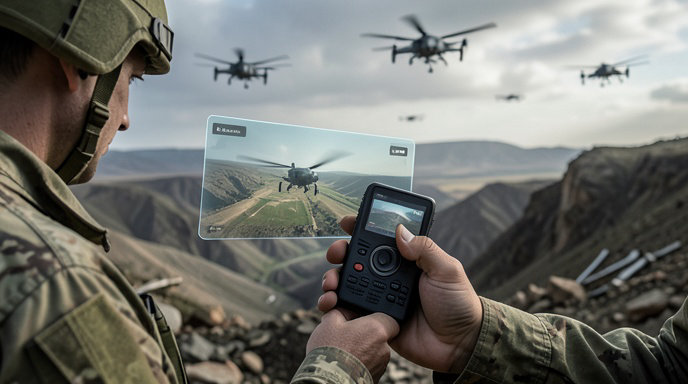
A small electronic device developed in Kyiv is turning one of Russia’s most important battlefield advantages—its extensive drone fleet—into a potential source of intelligence for Ukrainian troops.
The receiver is designed to detect and display video transmitted by certain Russian unmanned aircraft. Instead of relying solely on jamming, shooting down a drone or physically recovering its wreckage, Ukrainian units can sometimes watch what the aircraft’s camera is seeing while it is still in the air.
That capability can reveal Russian positions, vehicle movements and targeting activity. It can also provide an early warning that a drone is operating nearby, potentially giving troops time to move, conceal equipment or prepare countermeasures.
But the technology is not a universal “drone camera hack.” Its effectiveness depends on the aircraft, radio equipment, transmission protocol and security settings involved. As Russia adopts stronger encryption and more autonomous aircraft, the window in which such receivers can exploit a drone’s communications link may narrow.
A Radio Window Into the Battlefield
Most reconnaissance and first-person-view drones transmit some form of video to an operator or ground station. That link allows the pilot to navigate, identify targets and guide attacks. It also creates an electromagnetic signal that can potentially be detected and analyzed.
The Kyiv-developed receiver focuses on that signal. In favorable circumstances, it can identify a compatible transmission, lock onto the feed and present the drone’s imagery on a nearby screen. The system is intended to be portable, allowing soldiers to carry it close to the front rather than relying on a fixed intelligence facility.
The distinction between interception and control is important. A receiver that displays a drone’s video does not necessarily allow Ukrainian forces to fly the aircraft, disrupt its mission or take control of its flight computer. Its primary value is intelligence: seeing what the drone sees and learning where it is looking.
That information can still be operationally significant. A Russian drone scanning a road, artillery position or defensive line may unintentionally disclose the area it is monitoring. Its video feed can help Ukrainian personnel determine whether an attack is being prepared, identify the direction of Russian activity or locate the drone’s likely operator.
Turning Enemy Sensors Into Intelligence
The device effectively treats a hostile drone as an airborne sensor that Russia has already placed over the battlefield.
In conventional counter-drone operations, the immediate objective is often to deny the aircraft’s mission. Electronic warfare units jam its navigation or communications; air-defense teams attempt to destroy it; and troops use camouflage and concealment to avoid detection.
A receiver adds another option. If the feed can be viewed without alerting the aircraft or its operator, Ukrainian forces may gain information without expending ammunition or broadcasting a powerful jamming signal. That can be particularly valuable in an environment where both sides continuously monitor the electromagnetic spectrum.
The imagery may also help analysts identify the type of drone in use, estimate its operating area and understand how Russian units are conducting reconnaissance. Even a short video segment can reveal landmarks, weather conditions, defensive positions or the presence of other Russian equipment.
In some cases, the receiver’s warning function may be as useful as the picture itself. Detecting an active drone link could indicate that an aircraft is searching for targets nearby, prompting troops to reduce radio use, relocate exposed vehicles or suspend movement.
The Limits of Lightweight Interception
The system’s apparent simplicity should not be confused with universal access to drone feeds.
Different Russian aircraft use different cameras, transmitters, frequencies and communications architectures. Some consumer-style or improvised drones may use equipment that is relatively accessible to commercial receivers. Military systems can employ proprietary waveforms, directional antennas, hopping frequencies and encrypted links.
Encryption is the most obvious barrier. If the video is encrypted properly and the receiver does not possess the necessary keys, capturing the radio signal does not automatically reveal its contents. The device may detect that a transmission exists, but the image itself could remain unreadable.
Range is another constraint. A receiver must be close enough to detect a usable signal, and the quality of the feed may deteriorate because of terrain, interference or the drone’s altitude. Russian operators can also reduce their exposure by using directional antennas, short transmission windows or relay systems.
The battlefield is crowded with electronic noise. Ukrainian and Russian forces use jammers, decoys and other signals that can complicate identification. A receiver that works reliably in testing may perform less consistently during a large-scale electronic-warfare engagement.
The device is therefore best understood as a specialized intelligence tool rather than a universal method for defeating Russian drones.
Why Encryption Changes the Equation
Digital video links are vulnerable not only because they carry images, but because they must maintain a continuous connection between an aircraft and its operator. Every transmission creates a potential signature.
For drone designers, the answer is to make that link harder to observe, classify and exploit. Encryption can protect the content. Frequency hopping can make the signal more difficult to follow. Lower-power transmissions and directional antennas can reduce the distance at which the link can be detected.
Some systems can also process imagery on the aircraft itself. Instead of sending a high-quality, continuous video feed, an autonomous drone might transmit only brief updates, target coordinates or machine-generated alerts. That reduces the amount of information available to an interceptor.
The shift toward mesh networks and relays may add another layer of difficulty. A drone could communicate through another aircraft or a ground node rather than transmitting directly to a nearby operator. In that arrangement, intercepting one radio signal may not expose the entire communications path.
The contest is consequently moving beyond traditional jamming. Electronic warfare specialists increasingly have to identify a signal, determine its purpose, separate it from other emissions and decide whether to monitor, disrupt or attack it.
Autonomy Could Make the Receiver Less Relevant
The biggest long-term challenge may come from autonomous flight.
A remotely piloted drone needs to send its camera feed to a human who makes decisions. An autonomous or semi-autonomous aircraft can perform more of its mission without a continuous connection. It may navigate to a designated area, recognize objects using onboard software and return information only when necessary.
That architecture reduces the intelligence value of intercepting a live video feed. If there is no constant operator link, there may be little or nothing to watch in real time. The drone could store imagery onboard, transmit compressed data intermittently or send only the results of its onboard analysis.
Artificial intelligence could also allow aircraft to continue operating after communications are jammed or lost. A drone equipped with inertial navigation, visual navigation or target-recognition software may remain effective even when its radio link is disrupted.
Autonomy does not eliminate radio emissions altogether. Drones still need to receive instructions, share data or report mission results in many circumstances. But it can make those communications shorter, less predictable and less useful to an interceptor.
For Ukraine, that means the receiver’s value may increasingly depend on what kind of aircraft is overhead. A drone operating like a flying camera remains an attractive target for signal exploitation. A drone that behaves more like an independent robot presents a far smaller communications window.
A Fast-Moving Technology Race
The device illustrates how quickly battlefield technology is being adapted in Ukraine. The country’s defense-technology sector has grown around an urgent need to detect, disrupt and exploit inexpensive unmanned systems.
Commercial components, software-defined radios and rapidly updated firmware allow small companies to develop tools more quickly than traditional procurement programs. A lightweight receiver can be modified as new drone models and transmission methods appear.
That speed is essential because counter-drone systems rarely retain an advantage for long. Once one side demonstrates that a particular signal can be detected or decoded, the other can change frequencies, replace hardware, update software or alter operating procedures.
The result is a cycle of adaptation. Ukrainian units seek to identify Russian communications and extract intelligence from them. Russian engineers respond with encryption, frequency agility and autonomy. Ukraine then works on new detection methods, signal libraries and analytic tools.
The most effective systems are likely to combine several functions: radio detection, classification, direction finding, video interception, electronic attack and integration with battlefield command networks. A receiver that can pass useful information quickly to artillery, air-defense or drone operators is more valuable than one that merely displays an isolated video feed.
From Battlefield Gadget to Networked Sensor
The receiver’s strategic importance will depend on how well it fits into Ukraine’s wider intelligence architecture.
A soldier watching a drone feed can make an immediate decision, but the same imagery could be more valuable if it is recorded, geolocated and shared with other units. Software could compare the video with satellite imagery, drone reconnaissance and electronic-signature data to identify recurring Russian positions or operating patterns.
That kind of integration could turn a pocket-sized device into part of a larger sensor network. Several receivers positioned across an area might help estimate where Russian drones are operating and where their control stations are located. Combined with direction-finding equipment, intercepted transmissions could contribute to a map of enemy activity.
Such capabilities also raise practical challenges. Operators need training, reliable power and secure communications. Captured video must be interpreted quickly, and false positives can waste time or expose troops to unnecessary danger. A feed that appears to show a target may be delayed, incomplete or disconnected from the wider tactical picture.
The technology’s greatest contribution may therefore be speed: reducing the time between a Russian drone appearing overhead and Ukrainian forces understanding what it is observing.
An Advantage Measured in Minutes
The Kyiv startup’s receiver does not overturn the drone war by itself. It works only against certain systems and under specific conditions, while encryption and autonomy are steadily closing the gaps that make interception possible.
Its importance lies in the way it changes the relationship between drone and defender. A Russian aircraft is not merely a threat to be jammed or destroyed. Its camera, radio link and operating behavior can also expose information about the mission behind it.
For Ukrainian troops, even a temporary ability to view that feed can be decisive. A few minutes of warning may allow a unit to move artillery, hide a vehicle or identify an approaching assault. A short glimpse of a Russian position may help confirm intelligence gathered by other means.
As unmanned aircraft become more secure and more autonomous, the contest will shift toward identifying weak points in their software, sensors and supply chains. For now, however, a compact receiver offers a reminder that in modern warfare, the data flowing through a drone can be almost as valuable as the drone itself.

Get All The Latest Updates Delivered Straight To Your Inbox For Free!