
Why Many AI Data Centers May Never Get Built
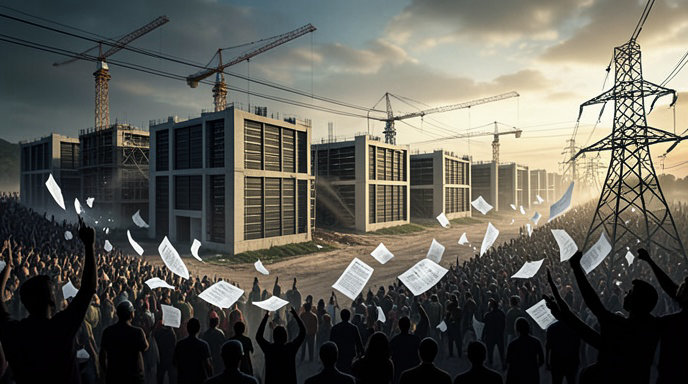
TL;DR
- AI data-center plans are multiplying faster than utilities, financiers, permitting agencies and communities can support.
- Many announcements represent land options, power studies or preliminary agreements—not fully financed projects with construction-ready permits.
- Grid constraints, high interest rates, equipment shortages and uncertain AI demand could leave a large share of proposed facilities delayed, downsized or abandoned.
Why Many AI Data Centers May Never Get Built
The artificial-intelligence boom has triggered a race to build enormous data centers capable of training and running increasingly powerful models. Technology companies, cloud providers, utilities, private-equity firms and real-estate developers have announced projects representing hundreds of billions of dollars in potential investment.
But the size of the pipeline may be misleading.
A proposed data center can appear in a press release long before it has secured financing, obtained permits, signed a binding power contract or received approval to connect to the electric grid. As the industry moves from announcements to construction, many projects are likely to encounter obstacles that were easier to overlook during the initial rush.
The result could be a sharp divide between the number of AI campuses announced and the number ultimately completed.
A Boom Built on Announcements
The most ambitious plans illustrate the scale of the opportunity. OpenAI, SoftBank and Oracle announced the Stargate initiative in January 2025, describing plans to invest as much as $500 billion in AI infrastructure in the United States over several years. The partners identified an initial project in Texas, while presenting Stargate as a broader national build-out.
Other technology companies have announced similarly aggressive expansion plans. Microsoft, Google, Amazon and Meta are investing heavily in data centers, while specialist operators such as CoreWeave, Crusoe and Applied Digital are developing facilities aimed at AI workloads.
Those announcements are important signals of demand, but they do not all carry the same commercial weight. Some refer to a specific site with a committed tenant. Others cover a portfolio of potential locations. Still others represent a memorandum of understanding, a land purchase, a power reservation or an early-stage development agreement.
That distinction matters. A site may be described publicly as a multi-billion-dollar data center even though its developer has not yet completed engineering, arranged debt financing or secured the electricity needed to operate it.
“Announced capacity” can therefore be much larger than “capacity under construction,” while capacity under construction can still exceed the amount that has received final investment approval.
The Financing Problem
AI data centers require unusually large upfront investments. A single campus can involve billions of dollars in land, buildings, substations, cooling systems, networking equipment and specialized computing hardware.
Developers generally need confidence that a tenant will occupy the facility and pay for its capacity before lenders will commit substantial capital. Yet AI demand is difficult to forecast. Computing requirements are rising rapidly, but the technology is also changing quickly.
A new generation of chips can deliver more performance per watt. Model developers may improve efficiency, use smaller models or shift workloads between training and inference. Customers may also decide that they need less dedicated capacity than originally expected.
That uncertainty complicates the financing model. A conventional data center may be supported by long-term leases with established cloud or enterprise customers. An AI facility may depend on a smaller number of rapidly growing companies whose own revenues, funding and computing needs are still evolving.
Higher interest rates make the problem more severe. Data-center projects are capital-intensive and often take years to generate cash flow. When borrowing costs rise, a project that looked profitable under cheap financing can become uneconomic. Developers may respond by delaying construction, reducing the size of a campus or seeking a larger equity contribution.
Some projects could also face trouble if customers are unwilling to sign long-term contracts that guarantee payments for unused capacity. Without those commitments, lenders may treat a proposal as speculative rather than infrastructure with predictable revenue.
Electricity Is Becoming the Critical Constraint
The biggest obstacle may not be land or money. It may be electricity.
AI servers consume far more power than many traditional data-center workloads, and large clusters can require several hundred megawatts. The largest proposed campuses could eventually demand a gigawatt or more—roughly comparable to the consumption of a major industrial site or a small city, depending on local conditions.
Utilities and grid operators are struggling to connect new demand quickly enough. Interconnection studies can take years, particularly where transmission networks need upgrades. A project may have a site, a customer and financing interest but still lack a firm date for receiving power.
In parts of Texas, data-center developers are seeking access to the same electricity market as industrial users, cryptocurrency miners and other energy-intensive businesses. In the eastern United States, grid operators face growing interconnection queues and concerns about whether existing generation can meet rising demand while older coal and gas plants retire.
The shortage is not limited to generation. New facilities often require substations, transformers, transmission lines and distribution equipment. Those components are themselves subject to long manufacturing backlogs.
A utility may agree in principle to serve a project while making clear that extensive upgrades must be completed first. The cost of those upgrades can materially change the project’s economics, especially if the developer must pay for infrastructure that serves only one campus.
Power Reservations Are Not Always Power Contracts
The language used around electricity can also create confusion.
A developer may announce that it has “secured” power when it has only obtained a preliminary allocation, entered a queue or signed a nonbinding agreement. In other cases, the project may rely on temporary generation, natural-gas turbines or a future nuclear or renewable-energy development that has not yet been built.
Those arrangements can be useful, but they do not eliminate risk. A utility still must determine whether the local network can operate reliably with the additional load. Regulators may impose conditions, and neighboring customers may object if they believe a data center will increase electricity prices or reduce reliability.
Some developers are exploring behind-the-meter generation, batteries and direct connections to power plants. These approaches may accelerate construction in certain locations, but they introduce additional permitting, fuel-supply, emissions and operational challenges.
Permitting Can Add Years
Data centers are often presented as economic-development projects, but their physical footprint can be substantial. Large campuses may include multiple buildings, cooling plants, substations, backup generators, water systems and new roads.
Local governments may require zoning changes, environmental reviews, traffic studies, noise assessments and agreements covering water use and tax incentives. Projects near residential areas can face particular scrutiny because of construction traffic, constant equipment noise and the low-frequency hum of cooling systems and backup generators.
The permitting process becomes more complicated when a project requires new transmission lines or generation capacity. A data center may be approved locally while the power infrastructure serving it remains stuck in a separate regulatory process.
In some jurisdictions, governments are eager to streamline approvals and attract investment. In others, officials and residents are demanding more information about tax breaks, water consumption, emissions and the effect on household utility bills.
A project that clears one stage can still be delayed at another.
Community Opposition Is Growing
Local resistance is becoming a larger factor in the data-center market.
Residents often question whether a facility will create enough permanent jobs to justify the land, tax incentives and infrastructure it receives. A campus can cost billions to build but employ relatively few people once it is operating, particularly compared with manufacturing plants of similar value.
Communities are also concerned about water. Some data centers use evaporative cooling, which can consume significant quantities in hot climates. Developers are increasingly turning to closed-loop or liquid-cooling systems, but those technologies do not eliminate every water, construction or environmental concern.
Noise is another flashpoint. Cooling systems, generators and electrical equipment can operate continuously. Even when a facility complies with formal noise limits, residents may object to its presence near homes.
In some areas, opposition has already prompted public hearings, lawsuits, planning delays or changes to proposed sites. The more projects that seek the same limited industrial land and power capacity, the more likely communities are to demand concessions—or reject them altogether.
The Semiconductor and Equipment Bottleneck
Even a fully permitted, financed project may not be able to open on schedule.
AI data centers depend on high-end accelerators, advanced networking equipment, optical components, transformers, switchgear and cooling systems. The rapid expansion of the market has strained suppliers across the chain.
The industry’s most visible bottleneck is advanced AI chips. Access to accelerators from Nvidia, AMD and other suppliers can determine when a facility becomes commercially useful. A building without enough chips is not an operating AI data center; it is an expensive shell.
Power equipment can be just as important. Transformer and switchgear lead times have lengthened, and manufacturers must serve utilities, factories, renewable-energy projects and conventional data centers at the same time. A developer that finishes its building before receiving electrical equipment may face months of additional delay.
Construction itself is also vulnerable to labor shortages. Projects require specialized electrical workers, engineers, commissioning teams and technicians. When numerous campuses are built simultaneously, competition for experienced labor can raise costs and extend schedules.
The Risk of Overbuilding
The most fundamental risk is that demand may not grow as quickly as developers expect.
The AI industry is expanding, but its economics remain unsettled. Companies are spending heavily on computing capacity while trying to determine how much customers will pay for AI products. If monetization disappoints, model developers may reduce infrastructure budgets.
Efficiency gains could also undermine the assumption that every increase in AI usage requires a proportional increase in data-center capacity. More capable chips, improved software, model compression and smarter scheduling can allow companies to perform more work with fewer servers.
This does not mean AI demand will disappear. It means the market may favor certain facilities and locations over others. Campuses with abundant low-cost power, strong fiber connections, modern cooling and committed tenants are more likely to proceed. Projects dependent on uncertain demand or expensive electricity may be postponed indefinitely.
A correction would not necessarily resemble a sudden collapse. Developers could quietly shrink campuses, phase construction over a longer period, sell partially completed sites or convert them to less power-intensive uses.
Who Bears the Risk?
The financial exposure is distributed across the ecosystem.
Developers risk losing deposits, design costs and land investments. Utilities may be left with partially built transmission infrastructure or customers that no longer need their reserved capacity. Local governments may have structured tax incentives around a project that never reaches its promised scale.
Lenders face the possibility that a tenant’s credit weakens or that specialized buildings become difficult to repurpose. Equipment suppliers may be stuck with canceled orders. Investors in data-center companies could see returns fall if construction costs rise faster than lease rates.
There is also a public-policy risk. If regulators approve expensive grid upgrades for speculative demand, ordinary ratepayers could end up paying for infrastructure that serves less AI load than expected. Conversely, if utilities refuse to invest, genuinely viable projects may move elsewhere or fail to materialize.
The Industry Is Likely to Consolidate
The projects most likely to survive will have several characteristics: credible tenants, binding power agreements, access to transmission, experienced developers and enough capital to absorb delays.
Large cloud providers have an advantage because they can finance facilities internally and shift workloads across a global network. They can also sign longer-term agreements with suppliers and secure equipment earlier.
Smaller developers may still succeed, particularly when they specialize in attractive regions or partner with strong customers. But they are more exposed to financing costs, construction overruns and tenant concentration.
That could lead to consolidation. Well-capitalized companies may acquire stalled projects, while weaker developers sell land and partially completed campuses at discounts. Some power-constrained sites could be repurposed for cloud workloads, industrial computing or other high-value uses.
The Bigger Picture
The AI data-center boom is real, but the project pipeline should not be interpreted as a guaranteed construction schedule.
The industry is attempting to build infrastructure at a pace that collides with slow-moving systems: utility planning, environmental review, local politics, heavy-equipment manufacturing and long-term project finance. Those systems cannot expand instantly simply because demand for AI has surged.
Many proposed facilities will probably be built. Others will be delayed, redesigned or merged into larger developments. A significant number may never progress beyond a land deal, a planning application or an investor presentation.
The central question is no longer whether AI will require more data centers. It is whether each proposed facility can secure affordable power, durable customers, financing, equipment and community approval at the same time.
For the projects that cannot, the AI boom may end not with a groundbreaking ceremony—but with a quiet cancellation.

Get All The Latest Updates Delivered Straight To Your Inbox For Free!