
Zipline Hits $21.5 Billion Valuation as Walmart Expands Drone Delivery Partnership
TL;DR
- Zipline is reportedly raising $1.5 billion at a $21.5 billion valuation, marking a dramatic increase in its market value.
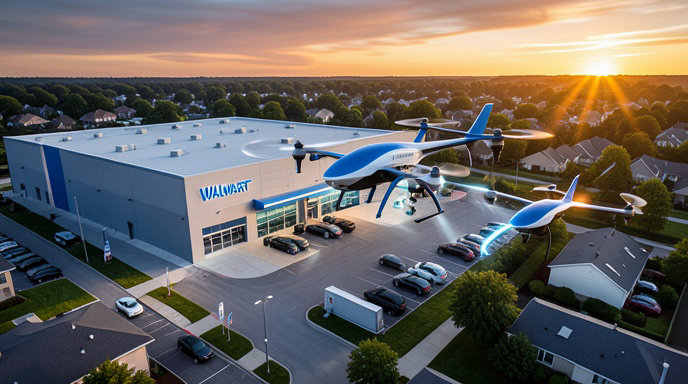
- Walmart is deepening its relationship with Zipline as it expands drone delivery beyond pilot programs and into a broader retail logistics strategy.
- The deal could accelerate the use of autonomous aircraft for fast, low-cost delivery of groceries, household goods and other small orders.
A major bet on autonomous delivery is pushing Zipline into a new phase of growth.
The drone-delivery company has reportedly raised $1.5 billion in new funding at a valuation of approximately $21.5 billion. The financing would make Zipline one of the most valuable private companies in the autonomous-mobility sector and underline growing investor confidence in drone delivery as a commercial logistics platform.
Walmart, already one of Zipline’s most important retail partners, is also deepening its investment in the relationship. The partnership reflects Walmart’s broader effort to make rapid delivery a central part of its competitive strategy while using automation to reduce the cost and complexity of serving customers.
A major funding milestone for Zipline
Zipline has spent years developing autonomous aircraft, delivery software and fulfillment infrastructure for medical, retail and consumer shipments. Its systems are designed to transport packages from distribution hubs to nearby delivery locations without a human pilot onboard.
The reported financing would provide the company with substantial capital to expand its fleet, build additional operating sites and improve the software that coordinates flights, orders and deliveries. It could also support expansion into new countries and additional commercial categories.
The reported $21.5 billion valuation would represent a significant increase from the valuations associated with Zipline’s earlier funding rounds. That jump reflects a shift in how investors view the company: not simply as a drone manufacturer, but as a technology and logistics platform capable of handling large volumes of time-sensitive deliveries.
Zipline’s business model combines aircraft, fulfillment operations and software. That integrated approach is intended to give the company more control over the customer experience and delivery economics than a model based solely on selling drones to retailers or logistics providers.
Walmart moves from experimentation to scale
Walmart has tested drone delivery in several markets, using Zipline and other providers to explore how autonomous aircraft can complement its existing delivery network.
The retailer’s interest is straightforward. Traditional delivery becomes increasingly expensive as orders become smaller, delivery windows become shorter and customers expect products to arrive within hours. Drones can potentially reduce the need for delivery drivers on short routes while avoiding traffic and making more direct journeys.
For Walmart, drone delivery is not expected to replace its broader network of stores, fulfillment centers, vans and third-party carriers. Instead, it can serve as another layer in the company’s logistics system, particularly for lightweight items and urgent purchases.
That could include groceries, over-the-counter medicines, personal-care products, electronics accessories and other goods that customers may need quickly but do not want to collect in person.
A deeper relationship with Zipline would give Walmart access to a dedicated autonomous-delivery network while allowing the retailer to test new service models. Customers could eventually place an order through Walmart’s app, have the items picked at a nearby store or facility and receive them by air within a much shorter window than conventional delivery allows.
The economics of autonomous delivery
The commercial case for drone delivery depends on more than speed. Companies must demonstrate that autonomous flights can operate safely, reliably and at a cost that compares favorably with vans, gig workers and other delivery methods.
Drones may be particularly useful for short-distance deliveries involving small packages. A direct flight can reduce travel time and fuel consumption, while a single operator or remote supervision system may be able to oversee multiple aircraft.
However, the savings are not automatic. Operators must invest in aircraft, charging or launch infrastructure, maintenance, route management, compliance systems and trained personnel. Weather, package weight, battery performance and local regulations can also limit where and when drones operate.
Zipline’s strategy is built around repeatable routes and automated systems rather than one-off demonstrations. The more deliveries a network handles, the more efficiently its fixed infrastructure can potentially be used. Walmart’s store footprint could help provide the density needed to make that model viable in selected markets.
From health care to household delivery
Zipline initially became widely known for delivering medical supplies, including blood and other critical products, in markets where roads and conventional logistics can be unreliable.
That experience gave the company an opportunity to refine long-range autonomous flight, precision delivery and centralized fleet management under demanding conditions. Expanding into retail introduces a different set of challenges: far more orders, tighter customer expectations and a wider variety of delivery locations.
Retail also offers a larger potential market. Medical deliveries can be highly valuable but relatively specialized. Everyday consumer orders could create the volume needed to support a much broader commercial network.
The shift does not mean medical logistics is becoming unimportant to Zipline. Rather, the company’s retail expansion gives it another source of growth and a way to apply its autonomous-delivery technology to a much larger customer base.
How Zipline’s aircraft fit into the network
Zipline’s aircraft are designed around autonomous flight and delivery without requiring the drone to land at a customer’s home. Depending on the system and operating environment, packages can be lowered or released to a designated delivery area while the aircraft continues its flight.
That design can reduce the need for landing zones and improve turnaround times. It also allows aircraft to serve locations where a conventional drone landing might be difficult or unsafe.
The company’s technology stack includes aircraft control, navigation, communications, delivery coordination and fleet operations. Integrating those components is crucial because a retail network must handle thousands of orders while adapting to changing weather, airspace conditions and customer instructions.
As operations scale, data from each flight can help improve routing, maintenance schedules and demand forecasting. The resulting network could become more efficient over time, provided the company maintains high reliability and public trust.
The regulatory and safety challenge
Drone delivery remains closely tied to aviation regulation. Operators must comply with rules covering aircraft certification, remote operation, airspace access, flight paths, package handling and operations beyond the direct line of sight of a human observer.
Regulatory approval has expanded in some markets, but the process remains gradual. Large-scale deployment requires authorities to be comfortable with autonomous systems operating over populated areas and sharing airspace with other aircraft.
Safety will also shape public acceptance. Retail drones must avoid people, buildings, power lines and other obstacles while ensuring that packages arrive accurately and securely. A small number of highly visible incidents could affect customer confidence and slow expansion.
For that reason, Zipline and Walmart will need to show that drone delivery is not merely fast, but predictable and unobtrusive. The strongest consumer proposition may be one in which the aircraft are barely noticed and deliveries work as reliably as any other Walmart service.
A competitive market takes shape
Zipline is competing in a market that includes drone specialists, established logistics providers, retailers developing their own systems and technology companies supplying aircraft or autonomous-flight software.
Amazon has invested heavily in its own drone-delivery efforts, while other operators have pursued partnerships with pharmacies, restaurants, grocery chains and local delivery companies. Traditional carriers are also studying how autonomous vehicles and aircraft could fit into their networks.
The competition will likely be determined by operating scale rather than aircraft design alone. Companies must secure suitable launch locations, win regulatory approvals, integrate with retailer inventory systems and deliver consistently in real neighborhoods.
Partnerships such as Walmart’s can provide the order volume and geographic reach needed to build that scale. They can also give drone companies valuable data about consumer demand, delivery timing and product selection.
What the funding could mean for Walmart
Walmart’s deeper investment gives the retailer a potential advantage in the race to make rapid delivery economically sustainable. The company already has an extensive network of stores located close to residential areas, creating a possible foundation for local fulfillment.
If drones can handle more short-distance orders, Walmart could reserve vans and drivers for larger, heavier or longer-range deliveries. That would allow the retailer to divide orders according to the most efficient delivery method rather than relying on a single system for every purchase.
The partnership could also help Walmart differentiate its membership and digital-commerce offerings. Faster delivery windows may encourage customers to consolidate more of their shopping with Walmart, particularly for urgent but relatively small orders.
Still, the financial benefits will depend on utilization. Aircraft that sit idle, serve too few customers or require excessive human oversight may not deliver the expected savings. Walmart will need to determine where demand is dense enough to justify the infrastructure and where traditional delivery remains the better option.
The broader future of same-day delivery
The Zipline financing is part of a larger shift in logistics toward increasingly automated fulfillment. Warehouses are becoming more robotic, software is coordinating orders across multiple facilities and delivery companies are experimenting with autonomous vehicles, sidewalk robots and drones.
Autonomous aircraft could be especially valuable in suburban and semi-rural areas, where homes may be spread out but delivery distances remain manageable. They may also help reach communities affected by traffic congestion, poor road access or temporary disruptions.
The technology is less likely to replace the entire delivery workforce than to change how delivery networks are organized. Human workers will continue to manage warehouses, package orders, maintain equipment, handle exceptions and perform deliveries that aircraft cannot support.
Over time, customers may not think of drone delivery as a novelty. It could become one option selected automatically by a retailer’s logistics software based on package size, urgency, distance, weather and local capacity.
The next test is execution
The reported $1.5 billion financing and $21.5 billion valuation give Zipline substantial momentum, but they also raise expectations. Investors will want to see evidence that the company can turn technological leadership and high-profile partnerships into durable revenue and attractive margins.
For Walmart, the next stage will be measured by practical results: how many customers can be served, how frequently deliveries arrive on time, what consumers are willing to pay and whether autonomous flights reduce total fulfillment costs.
If Zipline can scale safely and Walmart can generate consistent demand, drone delivery may move from a limited pilot to a meaningful part of mainstream retail. The result would not be an overnight transformation of logistics, but a gradual reshaping of how small, urgent orders travel from local stores to customers.
The funding marks a powerful vote of confidence in that future. The harder work now is proving that autonomous aircraft can deliver not only packages, but also the reliability and economics required to become a permanent part of everyday commerce.

Get All The Latest Updates Delivered Straight To Your Inbox For Free!