
Elon Musk's Shift: From Solar Promises to Natural Gas and Data Centers
TL;DR
- Recent reporting suggests Elon Musk’s energy narrative is shifting: solar remains part of the long-term vision, but near-term AI infrastructure is increasingly leaning on natural gas.
- SpaceX’s latest filing and related coverage point to orbital data centers as a future target for solar-powered computing, while xAI has already turned to gas turbines for rapid power delivery.
- The pivot raises a bigger question for clean energy advocates: is Musk still building toward a solar-electric economy, or simply relocating that dream to space while Earth-side operations rely on fossil fuels?
Musk’s Energy Story Is Changing
For years, Elon Musk has cast himself as one of the most influential champions of a solar-electric future. From Tesla’s early mission to accelerate the world’s transition away from hydrocarbons to his repeated emphasis on batteries, solar panels, and grid-scale storage, Musk helped make clean energy feel like a practical industrial strategy rather than a niche ideal.
But the latest wave of reporting suggests a more complicated reality. Instead of a clean linear march toward solar dominance on Earth, Musk’s companies are now making pragmatic choices that look increasingly like a hedge toward fossil fuels in the short term and orbital infrastructure in the long term.
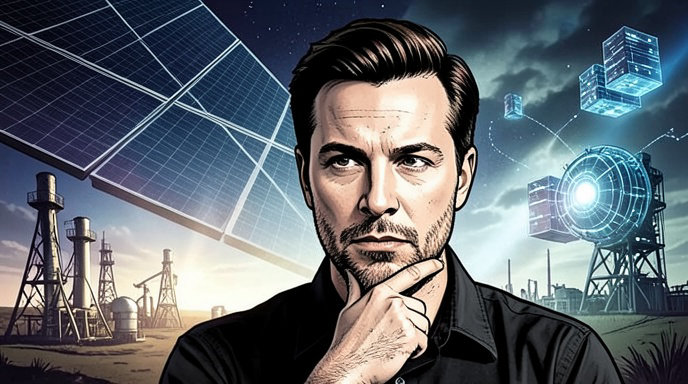
The clearest example is xAI, which has reportedly embraced dozens of natural gas turbines to power its data center operations, with plans to add billions more in turbine capacity. At the same time, SpaceX appears to be leaning into a highly futuristic idea: data centers powered by solar arrays in orbit, where sunlight is continuous and weather is irrelevant.
Why xAI Is Choosing Gas Now
The move to natural gas is less surprising when viewed through the lens of the AI boom. Modern AI data centers are power-hungry, and the industry is racing to deploy new compute as fast as possible. In that environment, the key constraints are often not ideology but speed, reliability, and build-out time.
Natural gas turbines can be installed faster than many grid upgrades and large renewable projects. They offer dependable baseload-style power, which matters for AI workloads that need to run continuously. In other words, if the goal is to bring massive compute online quickly, gas is a convenient bridge.
That does not mean the choice is environmentally neutral. It does mean that, in the near term, Musk’s AI ambitions appear to be prioritizing operational speed over the solar-first philosophy that defined much of his earlier public messaging.
SpaceX Looks to Orbit for the Solar Solution
While xAI is leaning on gas on Earth, SpaceX seems to be pursuing a very different answer to the same power problem: put the data center in space.
The logic is straightforward. In orbit, solar panels can receive uninterrupted sunlight, avoiding the daily cycles, clouds, and seasonal variability that complicate terrestrial solar generation. If computational hardware can be made durable enough, an orbital data center could, in theory, run on near-constant solar energy without needing huge land footprints or terrestrial grid connections.
This idea fits neatly into Musk’s long-running fascination with making space a platform for infrastructure. It also aligns with a broader belief that the hardest parts of Earth-based clean energy are not the engineering basics, but the constraints of geography, regulation, transmission, storage, and intermittency.
Still, the concept remains highly ambitious. Space-based data centers would face major hurdles, including launch costs, maintenance, thermal management, communications latency, and the challenge of operating complex hardware in a hostile environment. For now, it reads more like a future moonshot than an imminent replacement for Earth-based cloud infrastructure.
From Solar Evangelist to Energy Realist?
The tension in Musk’s current position is not that he has abandoned solar entirely. He has not. More accurately, he seems to be separating long-term aspiration from short-term execution.
That distinction matters. Musk has repeatedly argued that solar is the best long-term energy source because the Sun is abundant, scalable, and effectively free once the infrastructure exists. Batteries, in his view, solve the intermittency problem. In that framing, solar is not a side project; it is the backbone of a future industrial system.
Yet the current reality of AI infrastructure is pushing his companies toward something less elegant. Training frontier models and running large inference clusters requires enormous, reliable power right now. That creates a mismatch between the idealized future and the immediate business need. Natural gas fills the gap.
So the question becomes whether this is a temporary compromise or a deeper strategic shift. Is Musk building a bridge from hydrocarbons to solar, or simply revealing that the bridge itself still depends on fossil fuels?
What It Means for the Clean Energy Transition
Musk’s influence is bigger than any one company. When he shifts his rhetoric or his capital allocation, markets notice. Policymakers notice. Competing energy companies notice.
That’s why this moment matters. If one of the world’s most visible clean-energy evangelists is visibly leaning on gas for his fastest-growing AI ambitions, it may reinforce a broader industry narrative: renewables are essential, but they are not always the quickest tool for hyperscale computing.
At the same time, the orbital-data-center concept could keep solar futurism alive in a different form. Rather than asking whether Earth can support the entire next generation of compute with terrestrial solar alone, Musk appears to be asking whether the answer lies beyond Earth.
That’s an audacious idea, but also a telling one. It suggests that the future Musk once described as solar-electric may still be his destination — just not necessarily on the planet where most of the energy demand exists today.
The Bigger Picture
This is not just a story about one billionaire’s evolving preferences. It is a story about the collision between climate ambition and the realities of the AI race.
AI demands power, speed, and scale. Solar demands land, storage, transmission, and patience. Natural gas offers immediacy. Space offers a long-term science-fiction-style workaround. Musk, as usual, is trying to inhabit both timelines at once.
For supporters of renewables, the shift is unsettling. It suggests that even the most vocal clean-tech proponents may default to fossil fuels when the time-to-power equation becomes urgent enough. For Musk’s backers, it may simply be evidence of a founder willing to use whatever works today while pursuing a more radical solution tomorrow.
Either way, the message is clear: the solar-electric economy Musk once championed is no longer a simple terrestrial roadmap. It is now a contested vision, split between Earth’s practical constraints and space-based possibility.
What to Watch Next
The next developments to watch are straightforward:
- Whether xAI continues expanding gas-powered generation or begins shifting toward utility-scale renewables and storage.
- Whether SpaceX provides more concrete technical and financial details about orbital data centers.
- Whether Musk’s public messaging continues to frame solar as the endgame, even as near-term operations rely on hydrocarbons.
For now, Musk’s energy future looks less like a clean pivot and more like a bifurcation: gas on Earth, solar in space.

Get All The Latest Updates Delivered Straight To Your Inbox For Free!