
Global EV Market Diverges: U.S. Automakers Face Challenges
TL;DR
- Global EV sales are still climbing, but growth is increasingly concentrated in China, Europe, and fast-growing markets in Asia, Latin America, and parts of the Middle East.
- U.S. automakers are facing a tougher path as demand growth slows, policy support becomes less predictable, and rivals—especially Chinese brands—gain ground abroad.
- The EV transition is becoming more K-shaped: winners are scaling quickly in the right regions and segments, while laggards risk falling behind on cost, software, and model availability.
Global EV Market Diverges: U.S. Automakers Face Challenges
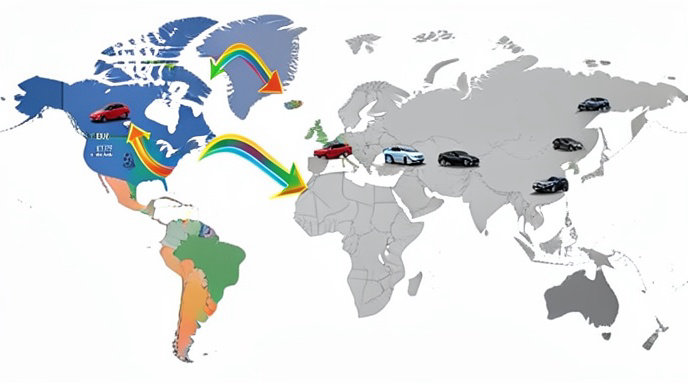
The electric vehicle market is no longer moving in lockstep around the world. Instead, it is splitting into distinct tracks: rapid expansion in many overseas markets, a more mature but still growing China, a steadier Europe, and a more uneven United States. That divergence is reshaping the competitive landscape for automakers, suppliers, and startups alike.
For legacy U.S. carmakers, the shift is especially uncomfortable. They face slowing domestic momentum, margin pressure, and intensifying competition from both established rivals and newer entrants that are moving faster on pricing, batteries, and software. At the same time, EV adoption is accelerating in countries outside the U.S. at a pace that is forcing automakers to rethink where the growth will come from next.
The Global EV Boom Is Still Real
Despite periodic headlines about softening demand, the broader trend remains clear: global EV sales continue to rise. Industry trackers estimate that more than 17 million electric cars were sold worldwide in 2024, accounting for over 20% of new car sales. By 2025, that figure is expected to move even higher.
But the story is not just about growth. It is about where the growth is happening.
China remains the center of gravity for the EV industry, accounting for nearly half of new car sales being electric in 2024 and roughly two-thirds of electric cars sold globally. Europe is also a major market, especially for battery-electric vehicles. Yet some of the most striking momentum is now coming from emerging markets.
In Southeast Asia, electric car sales have surged as governments offer tax breaks, import duty exemptions, and incentives for local production. Thailand and Malaysia have seen especially strong gains. In Latin America, Brazil has emerged as a major growth market, while Mexico, Colombia, and Costa Rica are also posting meaningful increases. Even in parts of the Middle East, EV adoption is rising quickly thanks to favorable import policies and lower taxes.
The U.S. Is Growing, But Not at the Same Speed
The U.S. EV market is still expanding, but its trajectory looks less dramatic than in many other regions. American buyers remain sensitive to vehicle prices, charging access, interest rates, and uncertainty around incentives. That has made the domestic EV transition more uneven than many automakers hoped.
Some U.S. brands have found success with specific models, but the market overall is not accelerating at the same pace as China or certain emerging economies. That creates a difficult backdrop for companies that invested heavily in factory conversions, battery sourcing, and future product plans based on faster near-term adoption.
For legacy automakers, the challenge is not simply selling more EVs. It is maintaining profitability while doing so. EVs generally carry thinner margins than internal combustion models, especially when companies rely on discounts to move inventory. If demand is choppy, the economics become even harder.
A K-Shaped Recovery Is Taking Hold
The phrase “K-shaped recovery” fits the EV market well. Some automakers and regions are moving sharply upward, while others are flattening or falling behind.
On the upswing are companies that can offer affordable EVs, efficient battery supply chains, and software-driven products tailored to local markets. Chinese automakers have been especially effective here, using scale and cost advantages to expand beyond their home market. Their influence is growing not only in China, but also in Southeast Asia, Latin America, and parts of Europe.
On the downward side are firms that are stuck with high production costs, slower product cycles, and limited model variety. That includes some traditional automakers in the U.S. that are trying to transition from a legacy business built on gasoline vehicles to a more volatile EV model. Startups, meanwhile, face a separate struggle: access to capital is tighter, investors are more selective, and the market is less forgiving of execution mistakes.
This is why the current EV transition feels less like a uniform wave and more like a sorting process. The winners are pulling ahead quickly. The rest are being forced to cut costs, delay launches, or rethink their strategy entirely.
Chinese Automakers Are Raising the Pressure
One of the biggest reasons the EV market is diverging is the rise of Chinese automakers. Their companies have become increasingly competitive on price, model selection, and production scale. They are not just dominating at home; they are exporting that advantage abroad.
A growing share of electric cars sold in markets like Brazil now come from China. That matters because it puts pressure on local and U.S.-based manufacturers to compete against vehicles that are often cheaper and available in more configurations. It also raises questions about supply chain resilience, trade policy, and whether Western automakers can keep pace without drastically lowering costs.
For U.S. brands, the threat is not only in direct competition overseas. It is also about learning speed. Chinese firms are moving quickly on battery chemistry, software integration, and vehicle features that appeal to a broad base of buyers. That raises the bar for everyone else.
Startups Face a More Brutal Market
The EV slowdown in some regions has been especially hard on startups. When demand is growing at a predictable pace, new entrants can find room to scale. But when growth becomes patchy and capital gets expensive, startup business models get exposed.
Younger EV companies often rely on continued investor support, high valuations, and the promise of future scale. That model is harder to sustain when established automakers are also chasing the same customers with lower prices, more service infrastructure, and broader brand recognition.
The result is a tougher environment for pure-play EV startups. Some are shifting toward niche segments, fleet sales, or software and charging services. Others are pursuing partnerships with larger manufacturers. But the days of easy access to capital and boundless optimism are over.
What Legacy Automakers Must Do Next
For legacy automakers, survival in the next phase of the EV market will depend on a few key moves.
First, they need to sharpen their cost structures. That means improving battery sourcing, simplifying platforms, and building EVs at scale without relying on constant incentives.
Second, they need to expand affordable model offerings. The premium segment helped kick-start EV adoption, but mass-market growth will come from lower-priced vehicles that can compete with gasoline cars on total cost of ownership.
Third, they need to move faster on software and user experience. Modern EV buyers increasingly expect seamless infotainment, driver-assistance features, over-the-air updates, and charging integration. Hardware alone is no longer enough.
Finally, they need a more flexible global strategy. The markets that will define EV growth over the next few years are not all in the U.S. Companies that treat EVs as a single-country story risk missing the regions where momentum is strongest.
The Bigger Implication for the Industry
The global EV market is entering a more mature and more competitive phase. Growth is still strong, but it is no longer evenly distributed. That creates both opportunity and risk.
For the winners, the next few years could bring huge scale advantages, stronger brand positions, and more leverage over suppliers. For the laggards, the danger is not just slower growth. It is strategic irrelevance.
The core lesson is that the EV transition is not slowing everywhere. It is accelerating in some places, stalling in others, and reshaping the automotive industry country by country. In that world, agility matters more than ever.
U.S. automakers are not out of the race. But if they want to compete in a global market that is becoming more K-shaped by the month, they will need to move faster, price smarter, and think beyond the domestic road ahead.

Get All The Latest Updates Delivered Straight To Your Inbox For Free!