
The Future of Work: How ClickUp's Layoffs Signal a Shift to AI
TL;DR
- ClickUp cut 22% of its workforce while CEO Zeb Evans said the company is reorganizing around an AI-heavy “100x org” model rather than simply trimming costs.
- The company says it now uses about 3,000 internal AI agents, roughly a 3:1 agent-to-employee ratio, and is pushing staff to become AI system managers instead of doing routine work themselves.
- ClickUp is also introducing salary bands up to $1 million for employees who deliver outsized AI-driven impact, signaling a new compensation model tied to automation.
ClickUp’s latest layoffs are more than a standard corporate downsizing story. They mark one of the clearest public bets yet that AI agents can replace large parts of white-collar work, and that the employees who remain will be judged by how effectively they can direct machines.
A layoff framed as a redesign
ClickUp, the productivity software company valued at about $4 billion, said it reduced headcount by 22% as part of a broader restructuring centered on artificial intelligence. CEO Zeb Evans has publicly framed the move as a structural shift toward a “100x org,” arguing that AI has changed what it takes to build software and operate a company at scale.
That framing matters. In the company’s telling, this was not a conventional cost-cutting round triggered by financial distress, but a redesign of the operating model itself. The savings from the cuts, Evans said, would be redirected toward remaining employees through much larger compensation bands.
The rise of the AI-agent workplace
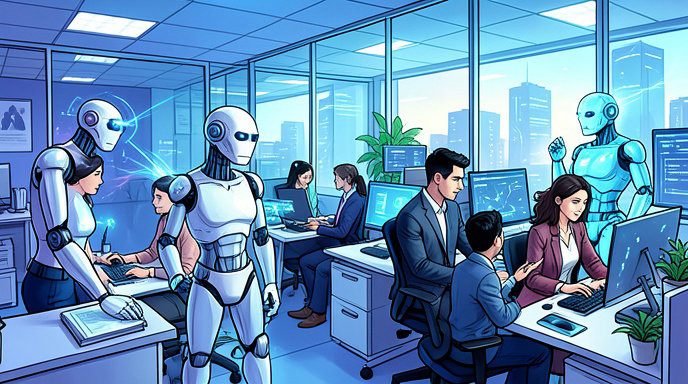
The most striking part of ClickUp’s new model is the scale of automation already inside the company. Reporting around the layoffs said ClickUp now runs roughly 3,000 internal AI agents, creating an approximate 3:1 ratio of agents to employees.
According to Fortune, those agents are embedded directly into day-to-day workflows across departments, and employees increasingly spend their time directing, reviewing, and refining work done by software agents rather than performing the tasks themselves. Evans described the biggest change as moving “from actually doing and waiting on the work, to reviewing the work and ensuring that it meets your standards.”
That shift is already changing job definitions inside the company. Workers are being pushed toward roles such as builders, system managers, and “front-liners” who preserve the human touch in customer interactions. In practical terms, ClickUp appears to be turning managers of AI systems into the new core workforce.
What the company says replaces routine roles
Evans has said that employees who automate their own jobs with AI will still have a place at the company, because they become “owners” or “agent managers” rather than being displaced by automation. That idea reflects a broader trend in AI adoption: tasks that are repetitive, document-heavy, or coordination-heavy are increasingly being handed to software, while humans supervise exceptions, judgment calls, and customer-facing interactions.
ClickUp’s internal policy seems to reinforce that logic. Fortune reported that employees now interact with agents that can gather information, format updates, and surface what matters, while guardrails limit what those agents can do on their own. The result is a workplace where AI is not a side tool, but the default layer between people and information.
The new compensation gamble
Alongside the layoffs, ClickUp is introducing salary bands that can reach $1 million per year for employees who generate “100x impact” through AI systems. That is an unusual move in startup compensation, where equity often matters more than cash and pay bands are typically far narrower.
The message is blunt: automation is not just replacing labor, it is being revalued as a direct path to elite compensation. In ClickUp’s model, the people most likely to be rewarded are not necessarily the fastest individual contributors in a traditional sense, but those who can build, manage, or amplify AI-driven systems.
What this means for the startup world
ClickUp’s move fits a wider pattern across tech companies that are using AI to boost output while keeping headcount in check. But its combination of large layoffs, heavy internal automation, and six-figure-to-seven-figure pay bands makes it an unusually visible case study in the future of work.
For startups, the appeal is obvious. AI can promise faster execution, lower operating costs, and more output per employee. The risk is just as clear: job security becomes tied less to tenure or expertise in a narrow role, and more to whether a worker can adapt quickly enough to manage machines effectively.
That could reshape workplace dynamics in several ways:
- Teams may become smaller but more leveraged, with each employee overseeing a much larger digital workload.
- Middle-management and coordination roles may shrink if AI handles more planning, triage, and documentation.
- Performance expectations may rise sharply, because “doing more with less” becomes the baseline rather than the exception.
The human side of the AI transition
ClickUp’s strategy also highlights a tension at the center of the AI boom. Companies want the efficiency gains of automation, but they still need people for trust, judgment, and customer relationships. Evans has suggested that as AI communication becomes more common, the “human touch” may become even more important in specific roles, especially those involving customers.
That creates a split labor market inside the same company: some workers will increasingly act as supervisors of AI, while others will be retained specifically because they are hard to automate. In that world, the question is no longer whether AI changes work, but which parts of work remain meaningfully human.
Why ClickUp’s move matters now
ClickUp is not the first company to automate aggressively, but its public embrace of a 3:1 agent-to-human ratio and million-dollar pay bands makes it a symbolic milestone. The company is effectively arguing that the next generation of startups will be built less around growing headcount and more around scaling autonomous systems.
If that model spreads, layoffs may increasingly be presented not as a failure to grow, but as a sign that management believes software can do the work faster, cheaper, and at greater scale. For workers, that means the safest career move may no longer be mastering a fixed job description, but learning how to supervise the tools that are quietly taking those jobs apart.

Get All The Latest Updates Delivered Straight To Your Inbox For Free!