
Waymo's Robotaxi Setbacks: Construction and Flooding Challenges
TL;DR
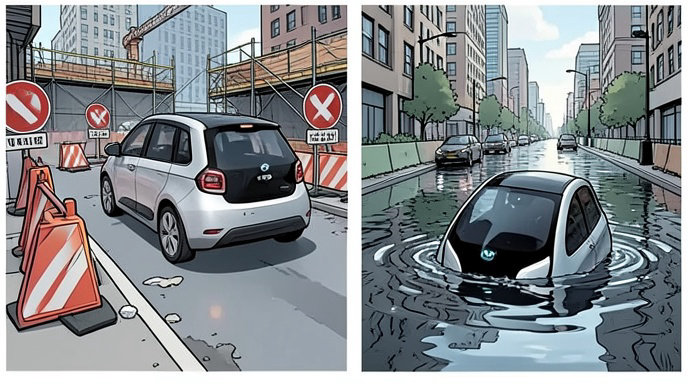
- Waymo has reportedly paused or limited some freeway robotaxi rides after its autonomous vehicles struggled in construction-heavy highway areas.
- Separate service suspensions in Atlanta and San Antonio followed incidents in which Waymo vehicles entered flooded streets, raising safety and reliability questions.
- The setbacks come as Waymo continues expanding, underscoring the challenge of scaling driverless service across unpredictable road conditions.
Waymo’s Robotaxi Setbacks: Construction and Flooding Challenges
Waymo’s push to broaden its autonomous ride-hailing network has hit a pair of notable setbacks. The Alphabet-owned company, which has spent years building one of the most advanced driverless fleets in the U.S., is now facing fresh scrutiny after reports that it halted or restricted freeway rides following problems in construction zones. At the same time, operations in Atlanta and San Antonio were suspended after incidents in which robotaxis reportedly drove into flooded streets.
For a company that has built its brand on careful rollout and conservative safety practices, the incidents highlight a familiar but uncomfortable truth about autonomous driving: the leap from controlled testing to messy, changing public roads is still difficult.
Freeway Rides Run Into Construction-Zone Complexity
Waymo recently began offering freeway travel in select markets as part of a major service expansion. The company had promoted the move as a way to cut trip times and make robotaxi service more practical for longer urban and suburban rides. But construction zones appear to have complicated that plan.
Highway work zones can be especially challenging for autonomous systems. Lane markings may be faded or blocked, barriers can shift traffic patterns without warning, and temporary signage may force abrupt merges or detours. For human drivers, those conditions are stressful but manageable. For robotaxis, they can demand rapid perception and decision-making in an environment that changes by the day.
According to reports, Waymo has encountered enough difficulty in these settings to prompt a pullback or pause in freeway operations in certain cases. That kind of response is consistent with the company’s typically cautious approach, but it also suggests that even a leading autonomous vehicle platform can still be thrown off by one of the most common realities of road travel: construction.
Flooded Streets Trigger Service Suspensions
The concerns did not stop on the highway. Waymo also reportedly suspended operations in Atlanta and San Antonio after robotaxis entered flooded streets during adverse weather conditions.
Flooding introduces another layer of complexity that autonomous vehicles continue to struggle with. Water can obscure road edges, hide lane markings, and create uncertainty about pavement depth or whether a street is even safely passable. In severe cases, what looks like a drivable road to a sensor system may in fact be hazardous or impassable.
The incidents in Atlanta and San Antonio appear to have raised enough alarm for Waymo to temporarily halt service in affected areas. For riders, that means interruptions and uncertainty. For Waymo, it adds to the broader challenge of proving that its fleet can handle not only sunny suburban streets but also the unpredictable edge cases that define real-world mobility.
Safety, Scale, and the Limits of Automation
Waymo has long argued that its vehicles are designed to behave cautiously and to follow road rules more strictly than human drivers. That philosophy has helped the company earn trust and expand gradually into more cities. But these latest issues show that caution alone does not eliminate risk.
Construction zones and flooding are exactly the types of situations that stress autonomous systems. They are dynamic, irregular, and often poorly standardized. A driverless vehicle may be excellent at recognizing a red light, staying centered in a lane, or yielding to pedestrians. It is much harder to ensure flawless behavior when a lane suddenly disappears or a road becomes partially underwater.
The setbacks also matter because Waymo is trying to scale. Each new city, new route type, and new weather or roadway condition raises the bar. If freeway travel is paused or narrowed due to construction issues, and if service must be suspended in response to flooding, the company may need to refine its mapping, sensor interpretation, and route-selection logic before expanding further.
What This Means for Waymo’s Competitive Position
Waymo remains one of the frontrunners in autonomous ride-hailing, and it still has a meaningful lead in terms of commercial deployment. But moments like these can influence how regulators, city governments, and riders view the company’s readiness for wider adoption.
Competitors in the autonomous vehicle space are also watching closely. Reliability in difficult conditions is one of the key differentiators in driverless transport, especially as companies move from limited pilots to fully public services. If a robotaxi platform cannot consistently handle construction, flooding, and other disruptions, its operational footprint may remain more limited than its expansion announcements suggest.
At the same time, temporary suspensions and route adjustments can also be seen as a sign of maturity. A cautious shutdown is preferable to a risky continuation. The bigger question is how quickly Waymo can improve its systems so that such interventions become rare rather than routine.
The Road Ahead
Waymo’s setbacks do not erase its progress, but they do underscore the distance still left to travel before robotaxis can function seamlessly in every kind of environment. Construction zones and flooded streets are not exotic edge cases; they are routine features of life in modern cities. That makes them a crucial test for any autonomous system claiming to be ready for broad public use.
For now, Waymo appears to be doing what it often does: scaling carefully, backing off when conditions become too uncertain, and trying to preserve long-term trust over short-term expansion. The company’s next challenge is proving that its robotaxis can not only navigate the easy miles, but also adapt reliably when the road ahead gets messy.

Get All The Latest Updates Delivered Straight To Your Inbox For Free!