
AI Adoption Fuels Job Growth: The Surprising Rise of Entry-Level Positions
TL;DR
- Companies with high-intensity AI adoption are reversing the "AI kills jobs" narrative, showing a significant increase in entry-level hiring, with some reports citing a 12% rise in junior positions.
- The nature of entry-level work is evolving: routine tasks are automated, while new roles demand critical thinking, human oversight of AI, and strategic decision-making skills typically reserved for more experienced workers.
- Despite a 13% drop in entry-level jobs for young workers in AI-exposed sectors since 2022, the overall market for early-career positions is expanding in absolute numbers, driven by productivity gains from AI integration.
The AI Paradox: Why High-Tech Adopters Are Hiring More Juniors
For years, the dominant narrative in the tech world has been clear: Artificial Intelligence is the great job destroyer, particularly for the entry-level workforce. The fear was that algorithms would automate the "grunt work" that fresh graduates relied on to learn the ropes, leaving young professionals with no path to the career ladder. However, a startling new wave of data from 2025 and early 2026 is shattering this assumption.
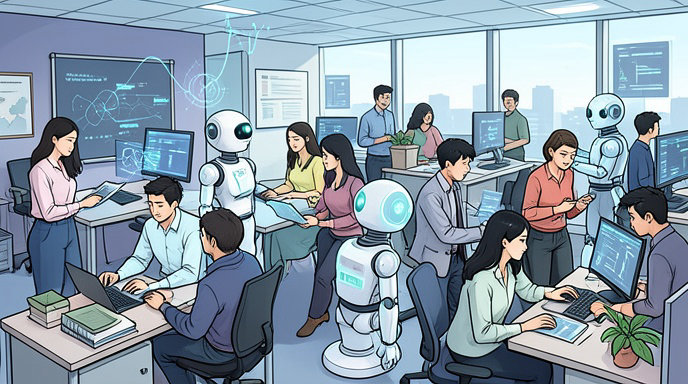
Contrary to popular belief, companies that are heavily adopting AI technology are not shedding junior talent; they are actively increasing it. Recent reports indicate that high-intensity AI adopters have seen a rise in entry-level positions, with some data pointing to a 12% increase in these roles. This shift suggests that AI is not replacing the workforce but rather reshaping it, creating a demand for new kinds of early-career employees who can manage, interpret, and oversee intelligent systems.
The Data Defies the Doom-and-Gloom Narrative
The most compelling evidence comes from a comprehensive survey conducted by the Strada Education Foundation, which analyzed the hiring plans of approximately 1,500 employers. The results were unexpected: executives from organizations utilizing or considering AI were nearly three times more likely to ramp up junior-level recruitment in 2026 than to scale it back.
Specifically, firms leveraging AI to the greatest extent displayed the most optimism regarding entry-level hiring. While general anxiety about AI's impact on white-collar jobs persists, the data shows a distinct divergence. Companies that have integrated AI deeply into their workflows are recognizing that they need more human hands to operate these systems.
"Entry-level roles are starting to prioritize systems thinking, critical analysis, and human oversight of AI, rather than repetitive execution," noted industry analysts. This shift means that while the tasks have changed, the need for entry-level talent has grown. The 12% rise in positions among high-intensity adopters is a direct reflection of this new operational reality.
Redefining the Entry-Level Role: From "Doer" to "Manager"
The rise in entry-level jobs is not a simple return to the old ways of hiring. The nature of the work has fundamentally transformed. In the past, a fresh graduate might have been tasked with data entry, basic coding, or drafting simple reports. Today, AI handles those routine responsibilities.
Consequently, the new entry-level role is one of management and oversight. Young workers are increasingly tasked with:
- Reviewing AI Outputs: Checking the accuracy and bias of content generated by algorithms.
- Making Critical Decisions: Using AI as a tool to inform high-stakes choices rather than just executing predefined steps.
- Strategic Integration: Learning how to weave AI tools into broader business strategies.
This evolution has led to a phenomenon described by PwC as "seniorization." Entry-level positions in AI-exposed sectors now demand skills typically expected later in a career, such as strategic decision-making and stakeholder management. In fact, 52% of the new skills listed in entry-level job ads for these sectors are usually linked to more experienced professionals. The bar has been raised, but the door remains open—and in many cases, it has been widened.
The Nuance: A Growing Market Amidst Sectoral Shifts
It is important to acknowledge the complexity of this trend. While the overall market for early-career positions is expanding, there are still significant challenges in specific sectors. A study by Stanford University revealed a 13% reduction in employment for workers aged 22 to 25 in AI-exposed occupations since late 2022. Similarly, Revelio Labs reported an 11% decline in entry-level hiring in sectors most exposed to automation over the past 18 months.
However, these declines are offset by massive growth in other areas. PwC’s global dataset found that approximately 11 million early-career positions were advertised in 2025, an increase from previous years. The key takeaway is that the growth is concentrated in roles requiring advanced judgment and AI literacy.
The "career ladder" is not disappearing; it is being rebuilt. The first rung now requires a different set of tools. For young workers, the path forward involves either seeking roles that require physical presence (which AI cannot yet replicate) or securing internships that lead to these newly defined, AI-enhanced entry-level positions.
What This Means for the Future of Work
The surge in entry-level hiring among AI-heavy companies signals a new era of productivity. AI is not just a tool for efficiency; it is a catalyst for job creation. By automating the mundane, it frees up human potential for higher-value tasks, creating a demand for a workforce that is adaptable, tech-savvy, and critically thinking.
As we move through 2026, the message for employers and educators is clear: AI literacy must be embedded across academic and workforce programs. The future of entry-level work is not about replacing humans, but about empowering them to work alongside intelligent systems. The "job killer" narrative is being replaced by a story of transformation, where the entry-level workforce is not just surviving, but thriving in a more dynamic, AI-driven economy.

Get All The Latest Updates Delivered Straight To Your Inbox For Free!