
South Korea's $550B Bet on Memory Chips to Combat RAM Crisis
TL;DR
- Samsung Electronics and SK Hynix are jointly investing 800 trillion won ($518 billion) to build four new memory fabrication plants in South Korea's southwest region, directly targeting the AI-driven surge in demand for high-bandwidth memory.
- The broader national strategy includes an additional $356 billion for AI data center infrastructure and $52 billion for advanced packaging hubs, aiming to double South Korea's memory chip production capacity within five years.
- This mega-investment, championed by President Lee Jae Myung, positions South Korea to maintain its global leadership in semiconductors and secure its supply chain against competition from China and Taiwan in the AI era.
South Korea's $550B Bet on Memory Chips to Combat RAM Crisis
The global artificial intelligence revolution is creating a massive bottleneck in computing infrastructure, and South Korea is responding with a historic financial counterattack. In a move that underscores the critical strategic importance of semiconductors in the modern economy, the world's two largest memory chipmakers, Samsung Electronics and SK Hynix, have unveiled plans to invest a staggering 800 trillion won (approximately $518 billion) to expand their production capabilities.
This investment is not merely about increasing volume; it is a targeted response to the "RAMageddon" crisis, where the demand for high-bandwidth memory (HBM) and advanced DRAM is outpacing supply due to the exponential growth of AI models.
The Mega-Investment: Four New Plants in the Southwest
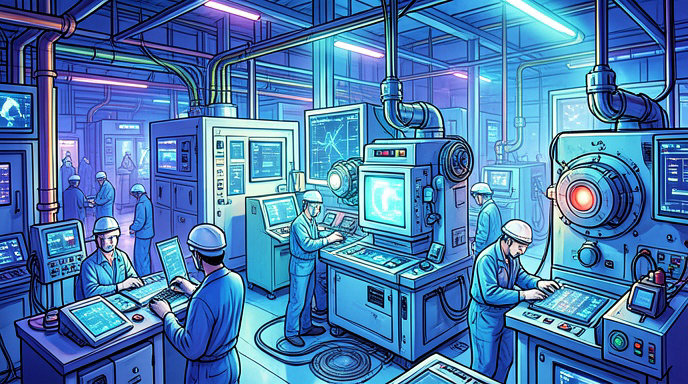
The cornerstone of this strategy is the construction of four new semiconductor fabrication plants. Two facilities will be built by Samsung and two by SK Hynix, all located in South Korea's southwest region. This area, historically underdeveloped for heavy industry compared to the Seoul metropolitan area, is being transformed into the nation's new "chip cluster."
Industry Minister Kim Jung-kwan confirmed that the investment will be supported by suppliers and infrastructure partners, creating one of the world's most comprehensive chip manufacturing ecosystems. The location was chosen not only for its strategic separation from existing hubs but also for its untapped power resources, which are essential for running the massive, energy-intensive data centers and fabrication lines required for next-generation chips.
Beyond Fabrication: Packaging and Data Centers
The $518 billion fabrication investment is part of a larger, triple-axis national strategy that encompasses semiconductors, physical AI, and data centers. The government has outlined additional funding streams to ensure the entire value chain is robust:
- Advanced Packaging: A dedicated $52 billion investment is earmarked for a high-bandwidth memory (HBM) packaging hub in the central region. As chips become more complex, the ability to stack and package them efficiently becomes as critical as the fabrication process itself. SK Hynix has already announced a specific $13 billion investment for a new facility focused on advanced packaging to meet AI memory demand.
- AI Data Centers: To support the computational needs of these chips, the government is backing $356 billion (550 trillion won) in investments for AI data centers. Major conglomerates like SK Group, GS Group, and Naver are leading this effort, with plans to build an additional 10-gigawatt AI data center by 2035, bringing the total capacity to over 18.4 gigawatts.
Doubling Capacity to Secure Global Leadership
The primary objective of this unprecedented capital expenditure is to double South Korea's memory chip production capacity within the next five years. This aggressive timeline is a direct response to intensifying competition from China and Taiwan, which are also pouring resources into their semiconductor sectors.
President Lee Jae Myung, who unveiled the blueprint at a policy briefing titled "Vision and Strategy for K-Semiconductors in the AI Era," described the situation as "do-or-die." The government's plan includes not just private investment but also public incentives, deregulation, and a public fund to lower the barriers for massive corporate spending.
The market has already reacted to this confidence. SK Hynix recently joined the ranks of Asia's trillion-dollar enterprises, with its stock skyrocketing by 1,000% over the past year, while Samsung's shares have risen by 500%. The Kospi index has reached unprecedented highs, reflecting the market's belief that South Korea is the indispensable engine of the global AI hardware supply chain.
The Future of the AI Economy
As AI models grow more complex, the demand for memory is becoming the single biggest bottleneck in the industry. By investing over $550 billion into the memory chip sector, South Korea is effectively betting that it will remain the gatekeeper of the AI revolution.
This investment signals a shift from a memory-dominated industry to a more balanced, innovation-driven ecosystem that spans the entire semiconductor value chain. From next-generation memory technologies to AI-specific chips and compound semiconductors, South Korea is positioning itself not just as a manufacturer, but as the architect of the future digital infrastructure.
With the first phase of construction set to begin immediately and mass production scheduled to ramp up by 2027, the world is watching to see if South Korea can successfully deliver on its promise to solve the global RAM crisis and secure its dominance in the AI era.

Get All The Latest Updates Delivered Straight To Your Inbox For Free!