
Amazon's Satellite Network: A New Challenger to SpaceX in Mobile Connectivity
TL;DR
- Amazon’s satellite internet project, now branded Amazon Leo, is moving from broadband-only ambitions toward direct-to-smartphone connectivity and broader mobile support.
- The company is also deepening partnerships with carriers like Verizon, signaling a hybrid model that could extend 4G/5G coverage rather than replace terrestrial networks.
- Amazon’s expanding constellation puts it in clearer competition with SpaceX’s Starlink, especially as both race to combine satellite internet with mobile-phone services.
Amazon’s Satellite Network: A New Challenger to SpaceX in Mobile Connectivity
Amazon is sharpening its satellite strategy into something bigger than home broadband. Its low-Earth-orbit constellation, now called Amazon Leo, is being positioned as a network that could support both internet access and mobile-phone connectivity, putting Amazon into more direct competition with SpaceX’s Starlink.
Amazon has said the network is designed to provide fast, reliable internet to customers and communities beyond the reach of existing networks, and it began an enterprise preview in November 2025 using production hardware and software. The company says it plans to roll out Amazon Leo more broadly in 2026 as more satellites launch and network coverage expands.
From Satellite Internet to Mobile Connectivity
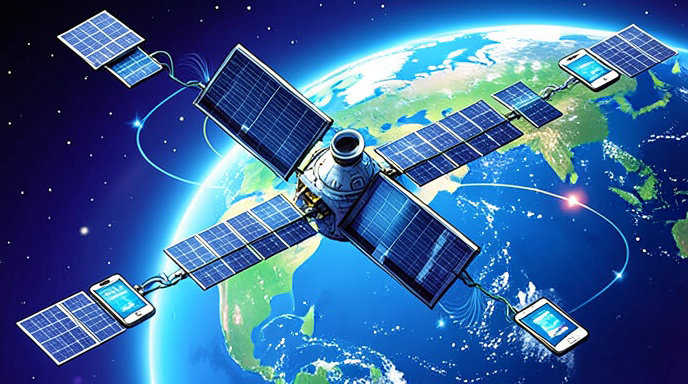
The most consequential shift is Amazon’s interest in direct-to-device or smartphone connectivity. Reporting on Amazon’s discussions with regulators indicates the company is developing technology to connect smartphones to its planned satellite constellation, signaling that its ambitions now extend beyond fixed broadband terminals.
That matters because smartphone connectivity from orbit is one of the most commercially significant frontiers in satellite communications. If Amazon can make the technology work at scale, it could offer a new layer of coverage for areas with weak terrestrial service, emergency fallback connectivity, and potentially new consumer and enterprise offerings.
Amazon Leo’s Buildout Is Accelerating
Amazon’s constellation is large by any standard. The FCC authorized the company in 2020 to deploy 3,236 satellites in low Earth orbit, and the project has been structured in phases, with service expected after the first 578 satellites are in orbit.
As of June 2026, Amazon had launched 367 production satellites, according to the project’s public record, with the first 27 production satellites launched in April 2025. Amazon says it is preparing to expand coverage as launches continue, and it plans wider service availability in 2026.
That rollout pace is important because satellite networks become more valuable as density increases. More satellites generally mean better coverage, lower latency, and more reliable service, especially for mobile use cases where seamless handoffs and capacity are critical.
Verizon Partnership Shows a Different Go-to-Market Strategy
Amazon is not approaching mobile connectivity only as a consumer service. Verizon announced a strategic collaboration with Amazon to pair its terrestrial mobile network with Project Kuiper, now Amazon Leo, in order to strengthen wireless coverage.
The stated goal is to extend Verizon’s footprint, particularly in harder-to-serve areas. Verizon said the effort is aimed at making its coverage map broader, and the company described the timeline as still being a few years away.
That partnership suggests Amazon sees satellite as a complement to terrestrial carriers, not just a standalone rival. It also gives Amazon a path into telecom infrastructure without having to build a nationwide mobile carrier business from scratch.
The Starlink Comparison
Amazon’s emergence inevitably invites comparison with Starlink, SpaceX’s satellite internet network, which has already established a major global presence and has been associated with both broadband and mobile-adjacent connectivity efforts.
BBC reporting says Amazon is enhancing its satellite operations to provide internet and mobile phone services and plans a next-generation satellite system by 2028, explicitly framing the move as a challenge to Starlink. While Starlink has a head start, Amazon’s scale, cloud expertise, and enterprise relationships could help it compete in different ways.
One key difference is strategic style. SpaceX has tended to move fast with vertically integrated launch capacity, while Amazon appears to be combining in-house satellite development with carrier partnerships and enterprise previews. That could make Amazon slower to market, but potentially more integrated with existing telecom infrastructure.
What This Means for the Telecom Industry
If Amazon succeeds, the telecom industry could see a broader shift toward hybrid networks that blend ground-based mobile infrastructure with satellite coverage. That would matter most in rural areas, disaster recovery, remote work, logistics, maritime use, and industrial deployments where coverage gaps are costly.
It could also increase pressure on carriers to differentiate through partnerships, pricing, and service quality rather than relying solely on spectrum and tower density. The Verizon deal is an early sign of that shift, suggesting satellite capacity may become a standard tool in carrier network design rather than a niche add-on.
The Competitive Stakes Are Getting Higher
Amazon’s move into smartphone connectivity raises the stakes in a market that is still forming. The company already has the scale to invest heavily, the cloud infrastructure to support enterprise services, and the consumer ecosystem to distribute products and services widely.
What remains uncertain is execution. Satellite-to-phone service is technically demanding, regulatory approvals are complex, and the economics of launching and maintaining large constellations remain challenging. But Amazon has made clear that it intends to be more than a satellite internet entrant; it wants to be a serious player in the next phase of global mobile connectivity.
What to Watch Next
The next major signals will be Amazon’s service launch timing, the pace of satellite deployments, and whether the company can move from experimental and enterprise access toward consumer-ready mobile service.
Also worth watching is whether Amazon expands its carrier partnerships beyond Verizon and how aggressively it positions Amazon Leo against Starlink in both broadband and direct-to-device markets.

Get All The Latest Updates Delivered Straight To Your Inbox For Free!