
AMD Challenges Nvidia with New Helios AI Rack-Scale System Launch
TL;DR
- AMD has unveiled Helios, an open rack-scale AI system built for hyperscale training and inference, and it is aimed directly at Nvidia’s newest data-center racks.
- AMD says Helios can deliver up to 2.9 exaflops of FP4 performance in a 72-GPU rack, with 50% more HBM capacity than Nvidia’s Vera Rubin rack design.
- The company is positioning Helios as a 2026 platform for OEMs, ODMs, and major cloud customers, with early deployments and partner systems already lined up.
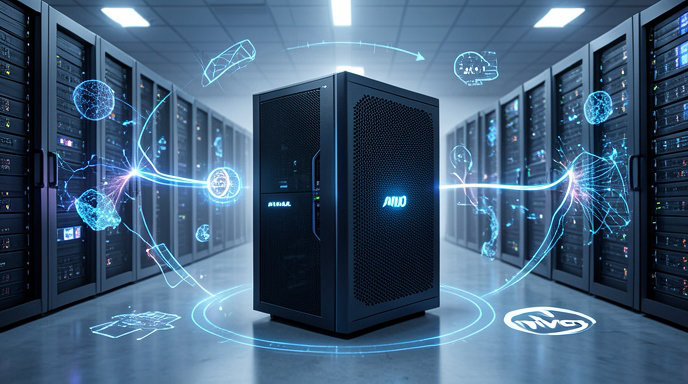
AMD is making its boldest push yet into rack-scale AI infrastructure with Helios, a new system designed to compete head-on with Nvidia at the high end of the AI data-center market. The platform is being pitched not as a single product, but as a blueprint for how next-generation AI factories will be built, serviced, and scaled.
What Helios is
Helios is AMD’s open rack-scale AI reference design, built around the company’s upcoming Instinct MI455X GPUs, EPYC “Venice” CPUs, and Pensando “Vulcano” networking. AMD says the system integrates compute, memory, networking, and software into a single rack-level platform intended for hyperscale environments.
The rack uses 72 GPUs and is designed to support extremely large AI workloads, including frontier model training and high-throughput inference. AMD has also framed Helios as aligned with Open Compute Project standards, including Meta’s Open Rack Wide direction, which is meant to simplify deployment and improve interoperability across large data centers.
The performance pitch
AMD’s headline claim is that Helios can deliver up to 2.9 exaflops of FP4 performance in a single rack, along with up to 1.4 exaflops of FP8 performance for training workloads. The company also says the system can provide about 260 terabytes per second of aggregated scale-up bandwidth in HPE’s Helios implementation.
AMD has paired those numbers with a direct comparison to Nvidia’s Vera Rubin NVL72 rack, saying Helios is designed to offer up to 15% more AI compute, 50% more HBM capacity, and 50% more scale-out bandwidth. In earlier messaging, AMD also said Helios could provide up to 36x higher performance versus previous generations, though that figure is based on engineering projections rather than a live shipping benchmark.
Why this matters in the Nvidia rivalry
Helios is important because it shows AMD is no longer only trying to sell individual accelerators; it is now challenging Nvidia at the system level, where the most valuable AI infrastructure deals are being made. Nvidia has dominated this space with integrated rack-scale offerings, and AMD is trying to answer with an open, standards-based alternative that emphasizes serviceability, scale, and memory capacity.
AMD’s strategy also leans heavily on openness. By building Helios around OCP-aligned standards and working with partners such as Meta and HPE, AMD is trying to make its platform easier for cloud providers and OEMs to adopt at scale. That could matter for buyers who want more flexibility than Nvidia’s tightly integrated ecosystem typically offers.
Early customers and deployment plans
AMD says Helios is already moving beyond concept stage. The company described the system as a reference design currently being released to OEM and ODM partners, with volume deployment expected in 2026.
HPE has already announced a Helios-based rack-scale architecture for cloud and neocloud customers, saying it will offer the solution worldwide in 2026. AMD has also pointed to Oracle as an early customer for initial Helios deployment, with rollout timing beginning in 2026 and further expansion planned afterward.
What the market impact could be
If AMD’s performance and bandwidth claims hold up in real deployments, Helios could give buyers a serious alternative in the most expensive segment of AI infrastructure. That matters because the market for AI racks is increasingly defined by total system capability, not just raw GPU specs, especially for customers training trillion-parameter models.
The bigger impact may be on purchasing leverage. Even if Nvidia remains the dominant supplier, a credible second platform at rack scale could pressure pricing, broaden customer choice, and push faster innovation across networking, memory, and software stacks. AMD is betting that openness, memory capacity, and large-scale integration will be enough to win meaningful share from Nvidia in 2026 and beyond.
What to watch next
The key questions now are whether AMD can translate its bold specifications into real-world deployments, and whether customers see enough benefit to adopt a new rack-scale architecture instead of staying with Nvidia’s established platform. The next major signals will come from production shipments, customer performance results, and how quickly OEMs and cloud providers move from pilot programs to volume rollouts.

Get All The Latest Updates Delivered Straight To Your Inbox For Free!