
NASA's Robot Telescope Lifter in Turbulent Trouble
TL;DR
- NASA’s robot spacecraft Link has launched to rescue the aging Swift Observatory, a first-of-its-kind mission meant to raise the telescope back to a stable orbit.
- The operation is high-risk and slow, requiring rendezvous, capture with robotic arms, and a gradual orbital boost over weeks to months.
- Success could create a new model for servicing and extending the life of satellites, while failure would highlight the limits of uncrewed orbital repair and tug missions.
A daring rescue for a fading observatory
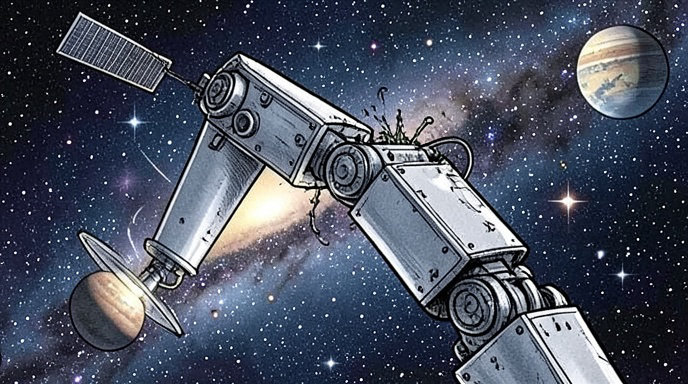
NASA has launched a robotic mission to save the Neil Gehrels Swift Observatory, a space telescope that is steadily losing altitude and is expected to re-enter Earth’s atmosphere if nothing is done. The rescue craft, called Link, is designed to approach the telescope, grab it with robotic arms, and then push it to a higher, more stable orbit.
This is an unusual mission because it is not just a flyby or a diagnostic check. It is a true orbital rescue, one that aims to preserve a working scientific observatory rather than replace it.
Why Swift is in trouble
Swift’s orbit has been degrading because increased solar activity has expanded the upper atmosphere, creating more drag on the spacecraft. That extra drag has gradually slowed the telescope and lowered its altitude over time. According to reporting on the mission, Swift has fallen from about 373 miles (600 km) at launch to roughly 220 miles (360 km) today.
Without intervention, the telescope could eventually burn up during atmospheric re-entry. NASA’s rescue effort is therefore intended to buy Swift more time to continue observing cosmic explosions and other high-energy events.
How the robotic capture is supposed to work
Link’s job is not simple. After reaching an orbit close to Swift’s, it must deploy its solar panels, perform checks, find the telescope, match its motion, and dock using three robotic arms. That sequence is expected to take weeks.
If capture succeeds, the craft will then slowly raise Swift’s orbit, with the full boosting phase expected to last at least a month and possibly longer. The goal is not a dramatic shove into a much higher orbit, but a careful, gradual lift to a more stable altitude.
Why this mission matters beyond Swift
NASA and its partners are treating the mission as more than a one-off save. If it works, it could demonstrate a practical way to extend the life of aging satellites instead of abandoning them when fuel or altitude becomes a problem.
That has broad implications for future missions. A successful robotic salvage could open the door to satellite servicing, orbital refueling, relocation, and debris-risk reduction in a more routine way. In other words, this mission could help turn spacecraft rescue from a rare stunt into a repeatable capability.
The risks are substantial
Officials and researchers have described the effort as high risk. That is not surprising: the spacecraft must perform precision rendezvous with an object that was never originally designed to be captured in orbit.
The challenge is compounded by the complexity of the docking sequence and the need to execute the orbital raise without damaging the telescope. Any failure during approach, capture, or propulsion could end the mission or leave Swift in a worse situation.
The broader trend: robotics as space infrastructure
The Swift rescue fits into a larger pattern of NASA using robotics to solve problems that would be difficult, expensive, or impossible for astronauts alone to handle. NASA has long relied on robotic systems for remote operations, and missions like this push that idea further into active orbital maintenance.
If Link succeeds, it would signal a shift in how agencies and companies think about spacecraft lifecycles. Instead of designing every satellite to last until it dies, future systems may be built with the expectation that they can be caught, serviced, and moved by another vehicle in orbit.
What happens next
The next critical phase is the rendezvous and docking operation, which will determine whether Link can actually seize Swift safely. If it can, the mission will move into the slower and equally delicate orbital-raising stage.
For NASA, the payoff is straightforward: keep a scientifically valuable telescope alive and prove that robotic recovery in space is more than theory. For the space industry, the mission could become a proof point for a new era of on-orbit repair and rescue.

Get All The Latest Updates Delivered Straight To Your Inbox For Free!