
AI Pioneers Hinton, Fei-Fei Li and Andrew Ng Defend Open Source at Ai4 Amid US-China AI Race
TL;DR
- At Ai4 in Las Vegas, AI pioneers Geoffrey Hinton, Fei-Fei Li, and Andrew Ng presented a rare unified stance in favor of open-source AI, arguing that open access drives safety, innovation, and democratization despite growing risks.
- The panel debated AI regulation, warning that heavy-handed restrictions on open models could stifle research and cede advantage to closed systems, while still calling for responsible guardrails and tiered safety evaluations.
- With China rapidly accelerating open-source development through models like DeepSeek and Qwen, the trio outlined strategies for the U.S. to stay competitive, including investing in public compute, academic research, and an open ecosystem.
A Rare United Front on the Ai4 Main Stage
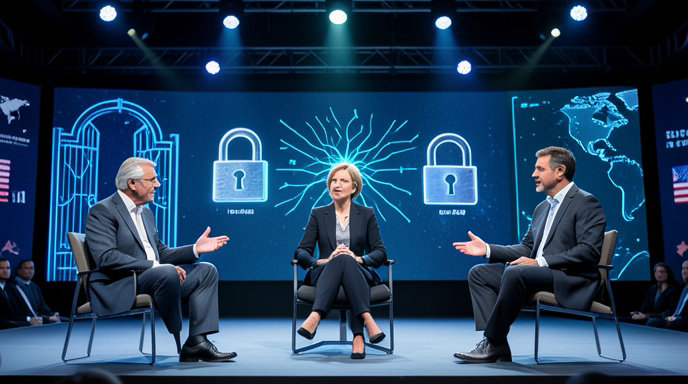
In a moment that surprised many attendees at Ai4 2026 in Las Vegas, three of the most influential voices in artificial intelligence found common ground. Geoffrey Hinton, the Nobel laureate often called the Godfather of AI, Stanford professor and ImageNet creator Fei-Fei Li, and DeepLearning.AI founder Andrew Ng took the main stage together to make a forceful case for open-source AI.
The appearance was notable because the three do not always agree on AI risk. Hinton has become famous for his warnings about existential threats from superintelligent systems, while Ng has been one of the most vocal critics of what he calls over-regulation. Li has charted a middle path focused on human-centered AI. At Ai4, however, they converged on a single message: closing off AI development behind corporate walls will make the technology less safe, less equitable, and less competitive.
Hinton's Warning: Secrecy Is Not Safety
Geoffrey Hinton, who has spent the last two years speaking out about the dangers of unchecked AI development, offered the most nuanced defense of open source. He acknowledged that open-weight models can be misused to generate disinformation or assist in bioweapon design, risks he takes seriously.
But Hinton argued that keeping powerful models closed does not eliminate those risks, it merely concentrates power and hides flaws. Open models, he said, allow thousands of independent researchers to stress-test systems, discover vulnerabilities, and build defenses faster than any single company could. True safety, in his view, comes from transparency and collaborative scrutiny, not secrecy. He advocated for a tiered release framework where models are evaluated for dangerous capabilities before their weights are made public, rather than blanket bans on open sourcing.
Fei-Fei Li and Andrew Ng: Open Source as an Engine for Democratization
Fei-Fei Li framed open source as a matter of access and equity. She pointed to her own work on ImageNet and more recently her startup World Labs, arguing that breakthroughs happen when students, researchers, and startups everywhere can build on top of existing models. If only a handful of large tech companies in the U.S. control frontier models, she warned, the U.S. risks creating a new kind of digital divide that locks out academia, smaller companies, and the public sector.
Andrew Ng delivered the most direct attack on the push for restrictive regulation. He has long argued that proposed licensing regimes and liability rules for open-source developers would be a disaster for innovation. At Ai4, he reiterated that open source is the foundation of the modern AI stack, from PyTorch to Llama to Mistral, and that it is the reason the U.S. has led the field for so long. Closing that ecosystem, he said, would not stop bad actors but would cripple the ability of good actors to innovate, audit, and create startups. He called open source the best antidote to hype and monopoly.
The Regulation Debate: Guardrails Without Gatekeeping
The panel's discussion on regulation reflected the broader tension in Washington and Silicon Valley. All three rejected the idea of an unregulated free-for-all, but they also warned against blunt, one-size-fits-all laws that treat an academic researcher fine-tuning an open model the same as a large corporation deploying a system to hundreds of millions of users.
Instead, they proposed a more targeted approach. Hinton and Li emphasized the need for robust, standardized safety evaluations, mandatory incident reporting, and funding for independent AI safety research. Ng pushed for what he calls responsible open source: clear model cards, usage guidelines, and tooling to help developers deploy models safely, without requiring government permission to publish research. The consensus was that regulation should focus on the application and impact of AI, not on criminalizing the sharing of weights and code.
The China Factor and America's Competitive Edge
The urgency behind the debate was the accelerating AI race with China. The panelists noted that China's AI ecosystem has embraced open source with remarkable speed. Models like DeepSeek-V3 and Alibaba's Qwen2 have become globally popular among developers, giving Chinese companies significant influence over the infrastructure developers use worldwide.
The pioneers warned that if the U.S. retreats from open source due to safety fears, it will inadvertently hand leadership to China in the most strategically important technology layer. To stay competitive, they argued, America needs to double down on its open advantage.
Their playbook for U.S. competitiveness included three pillars: First, massive investment in public compute infrastructure and national AI research resources so that universities can actually train and study open models without relying solely on Big Tech. Second, sustained federal funding for open research and talent development to prevent brain drain. And third, a policy environment that encourages companies to release open-weight models domestically, ensuring the next generation of global developers builds on American-led technology rather than alternatives from Asia.
Why This Debate Matters Now
The Ai4 panel did not resolve the fundamental tension between openness and safety, but it reframed it. For Hinton, Li, and Ng, open source is not the opposite of safety, it is a prerequisite for it.
As enterprise adoption of generative AI explodes and geopolitical competition intensifies, the choice facing U.S. policymakers is not simply whether to regulate AI, but how to do so without dismantling the open ecosystem that made American AI leadership possible in the first place.

Get All The Latest Updates Delivered Straight To Your Inbox For Free!