
Jill Lepore Warns How Silicon Valley Misreads Sci-Fi and Why Elon Musk Threatens Democracy
TL;DR
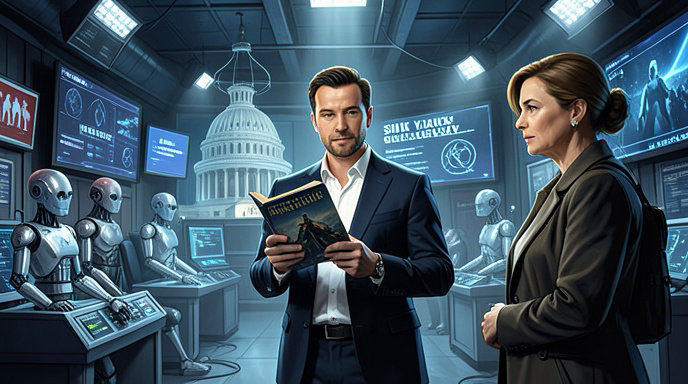
- Harvard historian Jill Lepore argues Silicon Valley has inverted science fiction, treating classic dystopian warnings like 1984 and Brave New World as utopian instruction manuals rather than cautionary tales.
- On the Equity podcast, Lepore introduces her concept of "government by machines" — a system where algorithmic and technocratic rule replaces democratic deliberation — and warns it is already taking shape.
- Lepore singles out Elon Musk as a prime example of a flawed sci-fi reader, arguing his embrace of longtermism and sci-fi-inspired visions for Mars colonization and AI undermines core democratic values.
The Dystopia as Blueprint
For decades, science fiction served as society's early warning system. Authors like George Orwell, Aldous Huxley, Margaret Atwood, and Philip K. Dick imagined futures where technology enabled authoritarianism, surveillance, and dehumanization — not to inspire those futures, but to prevent them.
According to Harvard historian and New Yorker staff writer Jill Lepore, Silicon Valley has missed the point entirely. In a recent deep dive interview on TechCrunch's Equity podcast, Lepore argued that many of the tech industry's most powerful leaders are engaged in a fundamental misreading of the genre. What were intended as dire warnings are now being treated as product roadmaps.
Lepore traces this inversion back to the counterculture roots of computing and the libertarian ethos that came to dominate Silicon Valley in the 1990s and 2000s. Instead of heeding the pessimism of dystopian fiction, founders and futurists have cherry-picked the cool gadgets and interplanetary ambitions while ignoring the political and moral collapse that surrounded them in the original stories.
What Lepore Means by Government by Machines
At the center of Lepore's critique is a phrase she calls "government by machines." It is not just about AI automating government services or algorithms deciding who gets a loan. It is a broader political philosophy where human governance — messy, deliberative, democratic — is seen as inefficient and obsolete.
In this worldview, Lepore explains, problems that were once understood as political questions requiring debate, compromise, and collective action are reframed as engineering problems with technical solutions. Democracy itself becomes a bug to be fixed rather than a feature to be protected.
She points to the growing influence of ideas like effective altruism and longtermism in tech circles, where the focus shifts from solving present-day inequality and institutional decay to optimizing for a hypothetical future of trillions of simulated or space-faring humans. When governance is outsourced to systems, models, and charismatic technologists, Lepore warns, accountability and consent disappear.
Elon Musk and the Case of the Flawed Reader
No figure embodies this misreading more clearly for Lepore than Elon Musk. An avowed fan of science fiction — from Douglas Adams' The Hitchhiker's Guide to the Galaxy to Isaac Asimov's Foundation series and Iain M. Banks' Culture novels — Musk frequently cites sci-fi as inspiration for SpaceX, Tesla, and his vision for AI and human colonization of Mars.
But Lepore argues Musk is a flawed reader of the very texts he reveres. Where authors intended satire, tragedy, or critique of unchecked power, Musk extracts a literal, heroic narrative of the lone genius-engineer who must save humanity from itself — even if it means bypassing democratic institutions to do so.
On Equity, Lepore detailed how Musk's self-styled mission to make humanity multiplanetary, his approach to content moderation at X, and his pronouncements on AI existential risk reflect a tech-utopian logic that is fundamentally anti-democratic. It places decision-making power in the hands of a small cadre of billionaires and their machines, rather than in the hands of the public.
She notes that this is not new. The history of American technocracy is filled with figures who believed experts and inventors should rule, from the early 20th century to today. What is new is the scale, the capital, and the cultural cachet that allows that vision to be implemented globally and almost without friction.
Why This Misreading Matters for Democracy Now
Lepore's warning is not simply a literary critique. It is a political one with immediate consequences. As AI systems are deployed to determine everything from hiring and healthcare to policing and news distribution, the question of who governs — people or machines — is no longer theoretical.
The danger, she argues, is that by treating science fiction as prophecy instead of parable, Silicon Valley is actively building the dystopias it claims to be preventing. A future of private cities, algorithmic governance, and escape to Mars for a select few is not the opposite of a dystopia; for most people, it is the dystopia.
The antidote, Lepore suggests, is not to reject technology or science fiction, but to read it correctly and to reinvest in the institutions that science fiction warned us about losing. That means reclaiming history, strengthening democratic deliberation, and remembering that the future is not something to be engineered by a few, but something to be decided by all.
As the 2026 election cycle and the AI regulation debate intensify, Lepore's message on Equity is timely: the most important question about technology is not what it can do, but who gets to decide what it should do.

Get All The Latest Updates Delivered Straight To Your Inbox For Free!