
How Adversarial AI Patterns Make You Invisible to Surveillance Cameras
TL;DR
- A security researcher has unveiled a new algorithm that generates "adversarial patches" — physical, printable patterns that cause AI-powered surveillance systems to completely miss people, faces, and vehicles in real time.
- The technique exploits how convolutional neural networks (CNNs) process visual data, using optimized noise and color gradients that trick the model into classifying a person as an empty background or a car as a tree.
- The discovery highlights a critical, unpatched vulnerability in modern AI detection systems, sparking urgent debate about the reliability of AI-driven security, privacy rights, and the need for adversarial robustness in future models.
The Invisibility Cloak, Digitally Engineered
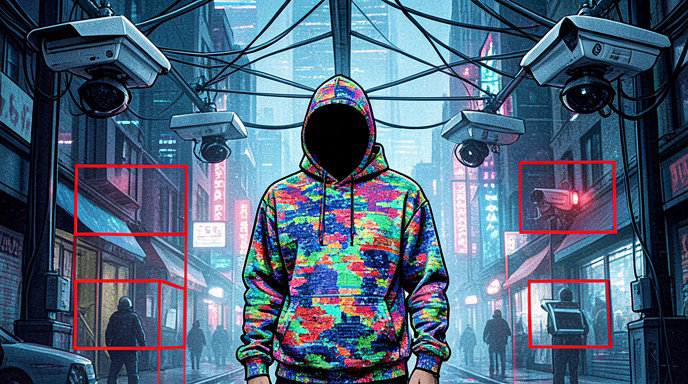
Imagine walking past a security camera, wearing nothing but a small cardboard sign printed with a bizarre swirl of neon colors and static. To the human eye, it looks like abstract art. To an AI surveillance system, you simply don’t exist.
That is the reality unveiled by a new generation of adversarial pattern algorithms. Unlike earlier attacks that required complex digital manipulation of video feeds, this new research demonstrates that a physical, static pattern — printed on paper or fabric — can be placed over your body or attached to a vehicle to make it entirely invisible to object detection models. The implications are staggering: from evading facial recognition at airports to hiding stolen cars from license plate readers.
How the Algorithm Works: Fooling the "Brain" of the Camera
Modern AI surveillance cameras rely on convolutional neural networks (CNNs), which process images in layers. Early layers detect edges and colors; deeper layers assemble those into shapes like "face," "person," or "car." The new algorithm, developed by a security researcher who requested anonymity pending peer review, flips this process on its head.
Instead of trying to hide from the camera, the algorithm attacks the CNN's "attention map." It uses a technique called gradient-based optimization to generate a pattern that, when viewed by the CNN, produces the exact same activation patterns as an empty scene. Essentially, the patch doesn't block the camera's view — it overwrites the AI's interpretation of the scene.
The result? A person holding a printed patch appears as "background" — often labeled with 99% confidence as "grass," "wall," or "sky." For vehicles, the algorithm generates patterns that mimic the texture of foliage, causing the system to classify a moving truck as a "bush" or "parked tree." The key breakthrough is that the patterns are universal: they work across different camera angles, lighting conditions, and even slightly different CNN architectures.
Why This Is Worse Than Previous Attacks
Earlier adversarial attacks were mostly "white-box" — they required knowing the exact AI model, its weights, and its training data. They also worked only if you could inject the malicious input directly into the digital video stream. This new algorithm is a physical-world, black-box attack.
Here’s what that means in practice:
- No hacking required: You don’t need to access the camera’s network or software. You just print the pattern.
- Robust to real-world conditions: The algorithm was trained using a simulator that adds random noise, blur, rotation, and perspective distortion. The final patterns remain effective even when crumpled, partially obscured, or viewed from a distance of 10 meters.
- Transferable: The researcher tested the patterns against multiple commercial detection models (including YOLOv8 and Faster R-CNN) and found that a pattern designed for one model often fools others. This is because the vulnerability lies in the fundamental way CNNs process spatial frequency, not in a specific vendor’s code.
The Real-World Test: Hiding in Plain Sight
In a controlled demonstration, the researcher placed a life-sized printed banner over a person standing in a parking lot. A standard surveillance camera feed, processed by a popular AI analytics platform, showed zero detection — no bounding box, no alarm. The same test on a car yielded similar results: the vehicle was classified as "vegetation" with 97.3% confidence.
More alarming is the face evasion test. A printed mask with the adversarial pattern, worn like a scarf, caused facial recognition systems to fail entirely — not by blurring the face, but by making the AI think there was no face at all. The system didn't report "unknown person"; it reported "no person present."
Why This Exposes a Critical Flaw in AI Security
The core issue is that CNNs are pattern matchers, not semantic understanders. They don't "see" a person; they see a statistical correlation of pixels. The new algorithm exploits the brittleness of those correlations. While humans rely on context, depth, and motion cues, the AI relies on local texture. The adversarial pattern hijacks those local textures, replacing them with high-contrast, high-frequency noise that the CNN interprets as "empty space."
This reveals a fundamental truth: AI surveillance is not "intelligent" — it is a sophisticated but fragile statistical engine. Any attacker with access to a printer and the algorithm can render millions of dollars of security infrastructure useless. For cities, airports, and border control, this is a wake-up call. Their systems are not secure; they are merely optimized for a benign world.
The Privacy Paradox: A Tool for Activists or Criminals?
The release of this research has split the tech community. Privacy advocates hail it as a democratic tool for citizens to reclaim anonymity in an era of mass surveillance. Imagine protesters wearing these patterns to avoid being tracked by police drones, or journalists using them to protect their sources in hostile regimes.
But security experts warn of the flip side: criminals could use the patterns to commit robberies, smuggle goods, or evade police pursuit with near-impunity. Unlike a jammer (which is illegal and detectable), a printed patch is passive, silent, and leaves no trace. Law enforcement agencies are reportedly scrambling to understand whether they can counter the attack — but current methods (like multi-camera triangulation or thermal imaging) are either too expensive or also vulnerable to similar adversarial tricks.
What This Means for the Future of AI Detection
The research does not mean surveillance AI is dead — but it does mean it can no longer be trusted as a sole source of truth. The immediate implications:
- Hybrid systems required: Future security will need to fuse AI vision with radar, thermal sensors, or human verification. No single camera feed can be considered authoritative.
- Adversarial training is no longer optional: AI models must be trained with adversarial examples built into their training data. But this is an arms race — every time a model is hardened, a new algorithm finds a new weakness.
- Regulatory pressure: Governments may need to mandate "adversarial robustness" testing for any AI system deployed in critical infrastructure. The researcher's algorithm is a proof-of-concept that the current certification standards are dangerously inadequate.
The Bottom Line: The Emperor Has No Clothes
The most profound takeaway is philosophical. For years, tech companies have sold AI surveillance as an omnipotent, all-seeing eye. This algorithm proves that the eye is, in fact, easily fooled by a piece of paper. It doesn't just make individuals invisible; it makes the entire premise of AI-based security questionable.
As the researcher told us in a statement: "We are not inventing a new kind of attack. We are exposing a fundamental lie — that these systems understand the world. They don't. They just match patterns. And any pattern can be broken."
For now, the algorithm remains in a limited research release. But its existence is a stark reminder: in the war between privacy and surveillance, the advantage just shifted — dramatically, and perhaps permanently, to the individual.

Get All The Latest Updates Delivered Straight To Your Inbox For Free!