
Silicon Valley's AI Paradox: Why Ubiquitous Adoption Hasn't Earned Consumer Trust
TL;DR
- Despite AI being embedded in nearly every app, device, and workplace tool, recent national surveys in 2025-2026 show consumer trust, excitement, and willingness to adopt AI are declining, not growing.
- The backlash is driven by forced adoption, persistent concerns over accuracy, privacy, job displacement, and creative theft, plus a feeling that users have no meaningful way to opt out.
- Silicon Valley now faces a critical trust gap: without transparency, user control, and proven real-world value, ubiquitous AI risks becoming a technology people tolerate rather than embrace.
The Unavoidable Algorithm
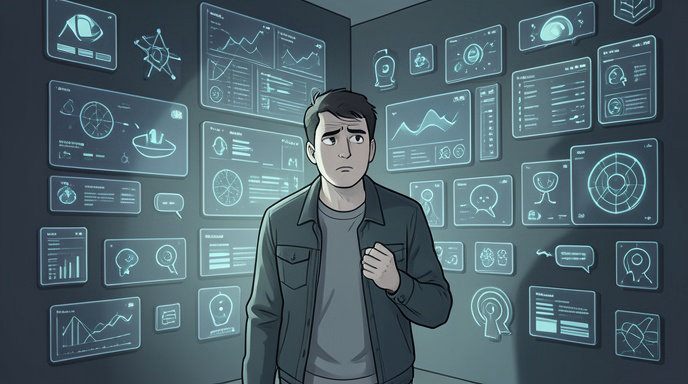
You didn't necessarily ask for it, but it's there anyway. It's summarizing your Google searches, drafting replies in Gmail, screening your job application, curating your Instagram feed, answering customer service chats, and quietly editing your iPhone photos. In less than two years, artificial intelligence has gone from a novelty to infrastructure.
That was always Silicon Valley's plan. OpenAI, Google, Meta, Microsoft, and Apple have spent tens of billions to make AI inescapable, weaving generative models into the core of search, social media, productivity software, and operating systems. The strategy worked on one level: adoption by the numbers has never been higher. But by almost every measure of public sentiment, it has backfired.
Instead of a wave of techno-optimism, 2026 is shaping up to be the year of the AI backlash.
When More Exposure Means Less Trust
The paradox is now backed by data. Multiple large-scale surveys from Pew Research Center, Axios/Harris Poll, and the Edelman Trust Barometer released in late 2025 and early 2026 all point to the same conclusion: as Americans have had more direct contact with AI, they like and trust it less.
Pew's 2025 survey on AI attitudes found that concern about AI continues to outpace excitement by a wide margin, with the share of U.S. adults saying they are "more concerned than excited" growing since 2023. An Axios/Harris poll tracking corporate reputation found that companies most closely associated with pushing generative AI saw their trust scores slip, while a recent study on workplace AI found a majority of workers who use AI daily worry it will make them less valuable or lead to surveillance.
This isn't just abstract anxiety. It's fatigue. For many consumers, the first sustained experience with generative AI hasn't been a magical productivity boost, but a flawed Google AI Overview that gives a wrong answer, an unhelpful customer service chatbot that won't let them reach a human, a flood of AI-generated spam and slop on social feeds, or an Apple Intelligence feature they didn't want and can't easily turn off.
Silicon Valley Sold Inevitability, Not Usefulness
Part of the trust gap comes down to how AI was sold. The dominant narrative from tech leaders over the past 18 months has been one of inevitability: AI is happening, resistance is futile, adapt or be left behind. That message may resonate with investors, but it has alienated consumers.
Critics argue that many AI integrations solve problems users never had. When Microsoft adds a Copilot button to every corner of Windows and Office, or when Meta injects its AI persona into the search bar of WhatsApp and Instagram, the value proposition feels inverted. Users aren't choosing AI because it helps them; AI is being chosen for them.
That forced adoption has created a sense of powerlessness. Unlike the smartphone revolution, where consumers actively lined up to buy the next device, the AI revolution is often something that happens to people in the background. Privacy advocates note that opting out is frequently difficult or impossible, buried in settings menus or not offered at all. When people feel they have lost agency over their own tools, trust erodes quickly.
The Four Pillars of Distrust
The backlash isn't monolithic. It stems from several overlapping fears that Silicon Valley has so far failed to adequately address.
First is accuracy and reliability. High-profile hallucinations, from AI search summaries that invent legal precedents to chatbots that fabricate product policies, have made users wary of trusting AI outputs for anything important. For a technology pitched as an omniscient assistant, being confidently wrong is a fatal flaw.
Second is privacy and data exploitation. Consumers are increasingly aware that their public posts, private messages, creative work, and behavioral data are being used to train models that may then replace them. The wave of lawsuits from artists, authors, and publishers against AI companies has reinforced the perception that AI was built by taking without asking.
Third is economic anxiety. While executives talk about AI as a tool for augmentation, many workers experience it as automation. Announcements of layoffs tied to AI efficiency gains, the rise of AI-generated voiceovers and illustrations, and the automation of entry-level coding and writing tasks have made the threat to livelihoods feel immediate and personal.
Finally, there is a deeper cultural rejection. A growing "human-made" movement, visible from Etsy to TikTok, is actively marketing against AI. Consumers are seeking out human customer service, human-written articles, and human-made art precisely because they are not made by AI. Authenticity has become a premium feature.
What Happens When Trust Doesn't Scale
This widening gap between ubiquity and trust has real consequences for the future of AI. A technology that people use grudgingly is very different from one they champion.
For tech companies, the risk is that AI becomes like the much-hated automated phone tree: universally used by corporations to cut costs, universally despised by customers. Early data suggests people are already developing workarounds, from using browser extensions to block AI summaries to adding "no AI" filters to their job searches and shopping.
For the broader economy, low trust could slow the adoption of AI in the high-stakes areas where it could actually be most useful, like healthcare, education, and scientific research. If people don't trust an AI to summarize an email, they certainly won't trust it to help diagnose an illness or manage their finances.
Closing the gap will require a fundamental shift in approach. Instead of pushing for mass adoption at all costs, companies will need to prioritize earned trust. That means radical transparency about when AI is being used and what data it was trained on, genuine opt-out controls that respect user choice, clear accountability when AI systems make mistakes, and a focus on solving specific, verifiable user problems rather than adding generative AI everywhere for its own sake.
Silicon Valley succeeded in making AI impossible to avoid. It has not yet succeeded in making it wanted. Until that changes, the AI paradox will only deepen — a powerful technology that is everywhere at once, and yet, trusted almost nowhere.

Get All The Latest Updates Delivered Straight To Your Inbox For Free!