
TechCrunch Disrupt 2026’s Real World AI Stage: Robots, Automated Factories, and De-Extinct Animals
TL;DR
- TechCrunch Disrupt 2026's new Real World AI stage will spotlight the convergence of software intelligence and physical hardware, moving beyond chatbots to robotics and manufacturing.
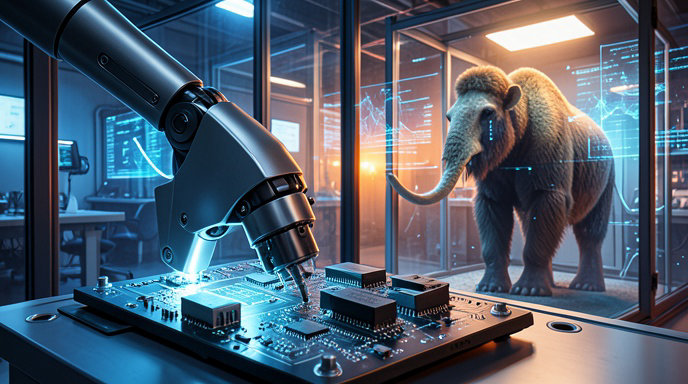
- Headlining themes include fully autonomous "lights-out" factories, AI-driven biological engineering, and a controversial case study using de-extinct animals (like the woolly mammoth) to test genetic AI models.
- Featured demos will include real-time robot fleet coordination, predictive maintenance systems, and a live lab showing AI-designed organisms, signaling a major shift in how investors and engineers view AI's tangible impact.
The Bits Meet the Atoms: A New Stage for a New Era
For the past two years, the tech world has been fixated on large language models and generative text. But at TechCrunch Disrupt 2026, the conversation is pivoting dramatically. The brand-new Real World AI stage is designed to address a gnawing question: what happens when AI stops talking and starts doing? The answer, based on the freshly released agenda, is that we are entering the era of physical AI—where algorithms control robotic arms, optimize supply chains, and even rewrite the code of life itself.
This stage is not a side note. It is positioned as the main event for investors and operators who are tired of demos that just produce text. Instead, they want to see machines that pick, place, weld, and assemble. The programming reflects a hard pivot from the virtual to the tangible, with a heavy emphasis on industrial automation and the messy, chaotic reality of the physical world.
The Rise of the Lights-Out Factory
One of the most anticipated panels on the Real World AI stage is titled "The Human-Free Floor: Scaling Autonomy in Manufacturing." The discussion will feature CTOs from major automotive and electronics firms who are actively rolling out "lights-out" factories—facilities that run 24/7 with zero human presence on the production floor.
The key technical hurdle, according to the session description, is not the individual robot, but the orchestration. While a single robotic arm has been precise for decades, the new challenge is getting hundreds of them to adapt to changing orders, material shortages, and unexpected jams without a human supervisor. Expect demos of "swarm logic" software that allows robots to re-plan their paths in milliseconds. The panel will also tackle the economic reality: while labor costs drop, energy consumption and maintenance complexity skyrocket. The takeaway is that the fully automated factory is no longer a sci-fi trope; it is a supply chain strategy that is being deployed right now, particularly in the semiconductor and EV battery sectors.
De-Extinction as a Case Study: AI's Biological Frontier
The most surprising inclusion on the Real World AI stage is the session on de-extinct animals. At first glance, bringing back the woolly mammoth or the Tasmanian tiger seems like a publicity stunt. However, the organizers are framing it as the ultimate stress test for AI-driven biological engineering.
The session, "Resurrecting the Past to Program the Future," will feature geneticists from a prominent biotech startup working on the "mammoth proxy" project. They will argue that the process of editing the genome of an Asian elephant to express mammoth traits requires an AI model capable of predicting how thousands of gene edits will interact across millions of cells. This is a far more complex problem than text generation. The AI must simulate protein folding, epigenetic markers, and developmental biology in real time. The speakers will present this as a proof-of-concept: if AI can successfully guide the creation of a functional, cold-resistant elephant, then the same architecture can be used to design novel enzymes for plastic degradation or drought-resistant crops.
The inclusion of this topic is deliberate. It signals to the audience that AI is not just about optimizing logistics; it is about mastering the software of life itself. Expect a lively Q&A, as the ethics of de-extinction will likely clash with the technical bravado on stage.
Live Demos: From Predictive Maintenance to Robot Baristas
The floor of the Real World AI stage will be a sensory overload. Unlike the static booths of the past, this stage is designed for live, high-stakes demonstrations. One of the headline demos involves a "digital twin" of a bottling plant. Attendees will be able to watch as an AI detects an impending bearing failure in a pump that is physically located in a factory in Ohio, then watch a drone autonomously fly to a parts locker and deliver the replacement component to a waiting robot.
Another demo will feature a fleet of quadruped robots navigating an obstacle course filled with moving humans and unpredictable debris. The focus here is on "edge AI"—the ability for the robot to make split-second decisions without pinging a cloud server. The organizers have also confirmed a crowd-pleasing demo: a fully autonomous robotic arm that can brew a specific pour-over coffee based on a scan of the attendee's biometric data (heart rate and sleep patterns). It is a gimmick, but it effectively illustrates how AI can personalize physical outputs in real time.
The Industrial AI Investment Thesis
Beyond the flashy demos, the Real World AI stage is expected to be a hotbed for deal-making. A dedicated "Investor Spotlight" session will feature venture capitalists who have shifted their funds from pure-play software to "deep tech" hardware. The consensus among the speakers is that the next trillion-dollar company will not be a social media platform, but a company that owns the AI stack for physical labor.
The investors will discuss the "robot tax" and the changing calculus of ROI. While the initial capital expenditure for a robotic factory is massive, the operational savings over a decade are staggering. The panel will also address the bottleneck: the shortage of engineers who understand both PyTorch and pneumatics. This session is designed to bridge the gap between Silicon Valley's software culture and the industrial Midwest's manufacturing base, arguing that the future belongs to those who can merge the two.
What This Means for the Workforce and Society
The final keynote on the Real World AI stage will take a step back from the technology to discuss the societal impact. The talk, titled "The End of the Routine," will argue that AI in the physical world will not just replace repetitive manual labor, but will also eliminate middle-management roles that involve monitoring and scheduling that labor.
The speaker, a labor economist, will present data suggesting that the transition will be faster than the digital revolution because physical AI can be deployed retroactively into existing factories. The session will propose a framework for "universal basic adaptability" where workers are retrained to supervise AI fleets rather than perform the tasks themselves. The tone is expected to be pragmatic rather than alarmist, but the message is clear: the physical world is about to be reprogrammed, and society needs new safety protocols, not just for data privacy, but for physical safety and economic equity.
A Glimpse of the Future
TechCrunch Disrupt 2026's Real World AI stage is more than a conference track—it is a declaration of intent. It acknowledges that the low-hanging fruit of AI has been picked from the digital orchard. The future lies in the messy, complex, and highly lucrative world of atoms. From the factory floor to the gene sequencer, the demos and panels preview a world where intelligence is not confined to a screen, but is embedded in every machine, every material, and potentially, every living creature. For attendees, the message is simple: the robots are no longer coming; they are already here, and they are learning to build the world around us.

Get All The Latest Updates Delivered Straight To Your Inbox For Free!