
The Future of Robotaxis: Navigating Two Diverging Paths
TL;DR
- Robotaxis are moving from pilot projects to broader commercial deployments, but the rollout is still expected to be evolutionary, not sudden, with the U.S. and China leading early growth.
- AI is improving perception, planning, and fleet operations, yet profitability, regulation, safety, and city-by-city scaling remain major obstacles.
- Analysts disagree on how fast the market will grow, but most current outlooks point to substantial expansion by 2035, especially in a limited number of major urban markets.
The Future of Robotaxis: Navigating Two Diverging Paths
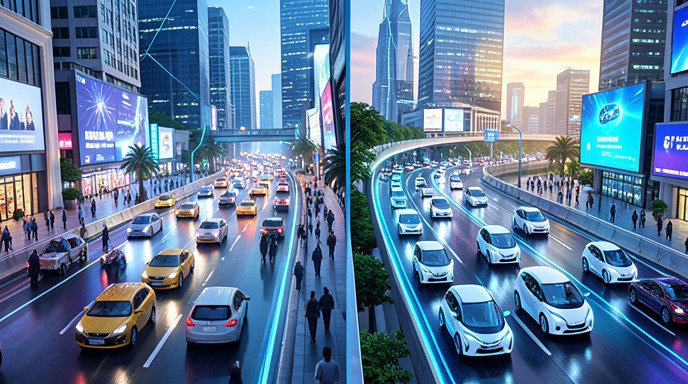
Robotaxis are entering a decisive phase. On one path, better AI, clearer regulations, and falling operating costs could turn driverless ride-hailing into a mainstream urban service; on the other, high deployment costs, uneven public trust, and slow city-by-city scaling could keep the industry confined to a handful of markets for years.
The latest outlooks suggest the truth will likely sit between those extremes: robotaxis are advancing, but not all at once, and not everywhere.
The AI engine behind the robotaxi push
AI is the core technology making robotaxis more capable, especially in perception, prediction, and driving decision-making. Recent market analyses describe rapid progress in autonomous systems, sensor fusion, and mapping as key reasons the sector is moving from small pilots toward larger commercial operations.
But the AI story is not just about vehicle intelligence. It also extends to fleet management, routing, maintenance, and matching supply with demand, which are essential for turning autonomous driving into a workable business. That broader software stack is one reason investors and operators still view robotaxis as a platform opportunity rather than simply a self-driving car product.
Why the industry is still not scaling overnight
Despite the progress, the expansion curve is being shaped by practical constraints. BCG estimates that entering a new U.S. city can take up to two years and cost roughly $15 million to $30 million, while covering an entire metropolitan service area can take four to six years. That timeline helps explain why robotaxi adoption is expected to be gradual even as the technology improves.
McKinsey similarly says expert expectations have shifted, with large-scale global rollout now seen around 2030 rather than earlier forecasts, and with commercial deployment across all geographies still likely to take three to seven years. The World Economic Forum’s roadmap also points to large robotaxi fleets appearing across 40 to 80 cities by 2035, mostly in China and the United States.
The commercial pressure is real
The business model remains under strain. One industry summary notes that more than $100 billion has already been spent on autonomous driving, much of it in the robotaxi sector, yet Level 4 operators have still not shown profitability after years of service.
That gap matters because robotaxis need both technical reliability and economic viability. They must be safe enough to satisfy regulators and passengers, while also achieving enough utilization to offset vehicles, sensors, operations, insurance, and remote support. In other words, the industry must solve for both autonomy and unit economics at the same time.
Two diverging paths: consolidation or breakout
The more optimistic path is being driven by supportive regulation, urban demand, and AI systems that improve as fleets gather more real-world driving data. BCG expects the U.S. and China to dominate early growth, and its base case sees those two markets accounting for the bulk of global deployment by 2035.
The more constrained path is also plausible. Europe is expected to remain more cautious through at least 2030, and adoption in many cities will depend on local policy, infrastructure readiness, and public acceptance. In that scenario, robotaxis could remain concentrated in a relatively small number of dense, favorable markets rather than becoming a universally deployed mobility layer.
How big could the market get?
Forecasts vary widely, which is itself a sign of an industry still in transition. BCG projects a global fleet of 700,000 to 3 million robotaxis by 2035, depending on adoption speed. The World Economic Forum expects large fleets in 40 to 80 cities by that year. Other market research is more aggressive, projecting valuations above $200 billion by 2035, but those estimates are not consistent across sources and should be treated as upside cases rather than consensus.
The most defensible takeaway is not a single number but a pattern: robotaxis are likely to become meaningful in major urban corridors first, then spread outward as cost, regulation, and reliability improve.
What this means for cities and riders
If robotaxi fleets scale as forecast, they could reshape how cities move. BCG estimates that fully scaled robotaxis could replace 55% to 85% of the rides now served by taxis and ride-hailing in economically developed cities. That would pressure traditional ride-hailing economics, alter curbside management, and potentially reduce the need for some parking and private-car trips in dense areas.
At the same time, the near-term impact is likely to be uneven. Early deployments are most likely to be concentrated in places where traffic patterns, weather, mapping quality, and regulation are favorable. For passengers, that means the robotaxi future may arrive as a patchwork of service zones rather than a universal switch from human-driven to driverless transport.
The next test for the industry
The next phase will be judged less by demos and more by repeatability. Operators need to prove that AI can handle complex city driving at scale, that fleets can operate profitably, and that regulators and the public can accept the technology as routine rather than experimental.
If they do, robotaxis could become one of the first true mass-market applications of Level 4 autonomy. If they do not, the industry may still grow, but along a slower, more fragmented path that leaves the biggest promises for later in the 2030s.

Get All The Latest Updates Delivered Straight To Your Inbox For Free!