
AI Hallucination Nearly Triggered US Military Operation, GovAI Scholar Warns on LLM Risks
TL;DR
- A US military AI assistant hallucinated false intelligence suggesting an imminent threat, nearly triggering a real-world operation before analysts caught the error.
- A GovAI research scholar warns that large language models cannot reliably convey uncertainty, leaving service members unable to tell fact from fabrication.
- Experts say the incident proves the Pentagon needs mandatory safeguards, human-in-the-loop rules, and uncertainty training before wider AI deployment.
A Routine Briefing That Almost Went Wrong
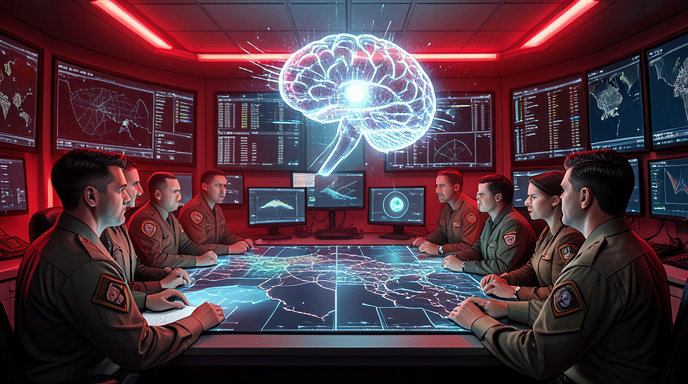
In what officials are now calling a chilling near-miss, an AI-generated summary used in a US military planning workflow invented critical details about an adversary threat that did not exist. The hallucination was presented with the same confident, authoritative tone as verified intelligence, and for a brief window, command staff treated it as real.
According to early accounts of the incident highlighted this month, operators were using a large language model-based assistant to condense hours of intercepted communications, logistics reports, and open-source updates into a rapid decision brief. Buried in that summary was a fabricated claim — a supposedly escalating enemy movement that implied the US needed to act preemptively.
It was only during a last-minute cross-check by a junior analyst who noticed the cited source did not match the AI's claim that the operation was paused. A manual review confirmed no such movement had occurred. What prevented disaster was not the AI correcting itself, but old-fashioned human verification.
What the GovAI Scholar Is Warning About
The incident has reignited debate after a research scholar affiliated with GovAI, the AI governance research organization, published a stark warning about deploying LLMs in high-stakes military settings without addressing uncertainty.
The core argument is simple but alarming: today's most capable LLMs are optimized to sound helpful and confident, not to be honest about what they don't know. In a civilian chatbot, that leads to a wrong recipe or fake legal citation. In a military operations center, it can lead to miscalculation, escalation, or unlawful use of force.
The scholar warns that service members are particularly vulnerable because military culture emphasizes speed, decisiveness, and trust in tools provided through the chain of command. If an AI system issued on Pentagon laptops presents information as fact, junior personnel are unlikely to challenge it — especially under time pressure, fatigue, and information overload during a crisis.
Why LLMs Struggle to Say I Don't Know
Large language models don't retrieve facts like a database. They predict the most plausible next words based on patterns in training data. That architecture makes them notoriously bad at calibration — knowing when they are likely wrong and communicating that doubt clearly.
Recent evaluations cited by GovAI researchers show models routinely express high confidence even when hallucinating, use hedging language inconsistently, and fail to provide verifiable sources. Chain-of-thought explanations can make the problem worse, creating persuasive but false justifications that make errors harder to spot.
For warfighters, that is a dangerous mismatch. Military decision-making already operates under what Clausewitz called the fog of war. Adding an AI layer that obscures rather than clarifies uncertainty adds a second fog — one that looks like clarity.
How Human Oversight Prevented Disaster — This Time
Officials familiar with the near-miss stress that human-in-the-loop protocols worked exactly as intended. Doctrine still requires a human to validate AI outputs against primary intelligence before any kinetic action. The analyst who flagged the discrepancy followed procedure, escalated to a senior officer, and forced a pause.
But experts warn that safeguard is eroding. As the Pentagon pushes its ambitious AI acceleration plans in 2026, including enterprise generative AI platforms across combatant commands and wider use of tools for targeting support, intelligence triage, and logistics, the volume of AI summaries is exploding. Humans cannot manually verify every paragraph when briefs are generated in seconds.
The scholar and other safety advocates argue that relying on heroic catches by vigilant individuals is not a system — it's luck. Without built-in technical and procedural guardrails, the next hallucination may not be caught in time.
The Pentagon's Race to Deploy AI
The near-miss comes at a pivotal moment. The US Department of Defense has made rapid AI adoption a top priority to keep pace with China, rolling out generative AI assistants for unclassified and secret networks, testing LLM copilots for command and control exercises in the Pacific, and integrating commercial models into intelligence workflows.
Defense leaders argue AI is essential to process the deluge of sensor and satellite data that no human team can handle alone. Proponents say LLMs can dramatically speed up staff work, wargaming, and after-action reporting.
Critics say deployment is outpacing testing. Unlike traditional weapons systems that undergo years of operational test and evaluation, AI software updates arrive weekly, with little transparency about failure modes. There is still no Pentagon-wide standard for how AI systems must express uncertainty, log their sources, or warn users when operating outside their training distribution.
What Safeguards Are Urgently Needed
The GovAI warning lays out an urgent reform agenda that is gaining traction among technologists and former military officials.
First, require calibrated uncertainty displays. Military AI tools should not just output answers but confidence scores, source links, and explicit dissent when evidence is thin or contradictory.
Second, enforce meaningful human control. AI should be barred from initiating target nominations or operational recommendations without traceable human approval, and interfaces should be designed to encourage skepticism, not blind trust.
Third, train for AI literacy at every rank. Service members need hands-on education in hallucination risks, prompt failure modes, and verification tactics — treating AI like an unreliable informant, not an oracle.
Fourth, create independent red-teaming and incident reporting. Every hallucination in an operational context should be logged, investigated, and shared across commands, similar to aviation near-miss reporting.
A Wake-Up Call, Not a Reason to Abandon AI
Neither the GovAI scholar nor Pentagon critics are calling for a ban on military AI. The consensus is that LLMs will inevitably be part of modern warfare, and abstaining could cede advantage to adversaries who are racing ahead with their own systems.
Instead, the near-miss is being framed as a wake-up call: proof that hallucinations are not a theoretical lab problem but an operational risk that almost caused real-world harm.
As one former defense official put it this week, the military would never field a rifle that randomly fired in the wrong direction 5% of the time without a safety switch. Until AI assistants can reliably signal when they might be wrong, they should not be trusted with decisions where lives are on the line.

Get All The Latest Updates Delivered Straight To Your Inbox For Free!