
Anthropic's Secret Biology Lab: AI Cure for Disease or Extinction Risk
TL;DR
- Anthropic has opened its first in-house wet biology lab to test whether Claude AI models can autonomously accelerate drug discovery and help cure human disease.
- The move puts Anthropic in direct competition with Google DeepMind's Isomorphic Labs, OpenAI, and Nvidia in a high-stakes race to turn AI into a virtual biologist.
- The same company warning that AI could enable catastrophic bioweapons and human extinction is now building the powerful biology AI it warned about, sparking intense debate over safety vs. progress.
Anthropic Wants AI to Cure Disease — So It Built a Lab to Prove It
Anthropic, the $60-billion-plus AI lab behind Claude, is no longer content to just build chatbots. This month the company confirmed it is standing up its own experimental biology lab — a real wet lab with real pipettes, cells, and CRISPR — designed to find out if AI can actually do science, not just talk about it.
The goal, in CEO Dario Amodei's words, is audacious: compress a decade of biomedical progress into a year and cure human disease. Amodei has long argued in his essay Machines of Loving Grace that AI could eliminate most cancers, halt Alzheimer's, and double human lifespan. Now Anthropic wants to prove it in-house.
Unlike a traditional biotech startup, Anthropic's lab isn't initially focused on selling a drug. It's focused on testing Claude itself. Can Claude design an experiment, troubleshoot a failed assay, interpret sequencing data, and then iterate like a postdoc? If yes, Anthropic believes biology will become the first field where AI-driven superhuman science arrives.
Inside the Secretive Wet Lab
Details are still emerging, but Anthropic has been hiring computational biologists, lab automation specialists, and former DeepMind AlphaFold researchers for a facility tied to its London and San Francisco Bay Area offices. Job postings and company briefings describe work on AI-driven cellular modeling, protein engineering, high-throughput screening, and lab-in-the-loop learning.
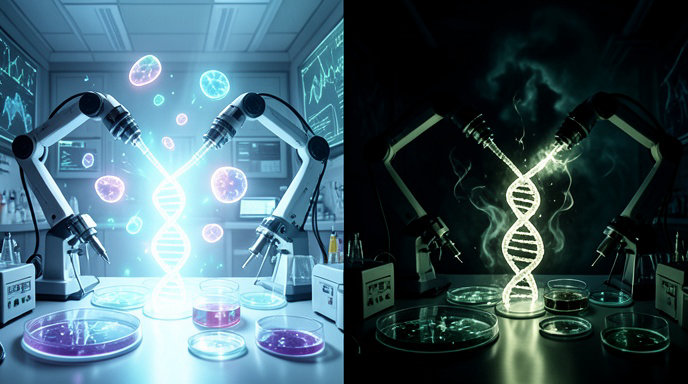
The approach is simple in theory and brutally hard in practice: give Claude access to robotic lab equipment, let it propose hypotheses, run experiments in the wet lab, analyze the results, and learn from failure — a closed loop.
Early results shared by Anthropic are striking. Internal benchmarks claim recent Claude models — Claude Opus 4.1 and Sonnet 4.5 — have jumped from PhD-level Q&A to actually troubleshooting complex cloning protocols, designing guide RNAs with fewer off-target effects, and predicting antibody binding better than specialist models. In partnership projects with the Arc Institute and the Chan Zuckerberg Initiative, Claude has been used to model virtual cells and analyze petabytes of single-cell data.
Anthropic says the lab will start with non-hazardous work: basic cell biology, functional genomics, and AI-assisted drug discovery for complex diseases, not work with live pandemic pathogens.
Big Tech's New Religion: AI Will Cure Everything
Anthropic is not alone. All of Big Tech has suddenly pivoted to the same promise: AI will cure disease.
Google DeepMind already proved the concept with AlphaFold 2 and 3, which solved protein structure prediction and earned a Nobel Prize in 2024. Its spinout, Isomorphic Labs, raised billions to design drugs entirely with AI and now has pharma deals with Eli Lilly and Novartis. Nvidia launched BioNeMo and virtual screening supercomputers. Microsoft released BioEmu for protein dynamics. OpenAI launched its own health and longevity bets with Retro Biosciences and Thrive AI Health.
The pitch is powerful and politically useful. As regulators threaten to rein in frontier AI over safety fears, curing cancer is the ultimate justification for scaling up ever-larger models and data centers. Amodei himself has testified to Congress and the UK AI Safety Institute that the upside of AI for biology could be $100 trillion in value and the end of most human suffering.
Investors are buying it. Biotech VCs say AI-bio was the hottest funding category of summer 2026, with AI-designed molecules now entering Phase I trials at record pace.
The Paradox: The Same Lab Warning About Extinction
Here's where the story gets uncomfortable. The same Anthropic researchers promising cures have spent the last year publishing some of the starkest warnings in the industry about AI-enabled bioweapons.
In 2025 and 2026, Anthropic's Safeguards and Alignment teams released studies showing Claude could already uplift a novice toward creating bioweapons, providing detailed guidance on pathogen acquisition, production, and deployment that exceeds public search. The company raised its internal biosafety level to ASL-3 — its designation for models that could catastrophically misuse biology — and called for mandatory screening of AI-generated DNA sequences, tighter export controls, and universal safeguards against biological instructions.
Prominent Anthropic staff, including Amodei, have signed statements warning AI poses an extinction risk comparable to nuclear weapons, specifically because AI tutors could democratize the creation of engineered pandemics.
Critics now ask: Why build an even more capable biologist AI if you believe it could kill everyone? Even former Anthropic employees and biosecurity experts like those at the Centre for Health Security have questioned whether lab-in-the-loop training will inevitably teach models dual-use skills — how to engineer immune evasion or enhance transmissibility — that can't be unlearned.
Cure or Catastrophe? Anthropic Says Both Are True
Anthropic's answer is that you cannot have one without confronting the other.
The company argues that defensive AI is the only realistic way to outpace offensive AI. An AI that can design a universal vaccine, predict viral evolution, or detect a lab leak in hours is also the best defense against an AI-designed bioweapon. To that end, Anthropic says its biology lab will co-develop safety tools alongside capabilities: better DNA synthesis screening, pathogen early-warning systems, and refusal training built from real lab data.
It has also pledged unprecedented transparency for the lab, including publishing its Biological Safety evaluations, working with the US and UK AI Safety Institutes, and keeping all high-risk pathogen work out of scope. No gain-of-function research, no work on select agents, and all experiments reviewed by an external biosecurity board, the company says.
Whether that firewall holds is now one of the most important questions in tech. If Anthropic succeeds, Claude could become the world's first AI scientist — shortening drug development from 10 years to 1 and delivering cures for diseases long deemed untreatable. If safeguards fail, the same system could lower the barrier to biological catastrophe.
For now, the pipettes are out, the robots are running, and Anthropic is betting that to cure the future, it has to risk building the very tool it fears most.

Get All The Latest Updates Delivered Straight To Your Inbox For Free!