
Apple Watch Always Listening? New AI Features Spark Privacy and Consent Fears
TL;DR
- Apple’s new Apple Watch features can transcribe the last few minutes of nearby speech and generate AI summaries of ambient conversations, all processed on-device with no raw audio stored.
- Apple says the system is opt-in, lights up with a visible indicator, and uses Private Cloud Compute for complex summaries, but privacy researchers say technical safeguards don’t solve social consent.
- Experts warn the features could normalize passive recording, chill candid conversation, and trigger legal fights over two-party consent laws.
What Apple Just Unveiled
Apple closed its September 9 hardware event with what it called its biggest push yet to make the Apple Watch an AI companion, not just a fitness tracker. Alongside the Apple Watch Series 12 and Ultra 4, Apple previewed two watchOS features powered by Apple Intelligence: Speech Rewind and Conversation Recap.
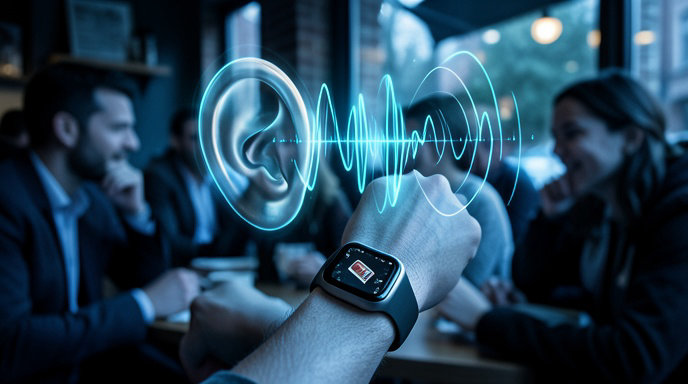
Speech Rewind lets a wearer pull up a rolling transcript of speech heard in the last five minutes — a missed coffee order, a doctor’s instructions, a name mentioned in a noisy room. Conversation Recap goes further, listening for extended dialogue and producing a short bullet summary: who said what, key decisions, follow-ups.
Apple positioned both as accessibility and memory tools, demos focused on students, caregivers, busy parents, and people with hearing or cognitive processing differences. The company confirmed the features will arrive later this fall in watchOS 26.1 as an opt-in beta on newer watches paired with an Apple Intelligence-capable iPhone.
How It Works Without Saving Raw Audio
Apple’s headline claim is that your watch is listening without remembering — at least not in audio form.
According to Apple, the microphone maintains a short rolling buffer in secure on-device memory, continuously overwritten every few minutes. An on-device neural engine converts that buffer to text in real time, then discards the waveform. Only the transcript or summary is kept, and only if the user chooses to save it.
Simpler transcriptions happen entirely on the watch. Longer summaries that need a larger model are sent as anonymized text — not voice — to Apple’s Private Cloud Compute servers, where Apple says data is not stored, not linked to an Apple ID, and independently auditable.
There is no continuous cloud audio upload, no searchable voice library, and a glowing Smart Stack indicator plus a subtle chime when active transcription is running. Turn your wrist down or tap to pause, and buffering stops.
What Apple Promises For Privacy
Privacy was the core of Apple’s pitch: on-device first, minimal data, user control.
Apple says both features are off by default, require explicit opt-in, process as much as possible on-device, never sell data or use conversations for advertising, and allow users to auto-delete transcripts after an hour, a day, or manually. Enterprise and education-managed watches can disable the features entirely, and a new API will let developers build similar summarization without ever accessing the microphone stream directly.
Apple also emphasized that transcripts never include speaker identification by default and that the watch will attempt to ignore background TV or other devices when possible.
In Apple’s framing, this is the opposite of a wiretap: ephemeral listening designed to leave no trace unless you ask it to.
Why Experts Are Still Worried
Privacy researchers and digital rights advocates say Apple is solving the engineering problem while sidestepping the human one.
The technical design is genuinely strong, several experts acknowledged. No raw audio retention dramatically reduces the risk of a hack or subpoena exposing actual voice recordings. But text is still sensitive, they note. A transcript of a therapy session, a breakup, a workplace complaint, or a protest chant can be just as revealing as audio — and far easier to search, copy, and forward.
Others point to accuracy and leakage risks. AI summarization can misattribute quotes, hallucinate details, or strip out sarcasm and context. A flawed summary saved to Notes or Messages could create misunderstandings that a fleeting spoken comment never would.
There is also the question of scope creep. Today it is five minutes of buffering for personal recall. Tomorrow, critics ask, will it be 30 minutes for meeting productivity, always-on summaries synced to iCloud, or integration with AI agents that act on what they overheard?
The Consent Problem No Indicator Can Fix
The sharpest criticism centers on consent: the person wearing the watch may have opted in, but everyone around them has not.
U.S. law is a patchwork — about a dozen states require all-party or two-party consent for recording conversations. Apple argues it is not recording under those statutes because it is not retaining audio. Legal scholars say that distinction has never been tested at scale for AI buffering and live transcription, and a transcript created without permission could still violate wiretapping expectations, workplace rules, or doctor-patient confidentiality norms.
A blinking light and soft chime borrowed from smart glasses and phones may not be enough in a loud restaurant, a classroom, or a hospital. Unlike holding up a phone to record, glancing at a watch is invisible. Bystanders have no real way to opt out, review what was captured, or demand deletion.
Advocacy groups are already calling for Apple to require an audible disclosure, a mandatory verbal prompt in sensitive locations, and automatic blocking in bathrooms, locker rooms, and other private spaces via geofencing.
How Constant Recording Could Change Social Behavior
Beyond law, sociologists warn of a chilling effect.
If people assume any Apple Watch nearby could be transcribing, they may self-censor — less venting, less joking, less honest disagreement. Researchers call this surveillance normalization: first we accept doorbells that film the street, then earbuds that translate calls, then watches that summarize dinner.
Therapists, journalists, organizers, and lawyers interviewed this week said clients and sources are already asking: Is that thing listening? Even if Apple keeps its no-audio promise, perception matters. Trust erodes when you cannot tell whether a casual remark is ephemeral or will resurface as a bullet point in someone else’s recap.
Supporters counter that hearing aids, smartphones, and smart speakers already created this world, and that memory aids could empower aging adults and neurodivergent users. The difference, critics say, is passivity. You choose to dictate to Siri. You do not choose to be summarized by a stranger’s watch.
What To Watch Next
Apple has not yet detailed how the features will behave across borders, in schools, or for minors, nor how it will handle law enforcement requests for saved transcripts. Regulators in the EU are already scrutinizing AI transcription under the GDPR and the AI Act, and U.S. lawmakers have revived calls for a federal recording-disclosure standard for wearables.
For now, the advice from experts is practical: if you try the beta, leave it off by default, tell people when you turn it on, treat summaries as drafts not truth, and set auto-delete to the shortest window.
The technology to remember everything we say is here. Whether social norms, laws, and Apple’s own guardrails can catch up will determine if the Apple Watch becomes a superpower for memory — or a reason to watch what you say.

Get All The Latest Updates Delivered Straight To Your Inbox For Free!