
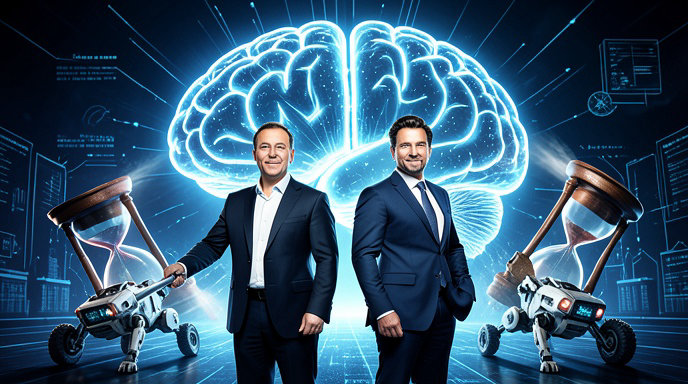
Dario Amodei and Sam Altman Want to Slow AI: What Pacing the Frontier Really Means
TL;DR
- Anthropic CEO Dario Amodei is pushing for a coordinated slowdown of frontier AI development centered on mandatory safety testing, third-party evaluations, and export controls, not a full pause.
- OpenAI CEO Sam Altman agrees that pacing the frontier is necessary, arguing the industry needs time to solve alignment, build regulatory guardrails, and earn public trust.
- A real slowdown would mean slower model releases, shared safety standards, and government oversight, but competition from open-source labs and China makes enforcement the biggest hurdle.
A Rare Moment of Agreement at the Top
For years, Anthropic and OpenAI have been cast as rivals in a breakneck race to build artificial general intelligence. Now their CEOs are saying the same surprising thing: slow down.
In recent interviews, memos, and public appearances this summer, Anthropic CEO Dario Amodei has laid out his most detailed case yet for pacing frontier development. OpenAI CEO Sam Altman, long an advocate for moving fast, has echoed the sentiment, saying the industry needs to give safety, policy, and society time to catch up.
It is not a call to stop AI progress entirely. It is a call to control the speed at the very frontier — the largest, most capable models — while the rest of the ecosystem continues to build.
What Amodei Actually Proposed
Amodei's plan is not a one-sentence soundbite. It is a multi-part framework he has developed across essays, Senate testimony, and Anthropic's Responsible Scaling Policy.
First, he wants standardized, pre-deployment safety testing for any model above a certain capability threshold. That includes evaluations for bioweapon uplift, cyberattack potential, autonomous replication, and deceptive behavior. If a model fails, it does not ship until mitigations are proven.
Second, he is pushing for transparency requirements. Labs would publish system cards, evaluation results, and deployment safeguards, with third-party auditors given API access before public launch.
Third, he has been vocal on export controls and compute governance. Amodei argues that high-end AI chips should be tracked and that smuggling loopholes must be closed to prevent unchecked frontier training outside the U.S. and its allies.
His core argument: we do not know how to fully control systems smarter than us yet, so racing to build them without guardrails is reckless.
Why Altman Agrees — With a Twist
Sam Altman agreeing with Amodei might seem unexpected given OpenAI's history of rapid releases from GPT-4 to GPT-5. But Altman has increasingly framed pacing as a practical necessity, not just a safety ideal.
Altman's version focuses on three concerns: trust, infrastructure, and regulation. He has said OpenAI has learned that deploying superintelligent systems without societal buy-in will backfire, leading to backlash, bans, and misuse. Slowing slightly now, he argues, allows for iterative deployment — releasing capable but aligned models, studying how people use them, then going further.
He also points to physical limits. Data centers, power grids, and chip supply chains cannot scale infinitely overnight. Pacing the frontier gives time to build the compute and energy infrastructure needed for the next leap.
Unlike Amodei, Altman stops short of endorsing hard capability caps. He favors flexible, government-led oversight like the U.S. AI Safety Institute and international norms, rather than lab-imposed pauses that could be ignored by competitors.
What a Coordinated Slowdown Would Actually Look Like
A coordinated slowdown would not mean no new AI products for a year. It would mean a change in how frontier models move from lab to world.
In practice, it would look like this: longer gaps between flagship models like Claude and GPT, with more time spent in closed red-teaming. Independent safety institutes in the U.S., U.K., EU, and Japan would get early access for testing. Governments would set thresholds — based on training compute and evaluation scores — that trigger mandatory reporting.
For developers and startups, little would change day-to-day. They would still get API access and open models. For the three to five labs training at the absolute frontier, however, every training run over a certain size would be documented, monitored, and potentially delayed.
Anthropic has already committed to this internally with its ASL levels. OpenAI has its Preparedness Framework. The new idea is to make those voluntary pledges legally binding and universal.
The Competition Problem No One Can Ignore
Here is the biggest obstacle: not everyone wants to slow down.
Inside Silicon Valley, executives at Meta, xAI, and Google DeepMind have warned that any U.S. slowdown could hand the lead to China. Open-source advocates argue that slowing closed labs only centralizes power while open models proliferate anyway.
Amodei's answer is that a slowdown must be international to work, similar to nuclear arms control or aviation safety. Altman agrees, calling for a global agency akin to the IAEA for AI, with inspections for massive data centers.
Critics remain skeptical. They note both Anthropic and OpenAI continue to raise billions and train ever-larger models even while talking about restraint. Is this genuine caution, or a moat-building strategy to lock in incumbents who can afford compliance while smaller rivals cannot?
What Comes Next for Future Models
All eyes are now on what happens with next-generation systems — what Anthropic calls Claude 4.5 and beyond, and what OpenAI is planning post-GPT-5.
Both companies have signaled that their next flagships will undergo the most extensive safety testing to date, potentially delaying launches by months. Washington is watching closely, with the White House's AI Action Plan and pending Senate legislation on frontier model transparency expected this fall.
If Amodei and Altman follow through, pacing the frontier could become the industry norm: build fast on applications, move deliberately on raw intelligence.
If they fail to convince rivals and regulators, 2026 may be remembered as the moment the two most powerful AI CEOs called for a brake — and the industry hit the accelerator anyway.

Get All The Latest Updates Delivered Straight To Your Inbox For Free!