
Tesla Roadster Gen 2 Finally Debuts October 1 After 8-Year Wait
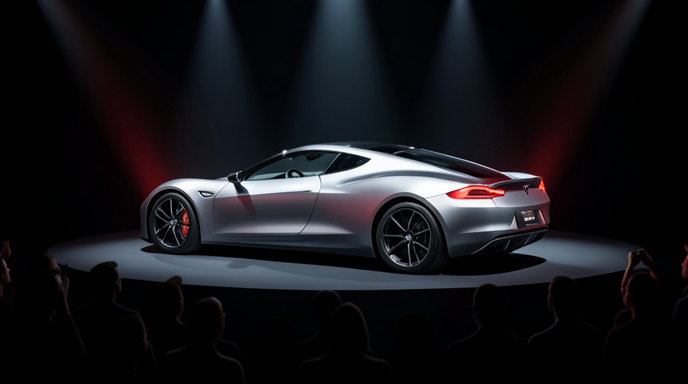
TL;DR
- Tesla will officially unveil the production second-generation Roadster on October 1, ending a delay stretching back to its original 2017 reveal.
- Expected specs include sub-1-second 0-60 mph with the SpaceX cold-gas thruster package, 250+ mph top speed, and 600+ km range, with a refreshed design and interior.
- Base pricing is expected to rise well above the original $200,000 promise, with low-volume production starting in 2027 as a halo car rather than a volume seller.
After almost a decade of teases, delays, and memes, it's actually happening. Tesla has confirmed it will finally unveil the production version of the second-generation Roadster on October 1, closing the loop on one of the longest-running sagas in the auto industry.
The original reveal back in November 2017 broke the internet. Elon Musk rolled a sleek red prototype out of a Semi truck trailer and promised 0-60 mph in 1.9 seconds, a 250+ mph top speed, and 620 miles of range for $200,000. It was supposed to arrive in 2020. Then 2021 came and went, then 2023, then 2025. Now, with Tesla confirming an October 1 debut event, the halo sports car is finally moving from vaporware to reality.
Eight Years in the Making
The Roadster Gen 2 story is as much about Tesla's evolution as it is about the car itself. When it was first shown, Tesla was still fighting for survival ramping the Model 3. Since then, the company has launched the Model Y to become the world's best-selling EV, weathered brutal price wars, launched the Cybertruck, pivoted hard into robotaxis, Optimus robots, and AI, and overhauled its lineup.
Musk has repeatedly blamed the delay on priorities, saying the Roadster was never meant to be a volume driver and that Tesla had to focus on mass-market cars, the Semi, Cybertruck, and now the Cybercab robotaxi platform. In recent updates on X and earnings calls, Musk said development is now complete and that the October 1 reveal will show a heavily revised production car, not just the 2017 prototype. Production is expected to be handled in very low volumes in California, likely at Fremont.
What To Expect From the Design
Don't expect the October 1 car to be identical to the one we saw in 2017. Spy shots, patent filings, and Musk's own comments point to a significant evolution.
The overall silhouette — low nose, wraparound glass canopy, active rear spoiler — remains, but the production car is expected to be wider, more aggressive, and more aerodynamic, with slimmer matrix LED headlights, a full-width light bar at the rear, larger carbon-ceramic brakes, and new forged wheels wrapped in bespoke tires. Tesla is also expected to ditch the 2017 concept's minimalist interior for a new layout borrowed from the updated Model S Plaid and Cybertruck, with a yoke or steer-by-wire wheel option, a large central landscape screen, a slim driver display, and 2+2 seating under a removable glass roof panel.
Crucially, Tesla is expected to show off the long-promised SpaceX Package. Musk has claimed this optional package will use 10 small composite overwrapped pressure vessel thrusters powered by cold compressed air to dramatically improve acceleration, braking, and cornering, even allowing the car to briefly hover. Whether Tesla will actually demo that on October 1 remains the biggest wildcard.
Performance Specs: Faster Than Ever Promised
Back in 2017, 1.9 seconds to 60 mph sounded impossible. In 2026, a Rimac Nevera R does it in 1.74 seconds and the Yangwang U9 Xtreme has proven EVs can go even quicker. Tesla knows it has to raise the bar.
Musk has recently teased a sub-1-second 0-60 mph time with the SpaceX thruster package, which would make the Roadster the quickest production car ever by a wide margin. Even without thrusters, expect the tri-motor Plaid-based powertrain to target around 1.7 to 1.9 seconds, a quarter-mile in the low 8-second range, and a top speed over 250 mph.
Range is the other big question. The original 200 kWh pack and 620-mile claim was based on early cell tech. With Tesla's latest 4680 cells and improved efficiency, sources suggest Tesla is still targeting over 600 miles or 1,000 km on a charge under light driving, though real-world range with track-focused tires will be lower. Expect 800V+ architecture or higher for ultra-fast charging, a first for Tesla, to keep up with modern supercar rivals.
Pricing and Production Timeline
Here's where reality bites. The 2017 pricing of $200,000 for the base model and $250,000 for the 1,000-unit Founders Series, all backed by $50,000 deposits, is almost certainly gone.
With inflation, carbon bodywork, and low-volume manufacturing, analysts expect the production Roadster to start at $250,000 to $300,000, with the SpaceX Package pushing well past $350,000. Tesla has not yet said whether original reservation holders will get price protection, a free upgrade, or refunds — a key detail to watch on October 1.
Don't expect instant deliveries either. Tesla is framing October 1 as a full unveil, with engineering validation and tooling to follow. Most industry watchers expect first customer deliveries in late 2027 in very limited numbers, ramping slowly through 2028. This will be a hand-built halo car, not a Model Y rival.
What It Means for Tesla and the EV Supercar Market
Why build a supercar when Tesla is focused on affordable EVs and robotaxis? Image and engineering.
For Tesla, the Roadster is a statement car. After years of criticism that its lineup has grown stale and that Chinese rivals like BYD Yangwang, GAC, and Lotus Technology have leapfrogged it on performance and luxury, Tesla needs a halo to remind the world it can still innovate. The Roadster also serves as a testbed for next-gen motors, batteries, steer-by-wire, and manufacturing techniques that will trickle down to other models.
For the EV supercar market, the timing is brutal and perfect. The $2 million Rimac Nevera R, $2.3 million Lotus Evija, Pininfarina Battista, and Porsche's upcoming electric hypercar have proven there is demand for electric exotics, but sales remain tiny. A $250,000-plus Tesla that can out-accelerate them all could disrupt the segment entirely, forcing legacy brands like Ferrari, Lamborghini, and McLaren — all preparing their first EVs — to respond on performance per dollar.
Whether the October 1 Roadster lives up to eight years of hype is still an open question. But after endless delays, Tesla finally has to deliver. The EV world will be watching.

Get All The Latest Updates Delivered Straight To Your Inbox For Free!