
Enveda Lands $311M at $2B Valuation to Advance AI Nature-Derived Drugs to Clinic
TL;DR
- Enveda has raised $311M at a $2 billion valuation to push its AI-discovered, nature-derived drugs deeper into the clinic, marking one of biotech's largest private rounds of 2026.
- The Boulder-based biotech uses AI paired with high-throughput mass spectrometry to decode plant chemistry at unprecedented scale, turning centuries of natural medicine into novel, patentable small molecules.
- The new capital will fund expanded clinical trials for its lead dermatology programs and a first-in-class oral therapy aimed at sustaining weight loss after GLP-1s, plus growth of its discovery engine and manufacturing.
The $311M Bet on Nature
Enveda Biosciences has closed a $311 million financing at a $2 billion valuation, a major step up that cements its position as a frontrunner in AI-driven drug discovery.
The round, announced this week, is aimed squarely at the clinic. The company said the funds will advance its growing pipeline of nature-derived small molecules through human trials, scale its end-to-end discovery and development platform, and expand its team across Boulder, San Francisco, and Hyderabad.
The size and valuation make it one of the largest private biotech raises of the year, and a strong signal that investors are still willing to pay up for AI platforms that are actually producing clinical candidates, not just preclinical promise.
Enveda, founded in 2019 by scientist Viswa Colluru, has now raised more than $600 million to date. The company declined to label the round with a traditional Series letter, describing it instead as a crossover-style financing with participation from new and existing technology, pharma, and life sciences investors.
How Enveda Turns Plants Into Pills
Enveda's core thesis is simple but ambitious: nature is the best chemist in history, and AI can finally read its notebook.
An estimated 80% of all small molecule drugs are inspired by or derived from natural products, from aspirin to penicillin to Taxol. But traditional natural product discovery was slow, messy, and hard to scale.
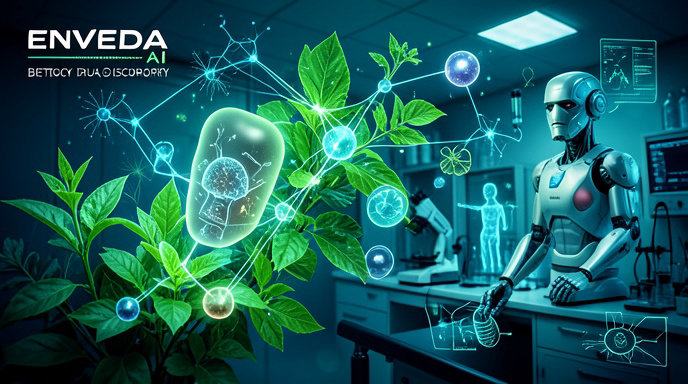
Enveda is trying to industrialize it. Its platform, which it calls PRISM, combines ultra-fast metabolomics, high-resolution mass spectrometry, and machine learning trained on one of the world's largest datasets of plant chemistry and human biology.
The process works like this: the company sources tens of thousands of medicinal plants with a history of human use, breaks them down into millions of individual chemical structures, and then uses AI to predict which molecules will hit disease-relevant targets, be orally bioavailable, and be safe enough for development.
Instead of isolating complex mixtures, Enveda synthesizes novel, optimized versions of the most promising natural scaffolds - creating patentable new chemical entities that retain nature's evolutionary advantages but meet modern pharma standards for potency, selectivity, and manufacturability.
The company says it has now characterized more than 10 million natural compounds and fractions, enabling it to move from plant sample to development candidate in months rather than years.
Lead Programs: Skin First, Then Weight Maintenance
While the platform can theoretically target almost any disease, Enveda is focusing its clinical dollars on two high-need, high-market areas: inflammatory skin disease and metabolic health.
In dermatology, Enveda is advancing a portfolio of oral small molecules for conditions like atopic dermatitis, vitiligo, and other inflammatory skin disorders. The lead candidates are designed to modulate novel inflammatory pathways first identified from plant compounds, offering a potential alternative to injectable biologics and JAK inhibitors with their associated safety concerns.
The company said the new funding will allow it to expand Phase 2 trials in atopic dermatitis and move additional skin assets into first-in-human studies in 2027.
Its second major focus is arguably even more timely: sustaining weight loss after GLP-1s.
With millions of patients now on Wegovy, Zepbound, and next-generation obesity drugs, physicians are confronting a new problem - rapid weight regain and muscle loss when patients stop injections. Enveda is developing an oral, nature-derived small molecule designed to preserve lean muscle, curb rebound hunger, and maintain metabolic benefits without the GI side effects, cost, and injections of GLP-1s.
The program, which is expected to enter the clinic in the next 12 months, positions Enveda against a crowded but lucrative field of post-GLP-1 maintenance therapies, including myostatin inhibitors, activin blockers, and oral peptides. Enveda argues a plant-inspired oral pill could be more scalable and accessible globally.
What the Funding Means Next
The $311 million gives Enveda multi-year runway at a critical inflection point: the transition from platform story to clinical-stage pharma company.
Top priorities for the capital include:
Expanded clinical trials across dermatology, with multiple Phase 2 readouts expected in 2027 and 2028. Advancement of its metabolic and inflammation pipeline toward IND filings. And continued scale-up of its AI + automation lab infrastructure to keep feeding new candidates into development.
The company also plans to grow its 300-plus person team, particularly in clinical development, regulatory, and AI research, and to invest in its commercial-scale supply chain for synthesizing complex natural scaffolds.
Longer term, the $2 billion valuation sets the stage for either a blockbuster IPO or major pharma partnerships. Enveda has already signaled interest in partnering on select non-core programs while retaining full rights to its lead skin and metabolic assets.
Why AI + Nature Is Having a Moment
Enveda's mega-round reflects a broader resurgence in both AI drug discovery and natural products.
After years of skepticism about AI biotechs with no clinical data, investors in 2026 are rewarding companies that can show AI-designed molecules actually working in humans. At the same time, Big Pharma is re-embracing natural chemical diversity as traditional synthetic libraries yield diminishing returns.
Plants, fungi, and marine organisms have spent 400 million years evolving molecules to interact precisely with biological proteins - a head start no generative chemistry model can fully replicate from scratch.
If Enveda can prove its AI can reliably translate that natural chemistry into safe, effective, oral drugs for skin disease and obesity maintenance, its $2 billion valuation may look cheap. The next two years of clinical readouts will tell.

Get All The Latest Updates Delivered Straight To Your Inbox For Free!