
Modal Motors Builds Rare-Earth-Free Motors to Cut China Out of EVs and Drones
TL;DR
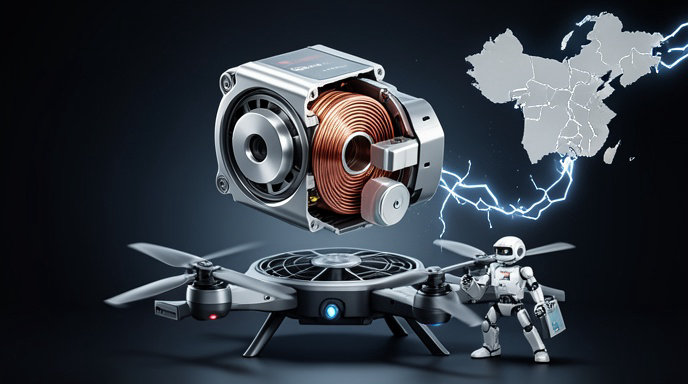
- Modal Motors is building small, lightweight electric motors that use zero rare-earth magnets, targeting drones, fans, robots, and other compact applications first.
- By replacing China-controlled neodymium and dysprosium with steel, copper, and software-optimized designs, the startup aims to slash costs and supply-chain risk.
- The approach could help reshore clean-tech manufacturing to the U.S., with pilot production and commercial partnerships scaling through 2026 and 2027.
The Magnet Problem No One Can Ignore
Every drone, EV, and robot that hums today likely depends on a handful of grams — or kilograms — of rare-earth magnets. Neodymium, praseodymium, and dysprosium make motors smaller, lighter, and more powerful than anything else on the market. They also come almost entirely from one place.
China refines roughly 90% of the world's rare-earth magnets and has repeatedly used export controls, licensing rules, and price swings as geopolitical leverage. For U.S. startups building drones, e-bikes, HVAC fans, and humanoid robots, that means volatile prices, months-long lead times, and a constant national-security headache.
Modal Motors, a young California-based startup, says there is a way out: just don't use them at all.
Meet Modal Motors
Modal Motors was founded to answer a deceptively simple question — what if you could get rare-earth-level performance without rare earths?
Instead of chasing giant EV traction motors dominated by Tesla, GM, and Chinese giants, Modal started small. Its first products are compact, high-speed motors in the sub-5kW class, the workhorses inside commercial drones, warehouse robots, cooling fans, power tools, and small appliances.
That focus is deliberate. Small motors are produced by the billions each year, they are highly sensitive to magnet cost, and they don't need the brute torque of a car motor — making them the perfect beachhead for a magnet-free architecture.
The company has kept a low profile while developing its platform, but in recent months it has begun showing production-intent prototypes to partners and investors as interest in non-Chinese supply chains has surged in Washington and Silicon Valley.
Inside the Tech: Software-Designed, Magnet-Free Power
Modal isn't betting on exotic new materials. Its motors ditch sintered neodymium magnets entirely, relying instead on abundant steel and copper paired with advanced electromagnetic design.
While the startup hasn't disclosed every detail of its IP, its approach builds on two big trends in motor innovation: synchronous reluctance and novel axial-flux topologies, supercharged by computational optimization.
In practice, that means:
- Modal uses AI-driven design tools to simulate thousands of rotor geometries in hours, squeezing more torque and efficiency out of simple materials.
- Precision manufacturing and tight air gaps make up for the raw magnetic strength lost by removing rare earths.
- Integrated power electronics and controls let the motor run faster and cooler, boosting power density to stay competitive with conventional brushless DC motors.
The result, according to the company, is a motor that is lighter than an equivalent induction motor, significantly cheaper than a rare-earth permanent magnet motor, and easier to recycle at end of life because there are no bonded magnets to extract.
For drones in particular, weight is everything. Modal claims its early drone drive units deliver comparable thrust-per-watt to premium magnet motors while shaving supply cost and eliminating exposure to dysprosium price spikes.
Why Drones, Fans, and Robots Come First
Modal is intentionally avoiding cars — for now.
Large EV motors require massive capital, automotive qualification cycles, and head-to-head competition with entrenched suppliers in China, Japan, and Europe. Small motors, by contrast, offer fast iteration and faster revenue.
Drones are the clearest test case. U.S. drone makers, pushed by Pentagon bans on Chinese components and new Buy American rules, are desperate for domestic propulsion systems that don't trace back to Chinese magnet refiners. A lightweight, ITAR-friendly, magnet-free motor is an easy sell.
Warehouse robots and humanoid developers face a similar math. A single mobile robot may use a dozen small motors for drive wheels, arms, and lifters. Multiply that by fleets of thousands, and rare-earth costs quickly dominate the bill of materials.
Even humble fans matter. HVAC, data-center cooling, and appliance fans run for thousands of hours a year. A 2-3% efficiency gain from a better magnet-free motor, built without volatile materials, translates into huge energy and cost savings at scale.
Cutting China Out of the Supply Chain
The geopolitical pitch may be even bigger than the engineering one.
A typical rare-earth magnet travels thousands of miles: mined in Inner Mongolia or Myanmar, refined in Jiangsu, magnetized in Zhejiang, then shipped to a motor factory in Vietnam or Mexico before finally reaching the U.S. Any disruption — export license delays, tariffs, or outright bans — ripples through the entire clean-tech stack.
Modal's supply chain looks radically shorter. Electrical steel and copper wire can be sourced in the U.S., and lamination stamping, winding, and final assembly can be done domestically or in allied countries. No refining in China, no magnet coating bottleneck, no traceability nightmare for defense customers.
That resonates in Washington, where the Department of Energy, Department of Defense, and new critical-minerals tax credits are pouring money into rare-earth-free drives, domestic motor manufacturing, and drone industrial base programs. Startups that can prove a China-free bill of materials are suddenly able to unlock grants, loans, and offtake agreements that were unthinkable three years ago.
Analysts say the timing is critical. Prices for neodymium spiked sharply in 2025 after Beijing tightened export licensing, forcing many Western motor buyers to rethink long-term contracts. Even if prices stabilize, few OEMs want to be caught exposed again.
Can It Scale and Compete on Price?
The big question for any magnet-free startup is always the same: can you match performance without raising cost elsewhere?
Modal argues yes — because magnets are the most expensive and volatile part of a small motor. By eliminating them, it trades a costly imported component for more clever engineering and automated manufacturing, both of which get cheaper with scale.
The company is pursuing a fab-light model, designing motors and control software in-house while partnering with U.S. contract manufacturers for laminations, windings, and assembly. That lets it scale from thousands to millions of units without building a gigafactory on day one.
Challenges remain. Reluctance-based designs can be noisier and harder to control than simple brushless motors, requiring sophisticated inverters. And incumbents like T-Motor, Maxon, and Nidec aren't standing still, with their own ferrite and reduced-rare-earth lines.
But Modal's bet is that customers will accept a small learning curve in exchange for price stability, domestic sourcing, and freedom from export-control risk.
What's Next for Domestic Clean-Tech Manufacturing
Modal Motors is still early, but its roadmap points to where the broader industry is headed.
Near-term, expect pilot shipments for commercial drones and robotics developers, followed by higher-volume fan and appliance motors where efficiency regulations are tightening. Longer-term, the same design stack could scale up to e-bikes, scooters, and eventually auxiliary EV motors — power steering pumps, cooling compressors, and actuators that collectively use tons of rare earths per million vehicles.
If the startup succeeds, it won't just be one more motor supplier. It will be proof that the U.S. can rebuild a foundational piece of the electrification supply chain — not by out-mining China, but by engineering around it entirely.
In a world racing to electrify everything from delivery drones to data centers, that kind of independence might be the most powerful spec of all.

Get All The Latest Updates Delivered Straight To Your Inbox For Free!